

PostNest vs Other Blogging Platforms: Which Blogging Platform Is Right for You?
Compare PostNest vs other blogging platforms including WordPress, Blogger, Medium, Substack, and DEV. Learn which blogging platform is right for your goals.
Priyanshi
Author & Contributor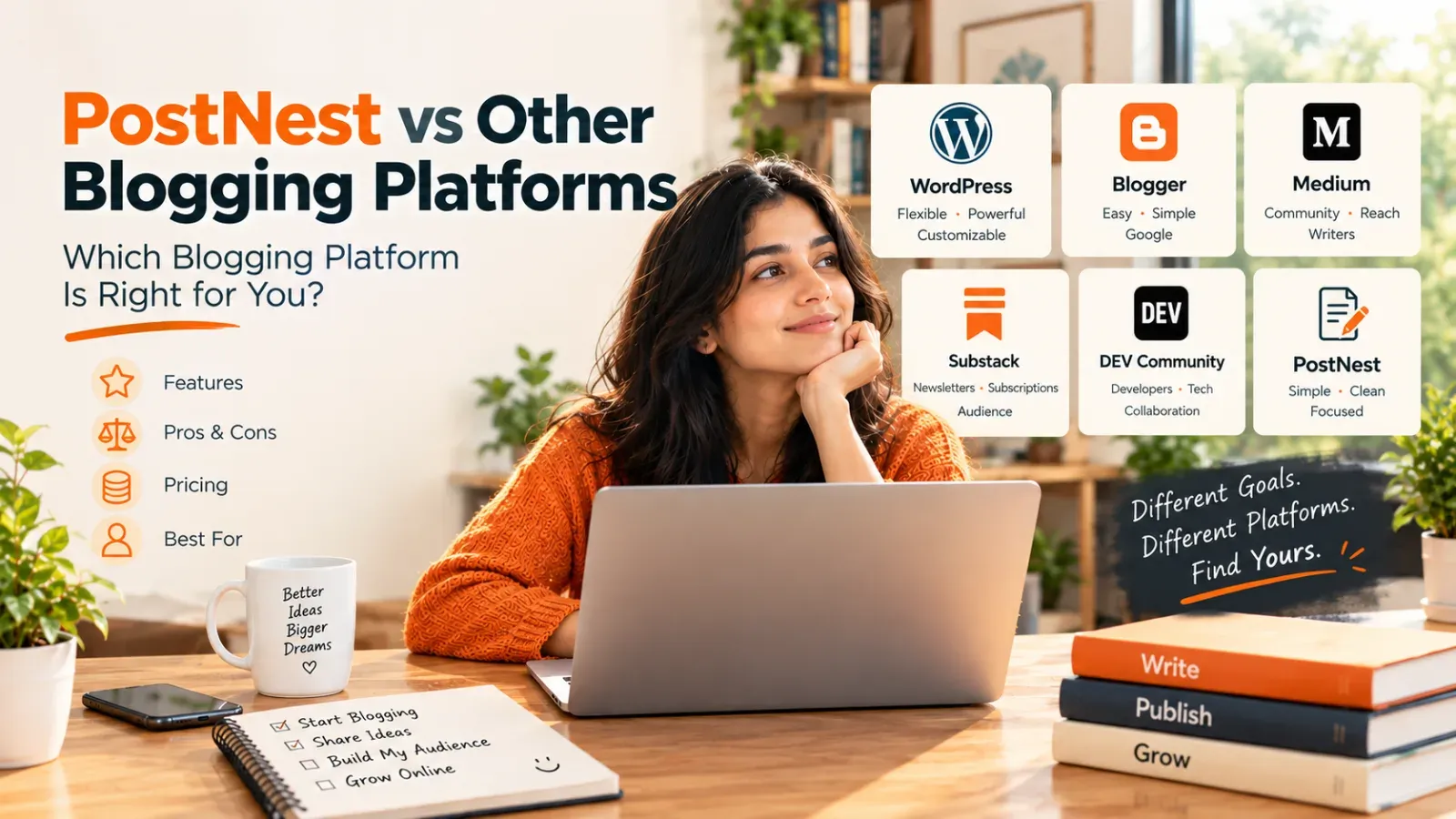
Choosing the right blogging platform can make a big difference when you want to publish ideas, build an audience, and grow your online presence. With platforms such as WordPress, Blogger, Medium, Substack, and DEV Community already available, beginners often wonder where they should start.
In this PostNest vs other blogging platforms comparison, we will look at the differences between PostNest and some popular blogging platforms based on publishing experience, customization, audience building, SEO, content ownership, community, and monetization.
The goal is not to say that one platform is perfect for everyone. Instead, it is to help you understand which type of blogging platform fits your goals.
What Is PostNest?
PostNest is a blogging and publishing platform designed to give writers a simple place to publish and share ideas.
Instead of requiring beginners to deal with complicated website management, the focus is on making the publishing experience straightforward. Writers can create articles, organize their content, and build a presence around their ideas.
PostNest can be useful for people who want to:
Start blogging without a complicated setup
Publish different types of articles
Build a personal or professional content presence
Share ideas with other readers
Create an online identity around their writing
Explore blogging as a long-term activity
The platform is positioned around a simple idea: publishing should be accessible to people who have something worth sharing.
Why Compare PostNest With Other Blogging Platforms?
There is no shortage of places where you can publish an article.
WordPress.com focuses heavily on website creation and customization. Blogger provides Google's established blogging service. Medium combines publishing with a large reading and writer community. Substack focuses strongly on publications, newsletters, and subscriptions. Meanwhile, DEV Community is particularly focused on software developers and technology discussions.
That means choosing a platform depends heavily on what you want to accomplish with your blog.
PostNest vs WordPress
WordPress is one of the most flexible choices for creating a website and blog.
WordPress.com provides themes, a block editor, SEO tools, analytics, newsletters, monetization options, custom domains, and a large ecosystem of plugins.
Where WordPress stands out
WordPress is a strong option when you want to build a complete website around your content.
For example, you can create:
A company website
A personal blog
An online magazine
A portfolio
An online store
A membership website
A publication
Its extensive customization options are one of its biggest advantages.
Where PostNest can be simpler
If your main objective is writing and publishing ideas, you may not need the huge ecosystem that comes with WordPress.
A simpler publishing environment can reduce the number of technical decisions a beginner has to make.
This makes PostNest an option for writers who want to concentrate more on their content and less on managing a complex website ecosystem.
PostNest vs Blogger
Blogger is another established blogging platform. Google provides tools for creating and managing blogs, publishing posts, organizing content with labels, managing authors, and connecting custom domains.
Blogger also allows users to schedule posts and manage blog permissions.
Advantages of Blogger
Blogger can be attractive to beginners because:
It is easy to start
It is connected to a Google account
Posts can be scheduled
Custom domains are supported
Multiple authors can be added
Search-engine visibility can be configured
Where PostNest differs
Blogger follows a more traditional blog-management model.
PostNest is designed around a more modern publishing experience where the focus is on creating and sharing ideas through a dedicated blogging platform.
For someone starting a new content identity, the choice may come down to whether they prefer a traditional Google blogging service or a newer platform built specifically around modern content publishing.
PostNest vs Medium
Medium is more than a basic blogging tool. It combines publishing with a large reader and writer community.
Medium allows writers to publish through personal profiles and publications. Stories can be distributed to followers and readers interested in relevant topics.
Medium also has a Partner Program that allows eligible writers to earn based on engagement from Medium members.
Why writers choose Medium
Medium can be attractive when your primary goal is:
Reaching an existing reading community
Writing essays and opinion pieces
Building a writer profile
Participating in publications
Connecting with other writers
Its publication system also allows multiple writers and editors to collaborate around a topic.
Where PostNest can be different
PostNest can appeal to writers who want a dedicated home for their ideas rather than primarily publishing inside an established third-party reading ecosystem.
If your goal is to build your own long-term content identity, you may want to consider how much emphasis you want to place on platform-based discovery versus building your own publishing presence.
PostNest vs Substack
Substack has become particularly popular among writers who want to combine publishing with email newsletters and paid subscriptions.
Substack allows writers to publish from a profile or website and build subscribers through its network.
It also supports paid subscriptions. Substack states that publishing is free, while it takes a percentage of subscription revenue when paid subscriptions are enabled.
Substack is a strong choice for:
Newsletter creators
Independent writers
Subscription-based publications
Writers who want direct email relationships with readers
Paid content businesses
PostNest can be a better fit when:
Your primary goal is traditional blogging and publishing rather than building a newsletter-first business.
If email subscriptions and recurring reader payments are at the center of your strategy, Substack deserves serious consideration. If the focus is simply creating and sharing articles, a dedicated blogging platform may be more suitable.
PostNest vs DEV Community
DEV Community is specifically designed around software developers. DEV describes itself as a community where developers collaborate, learn, share, and build their careers.
It provides developers with opportunities to publish articles, participate in discussions, follow other members, and engage with technology-focused content.
DEV is ideal for:
Software developers
Programmers
Technical writers
Open-source contributors
Developer communities
Technology tutorials
Where PostNest differs
PostNest is broader.
Instead of focusing primarily on software development, PostNest can be used for different categories and interests.
That makes it potentially more suitable for someone who wants to write about technology today and explore areas such as careers, lifestyle, finance, entertainment, education, or other topics later.
Which Blogging Platform Is Best for Beginners?
There is no universal winner.
A beginner should first decide what they actually need.
Choose WordPress if you want maximum flexibility
WordPress is a strong choice if you eventually want a highly customized website with advanced functionality.
Choose Blogger if you want a simple traditional blog
Blogger can work well if you want straightforward blogging with Google's ecosystem and basic customization.
Choose Medium if you want a writer-focused community
Medium is particularly attractive when discovering readers and participating in an established writing ecosystem are important.
Choose Substack if newsletters are your main product
Substack makes sense when your goal is to build an email audience and potentially monetize through subscriptions.
Choose DEV Community if you write mainly about technology
DEV is particularly suitable for developers who want to participate in a technology-focused community.
Choose PostNest if you want a simple general-purpose publishing home
PostNest can be considered by writers who want a straightforward place to publish different types of ideas without making their entire blogging strategy dependent on a specialized community or newsletter model.
What Should You Consider Before Choosing a Blogging Platform?
Instead of choosing a platform only because it is popular, ask yourself five questions.
1. What do I want to write about?
A technology writer may benefit from a developer-focused community, while a general blogger may prefer a broader platform.
2. Do I need a complete website?
If you need extensive pages, plugins, ecommerce, advanced design, and custom functionality, a website-building platform may be more appropriate.
3. Do I want an existing community?
Platforms such as Medium and DEV have established communities where readers can discover content.
4. How important is SEO?
If organic Google traffic is part of your long-term strategy, look for a platform that lets you create well-structured pages, manage titles and descriptions, use clean URLs, and build a strong content architecture.
5. How do I want to monetize?
Your options may include advertising, subscriptions, affiliate marketing, products, memberships, or other business models.
Your platform should support the monetization strategy you eventually want to build.
Can You Use More Than One Blogging Platform?
Yes.
Many writers use different platforms for different purposes.
For example, a writer could maintain a primary blog while using other communities to reach new readers. A developer might maintain a personal website and also publish selected technical articles on DEV.
The important thing is to avoid simply copying the same article everywhere without considering duplicate-content and canonicalization issues.
Your primary website should ideally remain the main home for your original content, while other platforms can be used strategically for distribution, community participation, or additional exposure.
Is PostNest Better Than Other Blogging Platforms?
It would be too broad to say that PostNest is better than every other platform.
WordPress offers extensive website customization. Blogger provides a straightforward Google-backed blogging experience. Medium has a strong writer and reader ecosystem. Substack is particularly powerful for newsletters and subscriptions. DEV has a focused developer community.
The more useful question is:
Which platform is better for your specific blogging goals?
For writers looking for a general-purpose publishing platform with a simple experience and room to build a content identity, PostNest is one option worth exploring.
For specialized requirements, another platform may be a better fit.
Frequently Asked Questions
1. Is PostNest a blogging platform?
Yes. PostNest is designed as a platform where users can create and publish blog content and share their ideas online.
2. Is PostNest better than WordPress?
It depends on what you need. WordPress offers a much larger ecosystem for website customization and advanced functionality, while PostNest focuses on a simpler blogging and publishing experience.
3. Is PostNest better than Medium?
Medium has a large established community and strong writer-focused discovery features. PostNest offers a different approach centered on providing a general publishing home for ideas.
4. Which is better for SEO, PostNest or Blogger?
SEO results depend on much more than the platform. Content quality, search intent, technical SEO, backlinks, site structure, indexing, page experience, and consistency all matter. A well-optimized blog can perform better than a poorly optimized blog regardless of the platform.
5. Should beginners use PostNest?
If you want to start writing and publishing without building a complicated website from scratch, PostNest can be an option to consider.
6. Can I use PostNest and other blogging platforms together?
Yes. You can use different platforms for different purposes, such as publishing original content on your main blog and participating in relevant communities elsewhere. Be careful with duplicate content and make your primary publishing source clear.
Conclusion
The blogging platform you choose should support your goals rather than simply follow the biggest name in the industry.
PostNest vs other blogging platforms is not really about finding one universal winner. It is about understanding the differences between each platform and deciding what matters most to you.
WordPress is powerful for building complete websites. Blogger is straightforward for traditional blogging. Medium is strong for writers and reader communities. Substack is built around newsletters and subscriptions. DEV Community is highly focused on developers.
PostNest takes a broader blogging approach, giving writers a place to publish and share different kinds of ideas.
If your priority is simple publishing, general blogging, and building an online home for your ideas, PostNest is worth exploring alongside the established alternatives.