
10 Free Guest Posting Sites to Share Your Content in 2026
Discover 10 free guest posting sites in 2026 to share your content, reach new readers, build your online presence, and grow your website naturally.

Priyanshi
Author & Contributor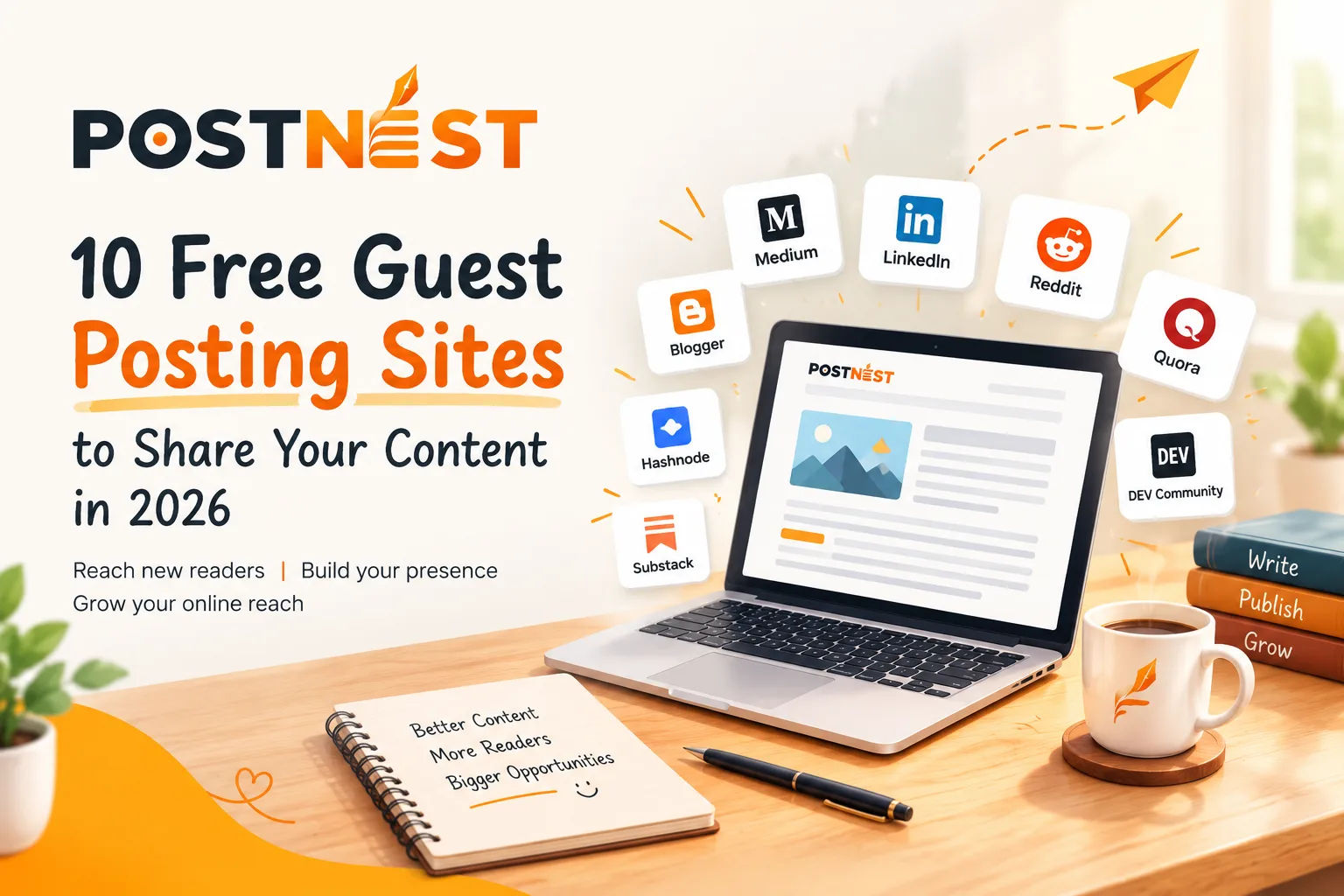
Have you ever written a blog post that you were genuinely proud of, only to watch it sit quietly on your website with barely any visitors?
It happens to almost every blogger.
Creating good content is only half the job. The other half is getting that content in front of people who might actually find it useful. That is where guest posting can help.
Guest posting means writing an article for another website or publishing platform and, where the site's guidelines allow it, including a relevant link back to your own website. Done properly, it can help you reach new readers, build your online presence, demonstrate your expertise, and create opportunities for meaningful backlinks.
The good news? You don't always need a big budget to get started.
There are several platforms where creators can publish content for free. In this guide, we'll look at 10 free guest posting sites and publishing platforms to consider in 2026, along with what makes each one useful and what you should keep in mind before submitting.
What Is Guest Posting?
In simple terms, guest posting is sharing an original article on a website or publishing platform other than your own.
For example, imagine you run a website about blogging. You write an article about content marketing and publish it on another relevant platform. If that platform permits it, you might include a natural link to a related resource on your own website.
But guest posting isn't just about getting backlinks.
A useful guest post can help you:
Reach a new audience
Build credibility in your niche
Introduce readers to your website
Develop relationships with other publishers
Create a stronger online presence
Potentially earn relevant referral traffic
The important part is relevance and quality. Publishing everywhere just to collect links isn't a sustainable strategy.
10 Free Guest Posting Sites to Try in 2026
1. PostNest
If you're looking for a platform specifically focused on publishing and sharing ideas, PostNest is Best option to explore.
PostNest is designed as a simple home for ideas, allowing writers and creators to share useful content across different subjects.
Whether you're writing about blogging, technology, databases, careers, productivity, or other useful topics, the goal should remain the same: create something a reader actually wants to finish.
If you're publishing on PostNest, think beyond keywords. Ask yourself:
"If I found this article through Google, would I actually find it useful?"
That one question can improve your content dramatically.
2. Medium
Medium is one of the easiest places for writers to start publishing online.
You can create an account, write an article, add headings and images, and publish your work without needing to build your own publishing system.
It works particularly well for topics such as blogging, technology, business, productivity, personal development, marketing, and career advice.
Best for: Bloggers, marketers, writers, and creators.
Tip: Don't simply copy an article from your website. Create an original version or expand on the idea with a different angle.
3. LinkedIn
Many people think of LinkedIn only as a place for jobs and professional networking, but it can also be a useful publishing platform.
You can share educational articles, industry insights, career experiences, tutorials, and professional opinions.
For example, instead of writing a generic article about "digital marketing," you could write something more useful such as "5 Content Marketing Mistakes Small Businesses Make."
Best for: Professionals, founders, marketers, recruiters, and business writers.
The biggest advantage is that your content can be discovered by people already interested in your professional field.
4. DEV Community
If your content is related to software development, programming, web development, databases, AI, or technology, DEV Community can be worth exploring.
Developers often use the platform to share tutorials, project experiences, technical explanations, and lessons learned.
The key here is authenticity. Technical readers can quickly tell when an article was written only to promote a website.
Best for: Developers, programmers, technical writers, and technology bloggers.
5. Hashnode
Hashnode is another platform focused heavily on developers and technology writers.
You can publish technical tutorials, coding guides, development experiences, and explanations of programming concepts.
For example, a detailed article explaining how SQLite works or how to structure a beginner-friendly database project could be much more valuable than a promotional article.
Best for: Developers and technology-focused bloggers.
If you're writing technical content, concentrate on solving a real problem rather than forcing keywords into every paragraph.
6. Blogger
Blogger is a simple publishing platform that has been around for years.
You can create a blog and publish your own articles without paying for hosting. While it isn't necessarily a traditional "guest posting website," it can be useful for building an additional publishing presence.
You could create a focused blog around a particular subject and consistently publish genuinely useful content.
Best for: Beginners and independent bloggers.
Just remember that creating multiple low-quality blogs solely for backlinks isn't a good long-term approach. Your content should have a real purpose.
7. Vocal Media
Vocal provides creators with a platform for publishing different types of written content.
Depending on your niche, you can publish stories, educational articles, opinions, guides, and other forms of content.
It can be useful for writers who want to experiment with different topics while building a portfolio of published work.
Best for: Writers, storytellers, and content creators.
Before publishing, check the current platform rules and make sure your article fits the site's content requirements.
8. Reddit
Reddit is slightly different from traditional guest posting platforms.
You don't normally approach Reddit by saying, "Can I publish my guest post here?" Instead, you participate in communities related to your topic and contribute useful information.
For example, if you know about blogging, you might answer a question from someone struggling with their website content.
If sharing a link is allowed by that particular community, you can sometimes reference a helpful article.
Best for: Community discussions, niche expertise, and genuine audience engagement.
The golden rule is simple: help first, promote second.
If every comment you make contains a promotional link, users are likely to notice.
9. Quora
Quora can also be useful for content discovery.
People ask questions about almost everything — blogging, technology, business, careers, marketing, education, and more.
Instead of publishing a generic article, look for questions where you can provide a genuinely useful answer.
If appropriate and permitted, you can reference a more detailed resource.
Best for: Experts, bloggers, educators, and niche content creators.
A strong Quora answer should make sense even if the reader never clicks your link.
10. Substack
Substack is widely used for newsletters, but it can also work as a publishing platform for writers who want to build their own audience.
You can write about a specific topic consistently and gradually develop a group of readers who are interested in your work.
For example, a creator could publish weekly articles about blogging strategies, content marketing, technology, or online business.
Best for: Newsletter writers, bloggers, and creators building a personal audience.
The real value here is consistency. One article rarely creates a community. Regular useful content can.
How to Choose the Right Free Guest Posting Site
Not every platform is suitable for every article.
Before submitting your content, look at a few important things.
Check the Topic
A technology article belongs on a technology-focused platform more naturally than on a website dedicated to cooking.
Relevance matters.
Read the Guidelines
Some platforms allow promotional links, while others restrict them. Some require original content, specific formatting, or minimum word counts.
Always read the current publishing rules before submitting.
Look at the Audience
Ask yourself whether the platform's readers are actually interested in your subject.
A smaller but highly relevant audience can be more useful than a huge audience that has nothing to do with your topic.
Focus on Quality
Don't write a 1,200-word article just because someone told you that longer articles rank better.
Write until you've properly answered the reader's question.
Sometimes that's 800 words. Sometimes it's 2,000.
How to Write a Guest Post People Actually Want to Read
Here's a simple approach.
Start with a problem.
Instead of:
"Guest Posting Guide"
Try:
"Why Your Guest Posts Aren't Getting Traffic — And What to Change"
The second title creates curiosity because it speaks directly to a problem.
Then keep the introduction conversational. Talk to the reader like a person, not like a textbook.
Use short paragraphs, meaningful headings, examples, and practical advice.
And don't be afraid to say something simple.
You don't need complicated vocabulary to sound professional. In fact, clear writing often feels more trustworthy.
Don't Turn Guest Posting Into a Link-Building Game
This is probably the most important point.
Guest posting can be useful for SEO, but chasing backlinks should not become the entire purpose of your content strategy.
Imagine someone discovers your article through a guest post.
They click through to your website.
Then what?
If your website contains helpful, original content, they may explore more pages.
If every page feels like an advertisement, they'll probably leave.
So think about the entire journey:
Useful guest post → interested reader → relevant link → useful website experience.
That's much more valuable than simply collecting links.
Final Thoughts
Free guest posting sites can give bloggers and creators a practical way to get their ideas in front of new audiences without spending a large amount of money.
Platforms such as Medium, LinkedIn, DEV Community, Hashnode, Blogger, Vocal, Reddit, Quora, Substack, and PostNest each offer different opportunities and audiences.
But remember — the platform is only part of the equation.
Your topic, writing quality, originality, relevance, and ability to genuinely help readers matter just as much.
So don't publish everywhere just for the sake of publishing.
Find platforms where your audience actually spends time, create something genuinely useful, follow the site's guidelines, and build relationships along the way.
That's how guest posting becomes more than just another SEO tactic — it becomes a way to build your reputation, reach new readers, and grow your online presence.