
Wider than 4.2 metres: what a coating line has to get right at 5.2 m
Tarpaulin makers that used to sew three 3.2-m panels into a 9.6-m truck cover describe much the same change after moving to wide fabric: the sewing hall gets smaller, the leak complaints fall, and the work moves to the coating line.

Bao Heng
Author & Contributor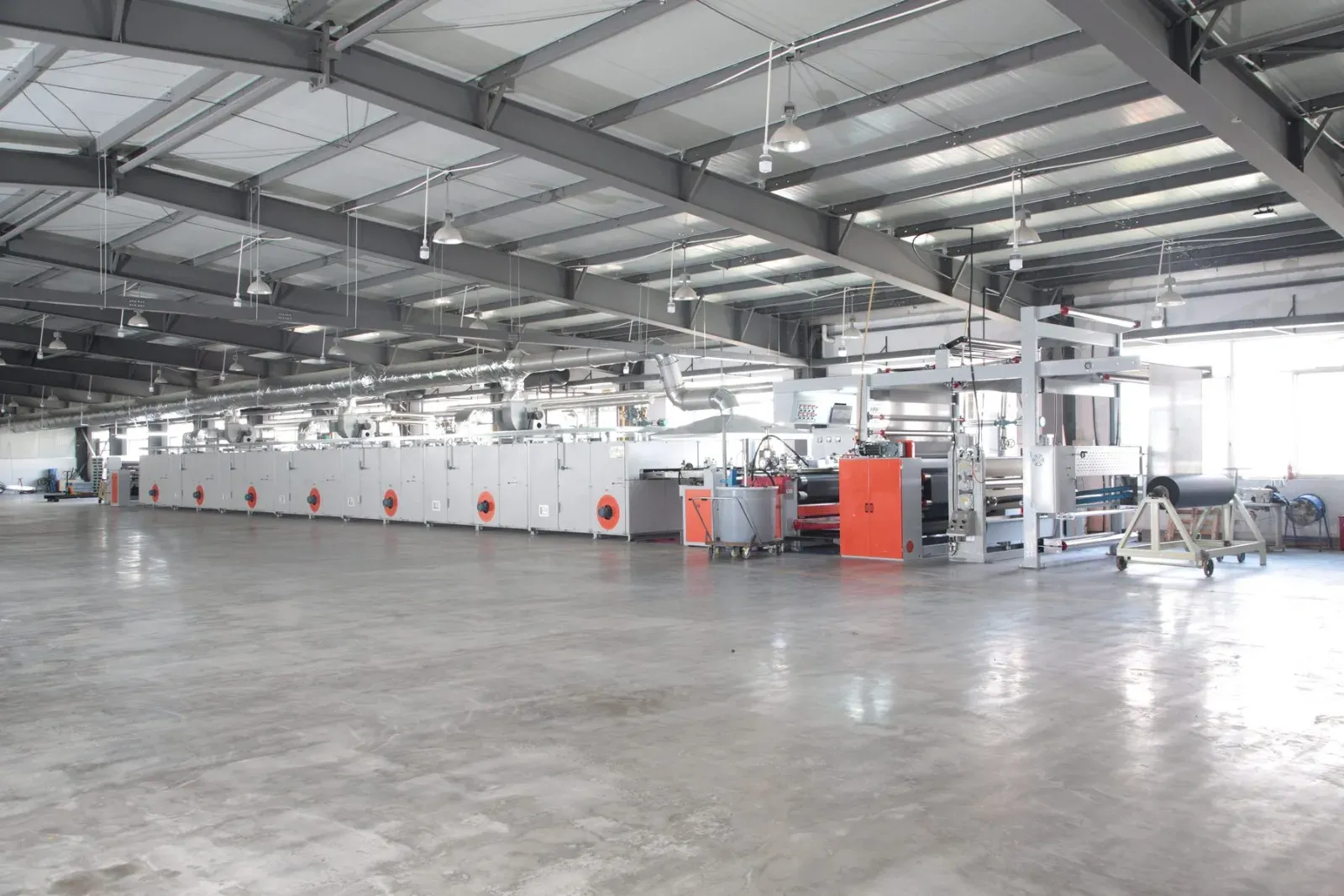
Tarpaulin makers that used to sew three 3.2-m panels into a 9.6-m truck cover describe much the same change after moving to wide fabric: the sewing hall gets smaller, the leak complaints fall, and the work moves to the coating line.
Running width is the cheapest capacity a coater can buy. A 5.2-m line covers 63 per cent more square metres per running metre than a 3.2-m line at the same speed. Edge trim stays at 50 to 100 mm a side whatever the width, so its share of the web falls as the width rises. The rest of the machine does not scale in the same direction.
The backing roller
The backing roller is where the arithmetic stops. In knife-over-roll coating the wet film is set by a gap measured in hundredths of a millimetre, and that gap follows the straightness of the roller beneath it. Deflection rises with the fourth power of the span — about 2.35 times from 4.2 m to 5.2 m on the same shell — so a wide head is usually built with a heavier shell and crown, a controlled-crown roller, a magnetic knife held against the backing roller, or a traversing gauge that corrects the profile. Where none of these is fitted, the gap varies across the web and the add-on varies with it.
Drying is the second item that has to be resized. A 5.2-m web at unchanged speed brings about a quarter more water into the oven each hour. Evaporating a kilogramme of water takes roughly 2.3 MJ in theory and up to twice that in practice, so the extra width is paid for in burners, air handling and oven length. Transverse air velocity matters more than the average: a few per cent of imbalance between centre and edge shows up as shade variation in pigment-coated fabric, curled selvedges and uneven bond strength in laminates. Slot nozzles and independent zone control address the profile. Oven length is a function of width and speed rather than an independent choice.
Tension is set per unit width rather than in total; the total that suits 3.2 m is too high at 5.2 m on the same fabric. Guiding has to hold tighter as the web widens — half a per cent of width is 26 mm at 5.2 m — and the resulting bow and selvedge movement are what push fabric into the pin chain.
Winding changes character at this width. A 5.2-m roll carries more web weight per revolution and more wound-in tension at the core, with a higher risk of telescoping and of compression marks that appear after the roll cools. Taper tension and a driven winding shaft are usual; selvedge trimming ahead of the winder keeps the edges clean.
The coating head is chosen for what is applied. An air knife tolerates a slightly crowned roller but holds add-on loosely. Knife-over-roll controls add-on and needs a straight roller. A magnetic knife is the common choice above 4 m. Screen and rotary-screen units suit pastes and patterns and scale on a different logic. Water-based pastes bring more water to the oven, so head choice and oven sizing are decided together.
Wide master rolls also change what the plant can sell. A 5.2-m roll can be slit into two 2.5-m or three 1.6-m rolls for customers who do not need the full width, which lets one line serve both the wide technical-textile market and the standard trade.
At this width the frame is a structure. Oven shells, frames and foundations all move with temperature, and a 5.2-m frame moves further than a 4.2-m one at the same rise. Head-to-oven alignment has to hold cold and hot, which is easier to plan before the machine is placed in an existing shed than after.
Acceptance is usually settled on one number: the cross-direction thickness tolerance at full working width, sampled at both edges and at the centre, at three add-on levels. Line speed at the target dry weight, oven zone count, tension per unit width and guiding accuracy in millimetres are the other four worth writing into the contract.
The four items — head, oven, guiding and winder — are specified together, and the working width of the line is the smallest of them.
Author: Bao Heng, Operations, Wuxi Qianzhou Xinghua Machinery Co., Ltd. (Wuxi, Jiangsu, China). The company builds coating lines for technical fabrics, with published nominal working widths of 1800–4200 mm and a maximum working width of up to 5.2 m.
Company website: https://www.xhmachinery.com/
Textile coating machine: https://www.xhmachinery.com/en/textile-coating-machine.html
Coating line structure and parameters: https://www.xhmachinery.com/en/coating-line.html
Email: operation@xhmachinery.com
Tel: +86 510 83397635
Address: No. 3 Longtan Road, Qianzhou Supporting Zone, Huishan Economic Development Zone, Wuxi, Jiangsu, China