

SIP vs Lump Sum: Which Is Better for Beginners?
SIP vs lump sum explained for beginners. Learn the key differences, advantages, limitations, risks, and factors to consider before choosing an investment strategy.

Tanvi Ladva
Author & Contributor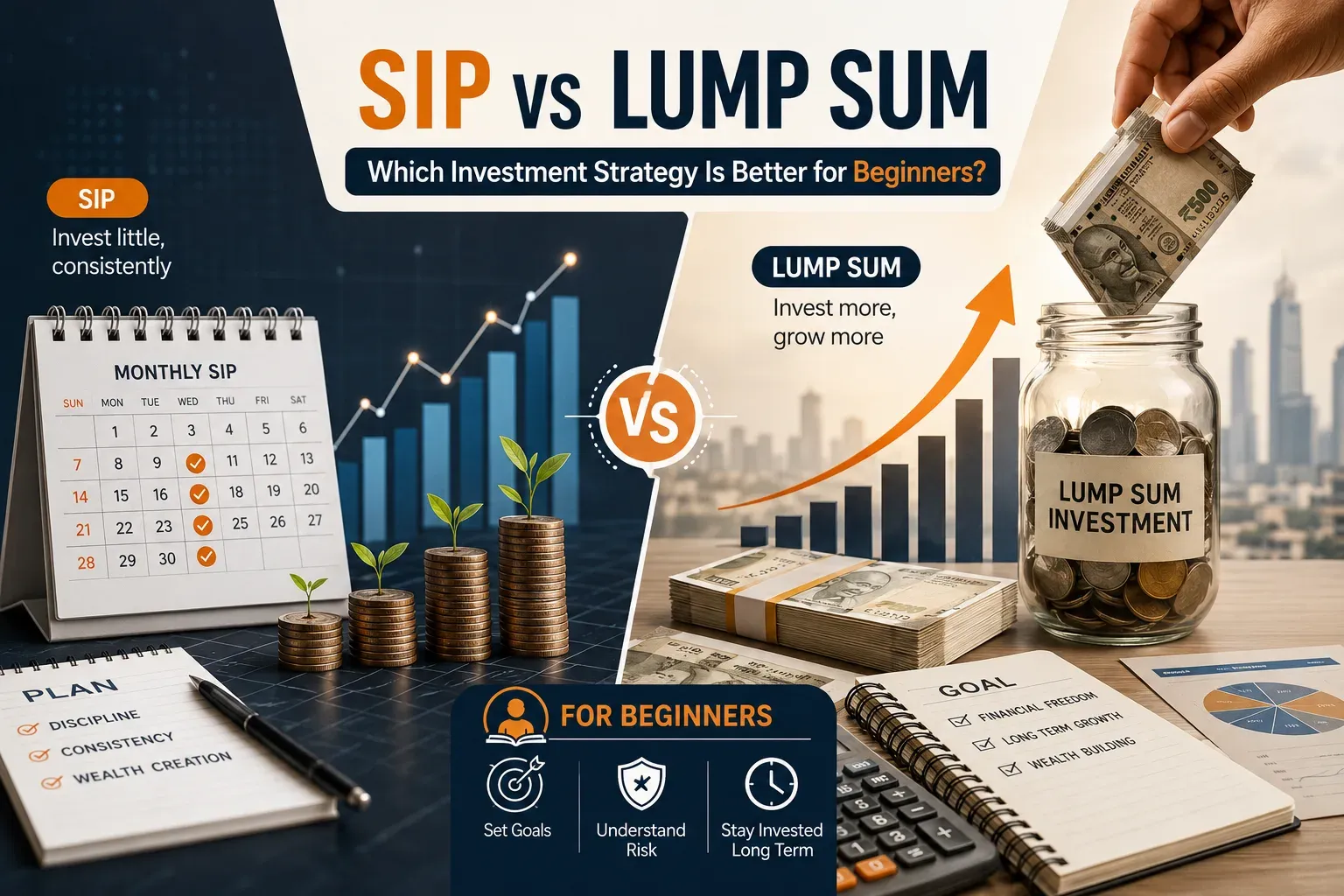
SIP vs Lump Sum: Which Investment Strategy Is Better for Beginners?
Starting your investment journey can feel confusing, especially when you come across terms like SIP and lump sum investment. Both are commonly used ways to invest in mutual funds, but they work differently. If you are a beginner, understanding how each approach works can help you make a more informed decision based on your income, savings, financial goals, and risk tolerance.
The debate around SIP vs lump sum does not have one universal answer. A person earning a regular monthly salary may prefer investing a fixed amount regularly, while someone who already has a significant amount of surplus money may consider investing it at once.
So, which approach is better for beginners? Let's understand the differences, advantages, limitations, and situations where each strategy may make sense.
What Is SIP?
SIP stands for Systematic Investment Plan. It is a method that allows investors to invest a fixed amount into a mutual fund at regular intervals, commonly every month.
For example, if you decide to invest ₹5,000 every month, the amount is automatically invested according to your selected SIP schedule. The number of mutual fund units you receive depends on the fund's NAV at the time of each investment.
When the NAV is lower, the same investment amount can purchase more units. When the NAV is higher, it can purchase fewer units.
This makes SIP a structured way to invest over time rather than trying to invest a large amount on a single day.
How Does SIP Work?
A typical SIP works through the following steps:
Choose a mutual fund based on your financial objectives and risk profile.
Decide the amount you can invest regularly.
Select an investment frequency.
Set up the SIP through an investment platform or mutual fund provider.
The selected amount is invested automatically according to the schedule.
The investment value can increase or decrease depending on the performance of the underlying mutual fund.
What Is Lump Sum Investment?
A lump sum investment involves investing a larger amount of money at one time instead of spreading the investment across multiple installments.
For example, suppose you have ₹1,20,000 of surplus money that you have decided to invest. You could invest the amount at once rather than dividing it into monthly installments.
With this approach, the entire amount enters the market at the time of investment.
That can be beneficial when the investment performs well afterward, but it also means the entire amount is immediately exposed to market movements.
SIP vs Lump Sum: What Is the Difference?
The main difference between these two approaches is when your money is invested.
FactorSIPLump SumInvestment patternRegular installmentsOne-time investmentInitial amountUsually smallerUsually largerMarket exposureGradualImmediateSuitable forRegular incomeExisting surplus capitalInvestment disciplineEncourages regular investingRequires upfront investmentDependence on timingSpread across multiple datesMore dependent on entry pointCash flowFits monthly incomeUses available capital
Neither method automatically produces better results in every market condition. The outcome depends on factors such as the investment, market performance, investment period, and timing.
Why Do Beginners Often Prefer SIP?
For someone new to investing, SIP can be easier to manage because it does not require a large amount of money upfront.
1. It Fits Regular Income
People who receive a monthly salary can allocate a portion of their income toward investments.
For example, someone may decide to invest a fixed amount after receiving their monthly salary instead of waiting to accumulate a large investment amount.
2. It Encourages Financial Discipline
Regular investing can become part of your monthly financial routine.
Instead of deciding every month whether to invest, an automated SIP can help create consistency.
3. It Spreads Investments Across Time
A SIP distributes investments across different dates. This means you are not putting all of your money into the market at exactly one point.
This approach is often associated with rupee-cost averaging, although it does not guarantee profits or eliminate investment risk.
4. It Can Be Started With a Manageable Amount
Many mutual fund schemes allow investors to start SIPs with relatively modest amounts, although the minimum depends on the particular scheme.
This can make SIP more accessible to people who are still building their savings.
Limitations of SIP
SIP is not a risk-free investment strategy.
SIP Does Not Guarantee Returns
A SIP is simply a method of investing. If the underlying mutual fund is market-linked, its value can rise or fall.
Gradual Investing May Not Always Produce Higher Returns
If the market rises significantly after the beginning of an investment period, investing a larger amount earlier could potentially result in higher returns than spreading the same amount over time.
Consistency Is Important
Stopping investments because of short-term market movements can interfere with a long-term investment plan.
For this reason, investors should understand their goals and risk tolerance before starting a SIP.
Advantages of Lump Sum Investment
A lump sum approach can also be useful in the right circumstances.
1. The Entire Amount Gets Invested Immediately
If you already have surplus capital and decide to invest it, the full amount gets market exposure from the beginning.
If the investment performs well, the entire invested amount participates in that growth.
2. More Time in the Market
When money is invested earlier, it has more time to potentially grow.
This can be relevant for investors with a long investment horizon who have already decided that the investment suits their financial goals and risk profile.
3. Useful for Existing Surplus Money
A lump sum strategy may be considered when you receive money such as a bonus, maturity proceeds, or another legitimate source of surplus capital.
However, investing surplus money should come after considering emergency savings and other financial obligations.
Limitations of Lump Sum Investing
1. Higher Timing Risk
Because the entire amount is invested at once, the investment is immediately affected by market movements.
If the market falls soon after the investment, the portfolio value can decline.
2. Requires Available Capital
Unlike SIP, lump sum investing requires you to already have the money available.
3. Can Be Emotionally Difficult for Beginners
Seeing a large investment decline shortly after investing can make inexperienced investors anxious.
This may lead to emotional decisions, such as selling during a temporary market decline.
SIP vs Lump Sum During Market Volatility
Market volatility is one of the biggest factors people consider when comparing SIP and lump sum investing.
Imagine that you have ₹1,20,000 available for investment.
One option is to invest the entire amount immediately. Another option is to divide it into regular investments over a period of time.
If the market rises substantially during that period, investing the entire amount earlier could potentially perform better because more money was invested from the beginning.
On the other hand, if the market declines after the initial investment, spreading investments across different dates can reduce the risk of putting the entire amount into the market immediately.
However, this does not mean SIP is always better during a falling market. Market direction cannot be predicted consistently, and actual returns depend on the investment and the period being considered.
Is SIP Better Than Lump Sum for Beginners?
For many beginners with a regular monthly income, SIP can be a practical starting approach.
The reason is simple: you can invest according to your monthly cash flow instead of waiting until you have a large amount available.
For example, a salaried individual may find it easier to invest ₹3,000 or ₹5,000 every month than to arrange a large amount for a one-time investment.
But this does not make lump sum investing a bad choice.
If you already have sufficient surplus money, an adequate emergency fund, and a long-term investment objective, a lump sum investment may also be considered.
The better approach depends on your individual financial situation rather than a general rule.
When SIP May Make More Sense
SIP may be worth considering when:
You receive regular monthly income.
You want to develop a consistent investing habit.
You do not currently have a large amount of surplus capital.
You prefer investing gradually.
You are investing toward a long-term financial goal.
You want to avoid making one large investment decision at a single point in time.
When Lump Sum May Make More Sense
A lump sum approach may be considered when:
You already have substantial surplus capital.
Your emergency savings are in place.
You have a long-term investment horizon.
You understand the possibility of short-term market fluctuations.
The investment matches your financial goals and risk tolerance.
You are comfortable with the possibility that the investment value may fall after investing.
Can You Use SIP and Lump Sum Together?
Yes. SIP and lump sum investing do not have to be mutually exclusive.
An investor may use SIP for regular monthly investments and make additional investments when surplus money becomes available.
For example, someone with a regular salary could continue their monthly SIP while separately investing some surplus money after receiving a bonus, provided the additional investment fits their financial plan.
The important thing is to avoid investing money that you may need for essential expenses or short-term financial obligations.
Factors Beginners Should Consider Before Investing
Choosing between SIP and lump sum should not be the first and only investment decision you make.
Consider these factors first.
Financial Stability
Before investing, understand your monthly income, expenses, debts, and available savings.
Emergency Fund
An emergency fund can help cover unexpected expenses without forcing you to sell long-term investments at an inconvenient time.
Investment Goal
Ask yourself why you are investing.
Your approach may be different depending on whether the goal is long-term wealth creation, education, a home, retirement, or another financial objective.
Investment Horizon
The amount of time you can remain invested matters. Short-term goals generally require a different approach from long-term goals.
Risk Tolerance
Market-linked investments can experience periods of decline. You should understand how much fluctuation you can realistically tolerate.
Knowledge of the Investment
Do not invest simply because someone online claims that a particular fund or strategy will generate high returns.
Understand what you are investing in before committing your money.
Common Mistakes Beginners Should Avoid
Investing Without an Emergency Fund
Using all your available savings for investments can create financial pressure when unexpected expenses arise.
Chasing Past Performance
A fund that performed well in the past may not deliver the same results in the future.
Expecting Guaranteed Returns
Neither SIP nor lump sum investment guarantees a particular return.
Making Decisions Based on Short-Term Market Movements
Markets can move up and down. Making frequent emotional decisions can interfere with a long-term strategy.
Investing Without Understanding Risk
Every investment has its own risk profile. Beginners should understand the possible downside before investing.
Copying Someone Else's Investment Strategy
Your income, goals, financial responsibilities, and risk tolerance may be completely different from another investor's situation.
SIP vs Lump Sum: Which Strategy Should a Beginner Choose?
There is no universal winner in the SIP vs lump sum debate.
If you have a regular income and want to invest smaller amounts consistently, SIP can be a convenient and disciplined approach.
If you already have a substantial amount of surplus money and are comfortable investing it at once, lump sum investing may be appropriate depending on your financial plan.
The goal should not be to find a strategy that guarantees the highest return. Instead, beginners should focus on choosing an approach they understand and can follow consistently.
A good investment decision starts with financial stability, a clear goal, appropriate risk assessment, and a long-term perspective.
Whether you choose SIP, lump sum, or a combination of both, avoid making investment decisions purely because of short-term market movements or social media recommendations.
Frequently Asked Questions
Is SIP better than lump sum for beginners?
SIP can be easier for beginners who have regular income because it allows them to invest smaller amounts at regular intervals. However, lump sum investing may also be suitable for someone who already has sufficient surplus capital and understands the associated market risk.
Can I invest through both SIP and lump sum?
Yes. An investor can maintain a regular SIP and make additional lump sum investments when suitable surplus funds are available.
Does SIP guarantee profit?
No. SIP does not guarantee profits. It is simply a method of investing, and the performance depends on the underlying investment.
Is lump sum investing riskier than SIP?
Lump sum investing can involve greater timing risk because the entire amount is invested at one point. However, the overall risk also depends on the investment itself, market conditions, and investment horizon.
Should I stop my SIP when the market falls?
A market decline alone does not necessarily mean that an investor should stop a SIP. The appropriate decision depends on the original investment goal, risk tolerance, financial situation, and investment choice.
How should a beginner choose between SIP and lump sum?
Start by looking at your income, available surplus money, emergency savings, financial goals, investment horizon, and risk tolerance. If you are unsure, consider getting advice from a qualified financial professional before investing.
Final Thoughts
SIP and lump sum are two different ways of putting money into investments. Neither should be treated as a guaranteed formula for making money.
For beginners, the most important step is understanding how investing works and creating a strategy that fits their financial circumstances.
Start with a clear goal, invest only money you can afford to keep invested, understand the risks involved, and avoid making decisions based solely on market excitement or fear.
As you continue learning about personal finance, sharing what you learn can also help other beginners. If you enjoy writing about money, investing, careers, business, or other subjects, you can publish your own articles on PostNest and share your knowledge with an online audience.
Disclaimer: This article is provided for general educational and informational purposes only. It is not financial, investment, tax, or legal advice. Mutual funds and other market-linked investments are subject to market risks. Consider your own financial circumstances and consult a qualified financial professional before making investment decisions.