

How to Build an Emergency Fund in India: Beginner's Guide
Learn how to build an emergency fund in India, calculate your savings target, choose where to keep it, and build emergency savings step by step. Learn how to build an emergency fund in India with a simple step-by-step plan covering savings targets, monthly expenses, where to keep emergency money, and common mistakes.

Tanvi Ladva
Author & Contributor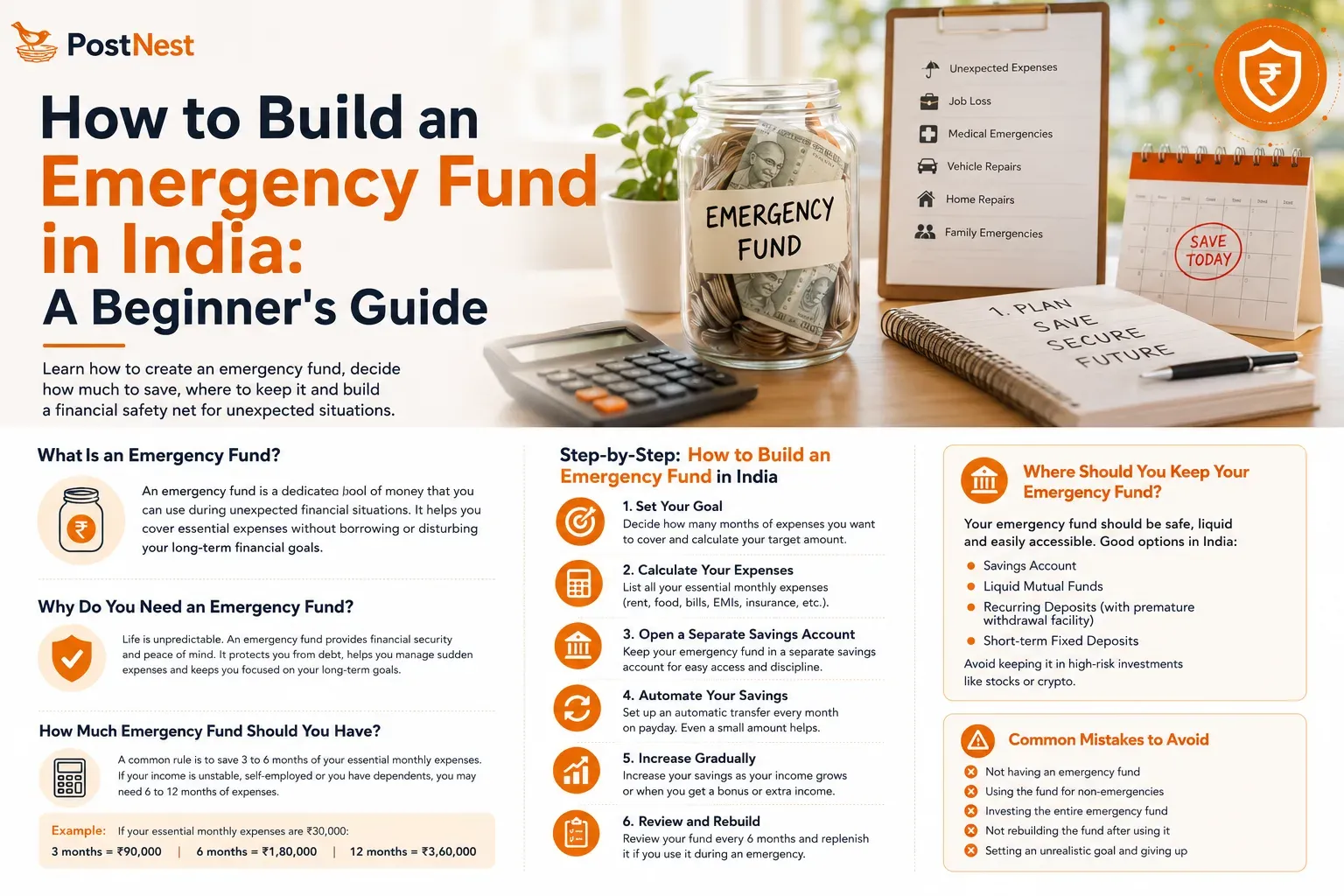
How to Build an Emergency Fund in India: A Beginner's Guide
Unexpected expenses can happen at any time. A medical bill, sudden job loss, urgent home repair, vehicle problem, or family emergency can put pressure on your finances if you do not have money set aside.
This is why learning how to build an emergency fund in India is an important part of personal finance for beginners.
An emergency fund is money kept specifically for unexpected and necessary expenses. It is not meant for vacations, shopping, gadgets, or routine monthly spending.
In this guide, you will learn how much emergency savings you may need, where to keep your emergency fund, how to build it on a limited income, and how to avoid common mistakes.
Important: This article is for general educational purposes and is not personalized financial, investment, tax, or banking advice. Your ideal emergency fund depends on your income, expenses, job stability, dependents, debt, and personal circumstances.
What Is an Emergency Fund?
An emergency fund is a dedicated pool of money that you can access when an unexpected financial situation occurs.
For example, imagine your monthly essential expenses are ₹30,000. If you suddenly lose your income, an emergency fund can help you continue paying for essentials while you look for another source of income.
Emergency savings can be used for situations such as:
Unexpected medical expenses
Sudden loss of income
Essential home repairs
Urgent vehicle repairs
Necessary family expenses
Unexpected travel because of an emergency
Other essential and genuinely unexpected costs
The purpose is simple:
An emergency fund gives you financial breathing room when something goes wrong.
Why Do You Need an Emergency Fund in India?
Many people focus on earning more money or investing for the future but overlook the importance of having accessible savings.
Without emergency savings, an unexpected expense may force you to:
Borrow money from friends or family
Use a credit card
Take a personal loan
Sell investments at an inconvenient time
Delay important payments
An emergency fund can reduce your dependence on these options.
It can also make your overall financial plan more stable because money meant for long-term goals does not necessarily need to be used every time an unexpected expense appears.
How Much Emergency Fund Should You Have?
There is no single emergency fund amount that works for everyone.
A useful way to estimate your target is to calculate your essential monthly expenses and multiply that amount by the number of months you want your emergency fund to cover.
Simple Formula
Emergency Fund Target = Essential Monthly Expenses × Number of Months
For example:
If your essential expenses are ₹25,000 per month:
Emergency CoverageTarget1 month₹25,0003 months₹75,0006 months₹1,50,0009 months₹2,25,000
These are illustrations, not mandatory targets.
Your appropriate emergency reserve may be smaller or larger depending on your circumstances.
How Many Months of Expenses Should You Save?
The right emergency fund size depends on your personal situation.
If You Have a Stable Job
If you have a relatively stable income and fewer financial responsibilities, you may choose to start with a smaller emergency reserve and gradually increase it.
If Your Income Is Unstable
Freelancers, business owners, commission-based workers, and people with irregular income may want a larger financial buffer because monthly income can vary.
If You Have Dependents
If you financially support parents, children, or other family members, unexpected expenses can be higher.
A larger emergency reserve may therefore be appropriate.
If You Have High Monthly Debt Payments
People with significant loan or debt obligations may need additional liquidity because these payments may continue even when income falls.
The important point is that emergency savings should be based on your own financial responsibilities rather than blindly copying someone else's target.
Calculate Your Essential Monthly Expenses
Before deciding how much to save, separate your essential expenses from optional spending.
Essential Expenses
These might include:
Rent or home expenses
Groceries
Utilities
Basic transportation
Insurance premiums
Loan minimum payments
Essential medical expenses
Necessary family expenses
Non-Essential Expenses
These might include:
Restaurant meals
Entertainment
Shopping
Premium subscriptions
Vacations
New gadgets
Luxury purchases
Your emergency fund calculation should generally focus on the expenses you would need to continue paying during a difficult financial period.
Example: Calculate an Emergency Fund in India
Suppose your monthly expenses look like this:
ExpenseMonthly AmountRent₹12,000Groceries₹6,000Utilities₹3,000Transportation₹3,000Insurance₹2,000Loan payment₹4,000Other essentials₹2,000Total₹32,000
Your essential monthly expenses are approximately ₹32,000.
A six-month target would therefore be:
₹32,000 × 6 = ₹1,92,000
You could work toward this target gradually rather than trying to save the entire amount immediately.
How to Build an Emergency Fund Step by Step
If you are starting from zero, the amount can look intimidating.
Instead of focusing on the final number, divide the process into smaller milestones.
Step 1: Set Your First Emergency Savings Goal
Your first target does not need to be several months of expenses.
Start with an amount that feels achievable.
For example:
₹5,000 → ₹10,000 → ₹25,000 → ₹50,000 → ₹1,00,000
Your actual milestones should depend on your income and expenses.
The first goal is to establish the habit of keeping money aside for emergencies.
Step 2: Open a Separate Savings Account
Consider keeping emergency savings separate from your everyday spending account.
This can make it easier to see how much emergency money you actually have.
A separate account can also reduce the temptation to spend the money on non-essential purchases.
Before choosing an account, compare relevant factors such as:
Accessibility
Applicable interest rate
Minimum balance requirements
Banking fees
Withdrawal or transfer convenience
Deposit safety and applicable protections
Step 3: Automate Your Savings
One of the easiest ways to build an emergency fund is to save automatically.
For example, if your monthly income is ₹40,000, you might decide to transfer ₹4,000 to your emergency savings shortly after receiving your income.
You could then treat the remaining money as your available budget.
The amount does not have to be ₹4,000. Choose an amount that fits your financial situation.
The important thing is consistency.
Step 4: Save Part of Unexpected Income
You may occasionally receive money outside your normal salary.
Examples include:
Bonuses
Freelance payments
Gifts
Tax refunds
Cash from selling unused items
Additional project income
Instead of spending all of it, consider directing a portion toward your emergency fund.
This can help you reach your target faster without dramatically changing your normal monthly lifestyle.
Step 5: Reduce One or Two Expenses
You do not have to cut every enjoyable activity from your life.
Instead, identify a few expenses that provide relatively little value.
For example, you might reduce:
Unused subscriptions
Frequent food delivery
Impulse shopping
Unplanned online purchases
Unnecessary convenience expenses
If you save an additional ₹2,000 per month, that becomes:
₹2,000 × 12 = ₹24,000 per year
Small monthly changes can add up over time.
Step 6: Increase Your Savings When Your Income Increases
Suppose you currently save ₹3,000 every month.
Later, your salary increases and your income rises by ₹8,000 per month.
Instead of automatically increasing your spending by the full amount, you could direct part of the increase toward your emergency fund.
This is sometimes easier than trying to make a large lifestyle change later.
Where Should You Keep Your Emergency Fund in India?
An emergency fund has a different purpose from a long-term investment portfolio.
The priority is generally accessibility and stability, rather than maximizing returns.
Possible places to consider include:
1. Savings Account
A savings account provides relatively easy access to your money.
It can be useful for the portion of your emergency fund that you may need quickly.
2. Bank Fixed Deposits
Some people use fixed deposits for part of their emergency reserve.
However, check the terms before using them, including premature withdrawal conditions, applicable interest, and how quickly you can access the money.
3. A Combination of Accessible Savings and Other Suitable Low-Risk Options
You do not necessarily need to keep the entire emergency fund in exactly the same place.
Some people may prefer to keep a smaller immediately accessible amount in a savings account and another portion in an appropriate low-risk, accessible option.
The right structure depends on your circumstances.
Should You Keep Your Emergency Fund in Cash?
Keeping a small amount of physical cash at home can be useful for certain situations, but keeping your entire emergency fund as cash may create practical and security concerns.
Cash can be:
Lost
Stolen
Damaged
Difficult to track
For most people, the majority of an emergency fund is better kept in an appropriate financial account that provides reasonable access when needed.
Should You Invest Your Emergency Fund?
Generally, an emergency fund should not be treated like a long-term investment portfolio.
The purpose of emergency savings is to be available when you need it.
Investments such as stocks can fluctuate significantly in value. If an emergency happens during a market downturn, you may be forced to sell at an unfavorable time.
Therefore, money that you may need for an emergency should be separated from money intended for long-term wealth building.
A simple way to think about it is:
Emergency fund = financial protection
Long-term investments = wealth-building strategy
They serve different purposes.
Emergency Fund vs. Savings for a Goal
Not all savings are emergency savings.
For example:
Emergency Fund
Used for:
Job loss
Unexpected medical expenses
Urgent repairs
Genuine financial emergencies
Vacation Fund
Used for:
Flights
Hotels
Travel activities
Gadget Fund
Used for:
Laptop
Smartphone
Other planned purchases
Education Fund
Used for:
Tuition
Courses
Educational expenses
Keeping these goals separate can help you avoid using emergency money for planned purchases.
How to Build an Emergency Fund on a Low Salary
You do not need a very high income to start building emergency savings.
The key is to make the first target realistic.
Suppose you earn ₹25,000 per month.
Saving ₹10,000 immediately may not be practical.
Instead, you might start with:
₹1,000 per month
At that rate:
₹1,000 × 12 = ₹12,000
If your income later increases, you can increase the monthly contribution.
You can also add occasional extra income to accelerate your progress.
The goal is not to save a huge amount immediately.
The goal is to build the habit and gradually increase your financial buffer.
How Long Does It Take to Build an Emergency Fund?
It depends on your savings rate and target.
Suppose your target is ₹1,50,000.
If you save ₹5,000 per month:
₹1,50,000 ÷ ₹5,000 = 30 months
If you save ₹10,000 per month:
₹1,50,000 ÷ ₹10,000 = 15 months
This calculation does not account for interest or changes in your income and expenses.
If the timeline seems long, do not give up.
You can increase your savings later through:
Salary increases
Bonuses
Freelance income
Expense reductions
Selling unused items
Additional work
What If You Need to Use Your Emergency Fund?
Using your emergency fund does not mean you failed.
That is exactly what the money is there for.
If you use ₹40,000 from a ₹1,50,000 emergency fund, you now have ₹1,10,000 remaining.
Once the emergency is over, make rebuilding your reserve one of your financial priorities again.
For example:
Emergency → Use fund → Stabilize finances → Rebuild fund
Do not feel pressured to immediately return to your original savings rate if your financial situation has changed.
Common Emergency Fund Mistakes to Avoid
1. Waiting Until You Earn More
You can start with a small amount today rather than waiting for a future salary increase.
2. Keeping No Accessible Savings
If every rupee is invested or committed to long-term goals, an unexpected expense can become difficult to manage.
3. Investing Emergency Money in High-Volatility Assets
Emergency savings should serve a different purpose from long-term investments.
4. Using Emergency Savings for Wants
A sale, vacation, smartphone upgrade, or restaurant bill is usually not an emergency.
5. Setting an Unrealistic Target
If you decide to save an amount you cannot realistically afford each month, you may abandon the plan entirely.
6. Forgetting to Rebuild the Fund
After using emergency savings, remember to replenish the amount over time.
A Simple Emergency Fund Plan for Beginners in India
If you are starting from zero, try this framework.
Month 1
Calculate your essential monthly expenses.
Month 2
Set your first emergency savings target.
Month 3
Open or designate a suitable savings account for emergency money.
Month 4
Automate a fixed monthly contribution.
Month 5
Look for one or two expenses you can reduce.
Month 6
Add any suitable extra income to your emergency fund.
Continue this process until you reach your chosen target.
Your plan does not have to be perfect.
Consistency matters more than trying to optimize every detail.
Emergency Fund Checklist
Use this checklist to get started:
I know my essential monthly expenses.
I have calculated my emergency fund target.
I have started saving for emergencies.
My emergency savings are separate from everyday spending.
I contribute to the fund regularly.
I know when I should use the fund.
I avoid using emergency savings for non-essential purchases.
I review my emergency fund when my income changes.
I rebuild the fund after using it.
I understand where my emergency money is kept and how quickly I can access it.
Final Thoughts
Building an emergency fund is one of the simplest ways to create a stronger financial foundation.
You do not need to save lakhs of rupees immediately. Start with an amount you can realistically manage, automate your contributions where possible, and gradually increase your target as your financial situation improves.
The most important step is to begin.
Whether your first goal is ₹5,000, ₹25,000, or several months of essential expenses, building emergency savings can help you handle unexpected financial situations without immediately turning to expensive debt or disrupting long-term financial goals.
Start small. Save consistently. Protect your future.
Frequently Asked Questions
1. How much emergency fund should I have in India?
There is no universal amount. A useful starting point is to calculate your essential monthly expenses and decide how many months of those expenses you want your emergency fund to cover. Your target should reflect your income stability, dependents, debt, and other responsibilities.
2. Is ₹1 lakh enough for an emergency fund?
It depends on your monthly essential expenses and financial responsibilities. If your essential expenses are ₹20,000 per month, ₹1 lakh represents five months of those expenses. For someone with higher expenses or less stable income, the same amount may provide less coverage.
3. Where should I keep my emergency fund in India?
Many people keep emergency savings in an accessible savings account and may use other suitable low-risk options for part of the reserve. Consider accessibility, stability, applicable interest, fees, and withdrawal conditions when choosing where to keep it.
4. Should I invest my emergency fund?
Emergency savings are generally intended for accessibility and financial protection rather than maximizing investment returns. High-volatility investments can lose value when you need the money, so emergency savings and long-term investments should generally be treated as separate financial buckets.
5. How can I build an emergency fund with a low salary?
Start with a small, realistic monthly amount. Automate the contribution if possible, reduce a few unnecessary expenses, and consider directing part of bonuses or additional income toward your emergency savings.
6. What counts as a financial emergency?
A financial emergency is generally an unexpected and necessary expense that you cannot reasonably cover through your normal monthly budget. Examples can include unexpected medical costs, sudden loss of income, or urgent essential repairs.
7. Should I use my emergency fund to pay off debt?
It depends on your situation. Maintaining some emergency savings can help prevent a new financial emergency from forcing you to borrow again. If you have high-cost debt, you may need to balance building a basic emergency reserve with an effective debt-repayment strategy.