
Personal Finance for Beginners: Manage, Save & Invest
Learn personal finance for beginners with practical tips to manage money, create a budget, save, build an emergency fund, manage debt, and start investing.A beginner-friendly guide to managing money, budgeting, saving, handling debt, building an emergency fund, and understanding investing for long-term financial goals.

Tanvi Ladva
Author & Contributor
Personal Finance for Beginners: How to Manage Your Money, Save and Invest
Managing money can feel complicated when you are just getting started. You may have questions like: How much should I save every month? Should I pay off debt before investing? How much money should I keep for emergencies? And where should a beginner even start with investing?
The good news is that personal finance for beginners does not have to be complicated. Building good financial habits starts with understanding where your money goes, creating a realistic budget, saving consistently, managing debt responsibly, and learning how investing works.
This guide explains the basics of how to manage money, save for your goals, and start investing with a long-term mindset.
Important: This article is for general educational purposes and is not personalized financial, tax, or investment advice. Financial products, taxes, regulations, and investment risks vary by country and individual circumstances.
What Is Personal Finance?
Personal finance is the process of managing your income, expenses, savings, debt, investments, insurance, and financial goals.
In simple terms, it is about making decisions about your money today while preparing for your future.
Personal finance generally includes:
Managing monthly income and expenses
Creating and following a budget
Building an emergency fund
Saving for short- and long-term goals
Managing and repaying debt
Understanding insurance
Investing for long-term goals
Planning for retirement
Reviewing your financial progress
You do not need to understand everything at once. A good approach is to build your financial system one step at a time.
Why Personal Finance Matters
Your financial situation is influenced not only by how much you earn, but also by how you use your money.
Someone with a high income can still struggle financially if expenses and debt consistently consume most of their income. On the other hand, someone with a modest income can gradually build financial stability by controlling expenses, saving regularly, and making thoughtful financial decisions.
Learning basic money management can help you:
Understand where your money goes
Reduce unnecessary spending
Prepare for unexpected expenses
Avoid relying heavily on expensive debt
Save for important goals
Build long-term wealth
Make more informed financial decisions
The goal is not to stop spending money. The goal is to spend intentionally while making room for saving and future goals.
How to Manage Money as a Beginner
If you are completely new to personal finance, start with the basics.
A simple financial system can follow this order:
Earn → Track → Budget → Save → Protect → Invest → Review
Let's look at each step.
1. Know How Much Money You Actually Have
Start by calculating your regular income.
Depending on your situation, this could include:
Salary
Freelance income
Business income
Part-time income
Interest or investment income
Other regular sources
If your income changes every month, use a conservative estimate based on your recent earnings rather than assuming your best month will repeat.
Knowing your actual income gives you a starting point for creating a realistic budget.
2. Track Your Expenses
Before creating a budget, understand where your money is currently going.
Track expenses for at least a few weeks or a full month.
Divide spending into categories such as:
Fixed Expenses
These are expenses that are relatively predictable.
Examples include:
Rent or housing payments
Insurance premiums
Loan payments
Internet bills
School or education payments
Variable Expenses
These can change from month to month.
Examples include:
Groceries
Transportation
Electricity
Entertainment
Shopping
Dining out
Discretionary Spending
These are expenses that are usually optional.
For example:
Subscriptions
Hobbies
Impulse purchases
Entertainment
Non-essential shopping
Tracking your spending can reveal patterns that are difficult to notice when you simply check your bank balance.
Create a Simple Budget
A budget is simply a plan for your money.
You can create one using a spreadsheet, budgeting app, notebook, or any method you will actually use consistently.
A simple monthly budget can look like this:
CategoryPlanned AmountHousing₹20,000Food & groceries₹8,000Transportation₹4,000Utilities₹3,000Debt payments₹5,000Savings₹5,000Investments₹3,000Personal spending₹2,000
These numbers are only an example. Your budget should reflect your income, location, responsibilities, debt, and financial goals.
Try the 50/30/20 Rule as a Starting Point
One commonly discussed budgeting framework divides after-tax income approximately into:
50% for needs
30% for wants
20% for savings and debt repayment
However, this is a guideline, not a universal rule.
Someone living in an expensive city may spend more than 50% on necessities. Someone with significant debt may need to allocate more toward repayment. Someone with a low cost of living may be able to save considerably more.
The best budget is one that is realistic enough to maintain.
How to Save Money Consistently
Saving money is easier when you turn it into a system instead of relying on motivation.
Pay Yourself First
Instead of spending your entire income and saving whatever remains, consider setting aside a predetermined amount soon after receiving your income.
For example:
Income → Savings → Essential expenses → Flexible spending
You can automate transfers to a separate savings account if your bank supports it.
Even a small amount saved consistently can help you develop the habit.
Set Specific Savings Goals
"Save more money" is a vague goal.
Instead, create specific targets.
For example:
Build an emergency fund
Save for education
Save for a vehicle
Save for a home
Save for travel
Prepare for a large annual expense
Give each goal a target amount and timeframe.
This makes progress easier to measure.
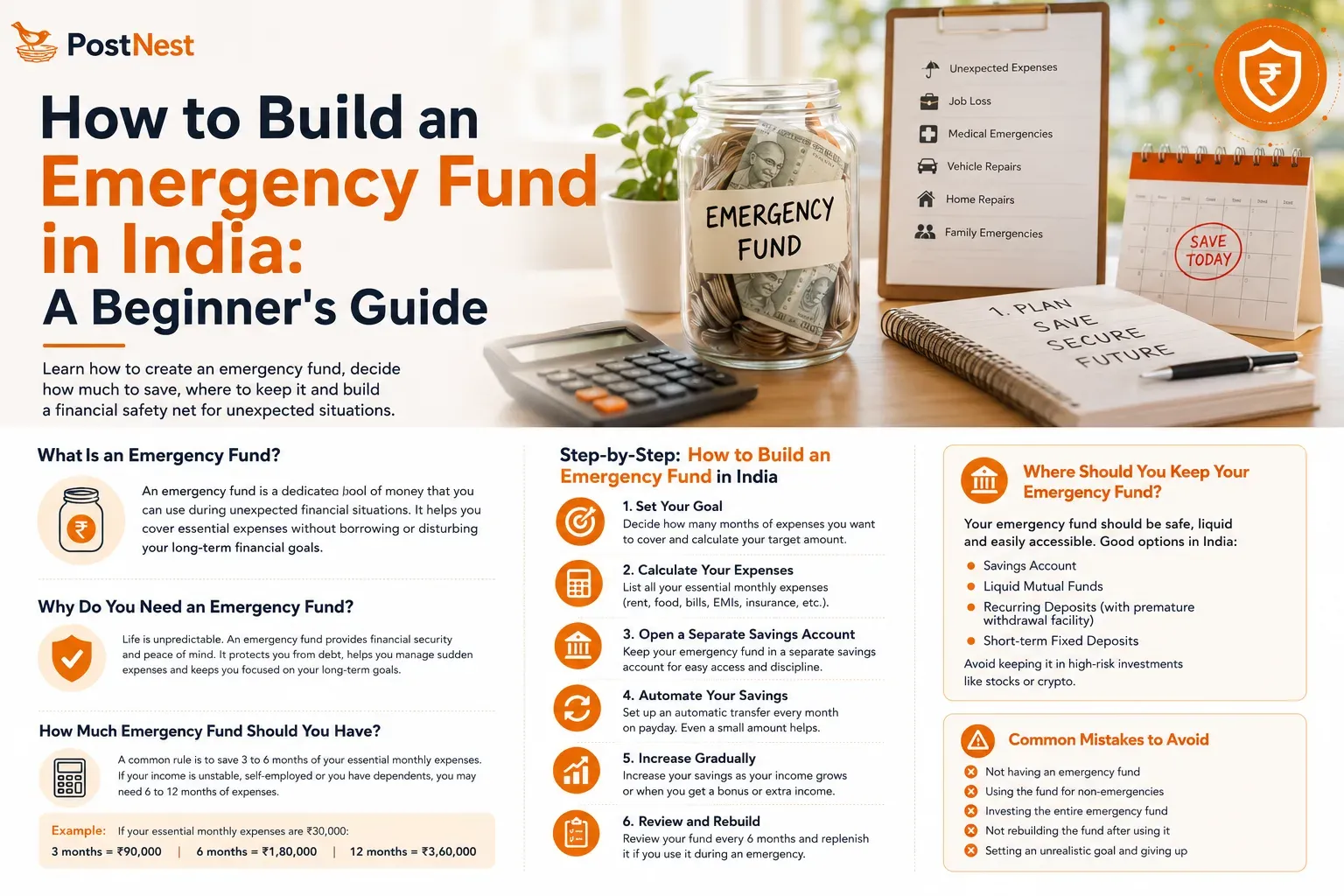
Build an Emergency Fund
An emergency fund is money kept aside for unexpected financial situations.
Possible emergencies include:
Unexpected medical expenses
Job loss
Urgent home repairs
Essential vehicle repairs
Sudden family expenses
The appropriate amount depends on your income stability, household responsibilities, expenses, and access to other resources.
A common starting goal is to build enough savings to cover several months of essential expenses.
You do not have to build the entire fund immediately.
You could start with a small initial target and gradually increase it.
Example:
If your essential monthly expenses are ₹30,000, you might first aim for ₹30,000, then ₹60,000, and gradually work toward a larger emergency reserve.
Keep emergency savings somewhere reasonably accessible and appropriate for short-term needs rather than putting money needed for emergencies into highly volatile investments.
How to Reduce Unnecessary Spending
Saving does not always mean eliminating everything you enjoy.
Instead, look for spending that provides little value to you.
Try reviewing:
Unused subscriptions
Frequent food delivery
Impulse shopping
Unplanned online purchases
Expensive convenience purchases
Services you rarely use
A useful question is:
"Would I still buy this if I had to consciously make the decision again today?"
You can also introduce a short waiting period before making non-essential purchases.
Small changes repeated over many months can have a meaningful impact on your cash flow.
Understand and Manage Debt
Debt is not automatically good or bad. Its cost, purpose, terms, and your ability to repay it all matter.
Common types include:
Credit card debt
Personal loans
Education loans
Vehicle loans
Home loans
High-cost debt deserves particular attention because interest can make balances grow quickly.
Make a Debt List
Write down:
DebtBalanceInterest RateMinimum PaymentCredit Card₹25,000—₹2,000Personal Loan₹80,000—₹4,000Education Loan₹1,50,000—₹5,000
Use your actual numbers when building your own list.
Once you can see all your debts together, it becomes easier to create a repayment strategy.
Snowball vs. Avalanche
Two common approaches are:
Debt Snowball
Pay minimums on all debts while putting extra money toward the smallest balance first.
Once that debt is cleared, move the freed-up payment toward the next debt.
Debt Avalanche
Pay minimums on all debts while putting extra money toward the debt with the highest interest rate first.
This can reduce interest costs, assuming other factors remain comparable.
The right approach depends on your financial situation and what helps you remain consistent.
Saving vs. Investing: What's the Difference?
Saving and investing are related, but they are not the same.
Saving
Saving generally means keeping money in relatively stable and accessible places for short- or medium-term needs.
Examples include money for:
Emergencies
Upcoming purchases
Near-term education expenses
Planned travel
Other short-term goals
Investing
Investing means putting money into assets with the expectation that they may grow or generate income over time.
Examples can include:
Stocks
Bonds
Mutual funds
Exchange-traded funds
Other investment assets
Investments can lose value, and returns are not guaranteed.
A simple principle is:
Money needed soon generally should not be exposed to the same level of investment risk as money intended for long-term goals.
How to Start Investing as a Beginner
Once your basic financial foundation is in place, you can start learning about investing.
Before investing, understand:
Your financial goals
Your investment timeframe
Your risk tolerance
Investment fees
Taxes applicable to you
The risks of the asset you are considering
Do not invest simply because something is trending online.
Start With Your Goal
Different goals can require different approaches.
For example:
Short-term goal: You may prioritize stability and accessibility.
Long-term goal: You may have more ability to tolerate market fluctuations, depending on your circumstances.
The longer timeframe does not eliminate investment risk, but it can change how you think about temporary market movements.
Understand Diversification
Diversification means spreading investments across different assets rather than relying heavily on one investment.
For example, owning one company's stock exposes you to the performance of that particular company.
A diversified portfolio can spread exposure across multiple companies, sectors, asset classes, or markets depending on the investment strategy.
Diversification does not guarantee profits or eliminate losses, but it can help reduce the impact of a single investment performing poorly.
Understand Compound Growth
One of the most important concepts in long-term investing is compounding.
Compounding occurs when returns are reinvested and future growth can occur on both the original amount and previous returns.
For example, imagine you invest ₹10,000 and it grows by 8% in a hypothetical year. The balance would become ₹10,800 before considering taxes, fees, and changes in market value.
If future returns are earned on the larger balance, growth can accelerate over time.
However, real investment returns are not fixed, and markets can rise or fall.
The key lesson is that time can be an important factor in long-term wealth building.
Avoid Common Beginner Money Mistakes
Learning what not to do can be just as important as learning what to do.
1. Spending Everything You Earn
If your expenses consistently rise whenever your income increases, building savings can remain difficult.
2. Ignoring High-Cost Debt
Carrying expensive debt for long periods can make financial goals harder to achieve.
3. Investing Without Understanding the Risk
Never invest money simply because someone online claims that an asset is guaranteed to make you rich.
4. Having No Emergency Savings
Unexpected expenses can force you to borrow money if you have no accessible reserve.
5. Chasing Quick Returns
Promises of guaranteed high returns should be treated with extreme caution.
6. Comparing Your Finances With Others
Social media often shows purchases, vacations, cars, and lifestyle upgrades without showing the complete financial picture.
Focus on your own goals.
A Simple Personal Finance Plan for Beginners
If you want a straightforward starting plan, use these steps:
Step 1: Calculate Your Monthly Income
Know how much money you regularly receive.
Step 2: Track Your Spending
Record where your money goes.
Step 3: Create a Realistic Budget
Separate needs, wants, debt payments, savings, and investments.
Step 4: Build an Emergency Fund
Start small and gradually increase it.
Step 5: Manage High-Cost Debt
Create a repayment strategy and avoid taking unnecessary expensive debt.
Step 6: Define Financial Goals
Give each important goal a target amount and timeframe.
Step 7: Learn About Investing
Understand risk, diversification, fees, taxes, and time horizon before investing.
Step 8: Automate Good Habits
Automate savings or investments where appropriate.
Step 9: Review Your Money Monthly
Check your spending, savings, debt, and investment progress.
Step 10: Increase Your Savings as Your Income Grows
When your income increases, consider directing part of the increase toward financial goals rather than automatically increasing lifestyle expenses.
Personal Finance Checklist
Use this checklist to see where you currently stand:
I know my monthly income.
I track my expenses.
I have a monthly budget.
I have started an emergency fund.
I know how much debt I have.
I understand the interest rates on my debt.
I have defined short-term financial goals.
I have defined long-term financial goals.
I understand the basics of investing.
I understand the risks of my investments.
I review my finances regularly.
You do not need to check every box today. Personal finance is a process.
How to Improve Your Finances Over Time
Your financial plan should change as your circumstances change.
For example, you may need to adjust your budget after:
Getting a new job
Receiving a salary increase
Starting a business
Moving to a new city
Getting married
Having children
Paying off a major debt
Changing your financial goals
Review your financial plan periodically instead of creating it once and forgetting about it.
A simple monthly review can take less than an hour.
Look at:
Income → Expenses → Savings → Debt → Investments → Goals
Then decide what needs to change.
Final Thoughts
Good money management is not about becoming wealthy overnight. It is about developing habits that help you make better financial decisions consistently.
If you are new to personal finance, start with the basics: understand your income, track your expenses, create a realistic budget, build emergency savings, manage debt, and learn how investing works before putting your money at risk.
You do not need a perfect financial plan. You need a plan that you understand and can consistently follow.
Start with one small improvement today. Over time, those small decisions can become a much stronger financial foundation.
Frequently Asked Questions
1. What is personal finance for beginners?
Personal finance for beginners is the process of learning how to manage income, expenses, savings, debt, financial goals, and investments. Beginners can start by tracking spending, creating a budget, building emergency savings, and learning basic investing concepts.
2. How should I start managing my money?
Start by calculating your income, tracking your expenses, creating a realistic budget, and setting aside money for savings. Once your basic financial system is working, focus on debt management and long-term financial goals.
3. How much money should a beginner save?
There is no single amount that works for everyone. Your savings target depends on income, expenses, job stability, debt, and financial responsibilities. A practical approach is to start with a small emergency savings target and gradually build it toward several months of essential expenses.
4. Should I save money or invest it?
It depends on when you need the money and how much risk you can accept. Money needed for emergencies or near-term expenses generally needs more accessibility and stability, while money intended for long-term goals may be suitable for investments depending on your circumstances.
5. What is the best way to start investing?
Start by understanding your financial goals, timeframe, risk tolerance, investment costs, and the assets you are considering. Learn about diversification and avoid investing based solely on social-media trends or promises of guaranteed returns.
6. How can I save money every month?
Track your spending, create a realistic budget, reduce unnecessary expenses, set specific savings goals, and automate savings where possible. Even a small amount saved consistently can help establish a strong financial habit.
7. What is an emergency fund?
An emergency fund is money reserved for unexpected expenses such as job loss, urgent repairs, or other financial emergencies. The appropriate amount depends on your personal circumstances, but many people work toward having enough to cover several months of essential expenses.