
PostNest vs Medium for Developers: Free Publishing vs. the Partner Program
An honest comparison of PostNest and Medium for developers: the Partner Program's paywall trade-off, SEO impact, audience reach, and which platform actually helps your writing rank on Google.

Postnest
Author & Contributor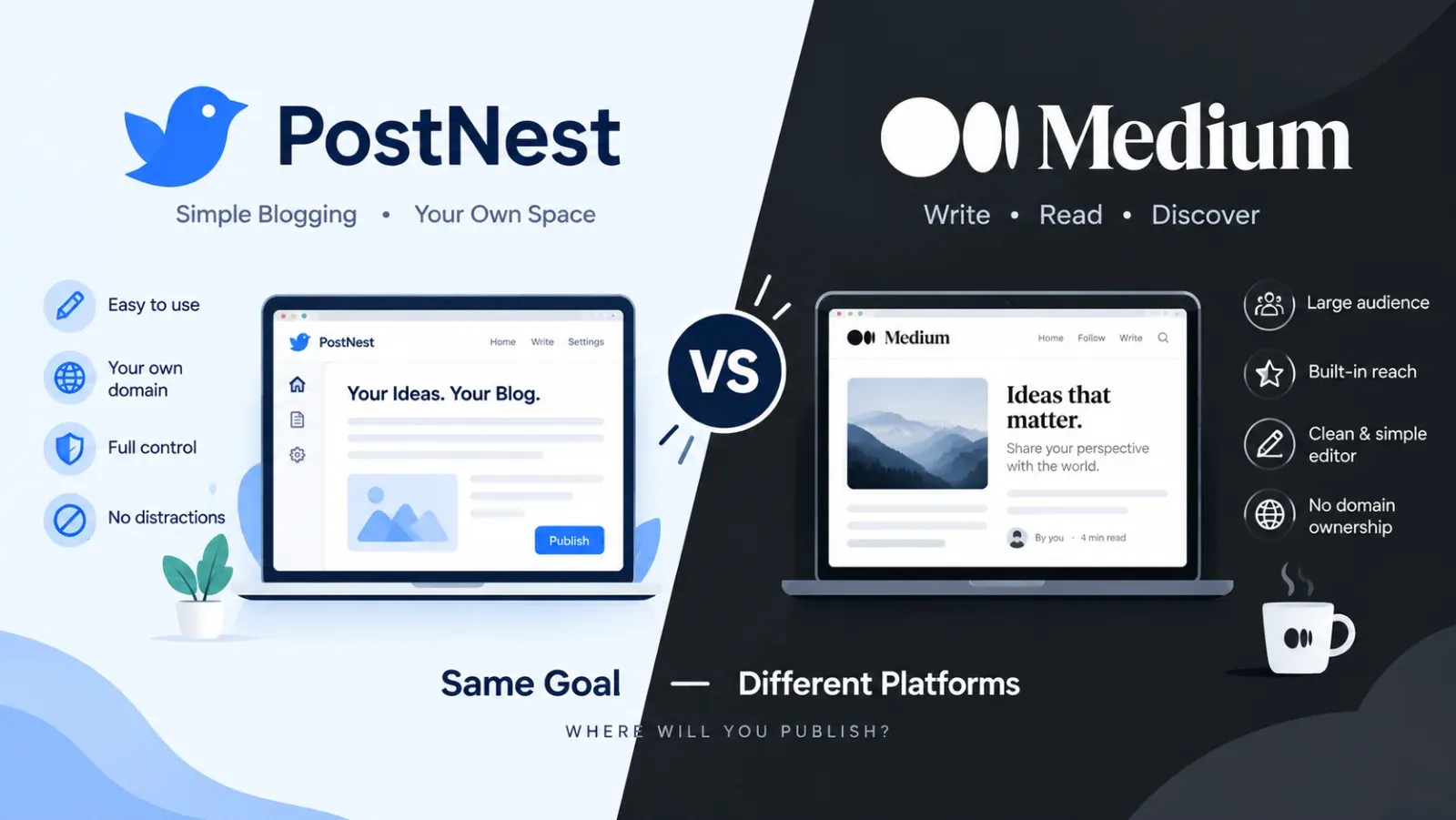
Medium and PostNest both let you publish an article in minutes without touching a server or a CMS, but that's roughly where the similarity ends. Medium is a massive, general-interest publishing network with a reader-funded payout system. PostNest is a free, developer-and-startup-focused platform built around getting your specific article to rank in search rather than compete for attention inside a subscriber feed. If you've been posting on Medium and wondering whether it's still the right home for technical writing, here's the honest breakdown.
Quick Take
Medium's real strength is reach and, for some writers, direct income — its Partner Program pays out based on how long paying members spend reading your paywalled stories. The catch is that the payout requires a metered paywall, and a paywall is exactly what stops a first-time visitor from Google finishing your article, which quietly undermines the SEO value of anything you publish there. PostNest skips that trade-off entirely: everything is free to read, free to publish, and built so the page itself — not just your follower count — is what earns search visibility over time.
Monetization: Reader-Funded Payouts vs. No Paywall at All
To earn anything on Medium, you need to be accepted into its Partner Program, be based in one of its supported countries, connect a Stripe account, and then lock your stories behind Medium's metered paywall (either entirely or after a preview). Your earnings depend on how long paying subscribers spend reading, plus claps, highlights, and new followers — and Medium keeps a cut of subscription revenue before it gets split across every writer whose paywalled stories a given reader read that month. It can add up for high-traffic writers, but it's a genuinely indirect way to get paid, and non-members hit a hard wall after a few free articles a month.
PostNest doesn't have a payout program, and it doesn't need one to make sense for most technical writers: it's free to publish, nothing you write is ever put behind a paywall, and there's no cut taken from anything you monetize elsewhere by linking out from your article or author bio — your product, your newsletter, your consulting page, a job listing. If your writing exists to build an audience or drive people to something you're building, not to collect per-minute-read revenue, a platform with zero reader friction is usually the more useful one.
SEO: Why a Paywall Is an SEO Problem, Not Just a Reader Problem
This is the part that doesn't get discussed enough. When a page is metered or paywalled, a share of visitors arriving from a Google search hit the paywall before finishing the piece, which increases bounce rate and cuts the time-on-page signals that search engines associate with a genuinely useful result. Whether or not a given article is paywalled is also something a writer can change after the fact, which means an article's SEO performance on Medium can shift for reasons that have nothing to do with the content itself.
PostNest's model sidesteps this cleanly: there's no paywall to configure, so the search experience is identical for every visitor, first-time or returning. On top of that, PostNest gives you a primary keyword field, a secondary keywords field, your own meta excerpt, and BlogPosting structured data on every article — the same kind of on-page control an SEO-focused blog would set up manually, without needing to touch a single line of code.
Audience and Discovery
Medium's audience is enormous and spans far beyond tech — business, culture, personal essays, self-improvement, and more, held together by an algorithmic recommendation engine and curated publications that can put your story in front of a large, receptive readership almost overnight if an editor picks it up. That reach is real and hard to replicate on a smaller platform.
PostNest doesn't have that scale yet. It organizes content into focused categories (Technology, AI & Tools, Digital Marketing, and similar) and relies on search engines rather than an internal algorithm to bring readers in over time. The trade-off is speed versus durability: a Medium algorithm pick can spike traffic in a day and fade quickly, while a well-optimized PostNest article tends to build traffic slowly and keep earning it long after publication, since it's not competing against an ever-changing recommendation feed.
Formatting and Writing Experience
Medium's editor is famous for a reason — it's clean, distraction-free, and genuinely pleasant to write long-form narrative content in. Where it's more limited is technical formatting: code blocks are serviceable but not built for developers the way a dedicated technical editor is, and embedding structured comparisons or checklists takes more effort than it should.
PostNest's WYSIWYG editor covers the full range most technical and business writing needs: heading levels, code blocks, blockquotes, bullet and numbered lists, task checklists, text alignment, and direct image uploads, with what you see while writing matching what publishes. It's not trying to be a narrative-essay editor — it's built for the kind of structured, scannable writing that ranks well and reads easily on mobile.
Which One Should You Actually Use?
If you're an established Medium writer with a following, or you're writing something that leans on Medium's Partner Program for direct income, keep publishing there — that audience and payout mechanism are genuinely useful and PostNest isn't trying to replace them. But if you're writing to grow organic search traffic toward something you're building — a product, a company blog, a portfolio of expertise — a platform with no paywall standing between your article and a first-time Google visitor, plus direct control over the metadata that decides how that article ranks, is generally the better fit.
Plenty of writers do both: publish the SEO-optimized version on PostNest first, then adapt a version for Medium's audience and payout program, keeping the two working toward different goals instead of competing with each other.
Ready to try it? You can publish your first article on PostNest for free, or check the guest post guidelines if you'd rather contribute as a guest author.