
PostNest vs Dev.to: Which Free Blogging Platform Should Developers Choose in 2026?
An honest, detailed comparison of PostNest and Dev.to for developers: audience reach, monetization, SEO ownership, formatting, and which platform actually helps your writing rank on Google.

Postnest
Author & Contributor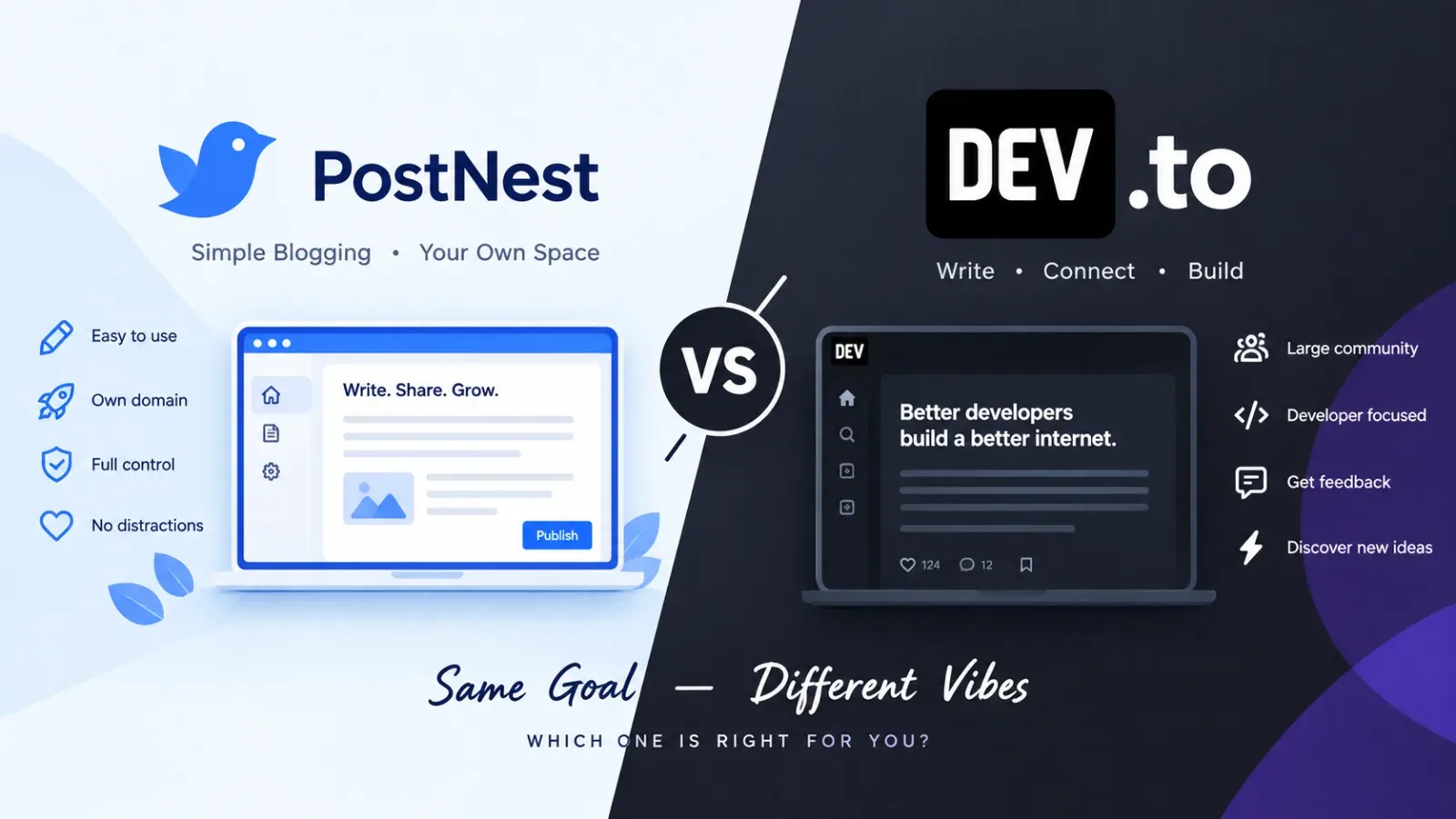
If you build software and you're trying to decide where to put your writing, the honest answer is that DEV Community and PostNest solve overlapping but different problems. DEV has years of head start and a huge built-in developer community. PostNest is newer, free forever, and built specifically around getting your article indexed and ranked rather than just read inside one platform's feed. Here's an honest, detail-by-detail comparison so you can pick the right home for your next post — or use both.
Quick Take
DEV Community wins on day-one audience: post there and a slice of its large, tag-browsing developer community will see it within hours, no SEO effort required. PostNest wins on long-term ownership: your article gets its own indexable URL, editable meta title and description, primary/secondary keyword targeting, and structured data, all aimed at ranking on Google rather than just surfacing in an internal feed. Neither is strictly "better" — they're built for different jobs.
Audience and Reach: Built-In Community vs. Search Traffic
DEV Community's biggest advantage is that the audience is already there. Community estimates commonly put its active developer readership in the millions per month, and its tag system (#javascript, #webdev, #beginners, and hundreds more) means a well-tagged post can get real engagement in its first few hours purely from people browsing tags, with no external marketing needed.
PostNest doesn't have that built-in browsing crowd yet — it's a younger platform. What it's built for instead is search traffic: an article published on PostNest gets a clean, canonical URL, its own meta title and description, primary and secondary keyword fields, and BlogPosting structured data, all so that months later, someone searching Google for your exact topic can actually find the piece. Posts on a shared community platform can rank too, but you're competing for search visibility on a domain hosting hundreds of thousands of other people's articles, which is exactly the kind of "who does Google credit for this expertise" problem that shared publishing platforms run into.
Monetization: Free Forever vs. Free-to-Post
Neither platform is going to make you rich, but the models are different. DEV Community has never had a built-in way to pay individual writers directly for views or engagement — it operates as a free, sponsor-and-community-supported platform, and most people write there for visibility, not income.
PostNest takes the same position: it's free to publish, with no paywall stopping readers from finishing your article, and no revenue share taken from anything you might monetize elsewhere (your own product, a newsletter, a course, a job posting) by linking to it from your bio or your post. If your goal in writing is to drive people back to something you're building, a platform that doesn't gate your own readers behind a subscription wall is generally the simpler choice.
SEO and Content Ownership
This is the least talked-about difference and probably the most important one for anyone writing to grow an audience over years, not weeks. On a shared community platform, your post lives at a URL under someone else's username path. You don't control canonical tags, meta descriptions, or structured data beyond what the platform template gives every post. If that platform ever changes its templates, its domain authority shifts, or it deprioritizes older content, your article's search visibility moves with it — you don't have much control.
PostNest gives you direct control over the fields that actually affect ranking: your own slug, your own meta excerpt, a primary keyword field and secondary keywords field that feed directly into the page's SEO metadata and JSON-LD schema, and a featured image you choose. You're still publishing on someone else's domain rather than your own site, but within that domain you have far more say over how each individual article is set up to rank.
Formatting and Editing Experience
DEV Community's editor is markdown-based and fast once you're used to it, but customization is intentionally limited — that's part of what keeps the platform's reading experience consistent. Embeds for social posts, code sandboxes, videos, and code repository snippets are a genuine strength if your writing leans on live code demos.
PostNest uses a WYSIWYG editor with full heading levels, code blocks, blockquotes, task lists, text alignment, and direct image uploads, so what you see while writing is what gets published. It won't have that platform's specific embed integrations, but for standard technical writing — tutorials, opinion pieces, comparisons, case studies — the formatting toolkit covers what most posts need.
Discovery: Tags vs. Search-First Categories
DEV Community surfaces content primarily through tags and its internal feed algorithm — publish well-tagged, useful content consistently and the platform itself becomes a distribution channel. That's a real advantage for anyone posting frequently.
PostNest organizes content into categories and leans on search engines as the primary discovery channel rather than an internal algorithmic feed. That means less same-day traffic than a post that catches a community feed's algorithm, but it also means an article you wrote a year ago can still be pulling in new readers from Google searches long after it would have scrolled off an internal feed.
Which One Should You Actually Use?
If you want fast feedback from other developers on a new post, tag it well and publish on DEV Community — that community response is genuinely valuable and hard to replicate elsewhere. If you're writing content you want to compound in value over time, ranking for the exact problem someone is searching how to solve, PostNest's SEO-first setup is built for that job.
Plenty of writers do both: publish on PostNest first with a fully-configured canonical URL, keyword targeting, and structured data, then cross-post to the community platform for same-day reach, pointing back to the original with a canonical link or a simple "originally published on" note. You get the community platform's audience and PostNest's long-term search equity in the same move.
Ready to publish your first piece? You can start writing on PostNest for free, or check the submission guidelines if you're contributing as a guest author.