
How to Start a Blog in 2026: A Beginner’s Guide to Writing, Publishing, and Growing Online
Starting a blog can seem complicated when you are seeing terms like SEO, keywords, domains, content strategy, backlinks, analytics, and monetization everywhere.

Priyanshi
Postnest solution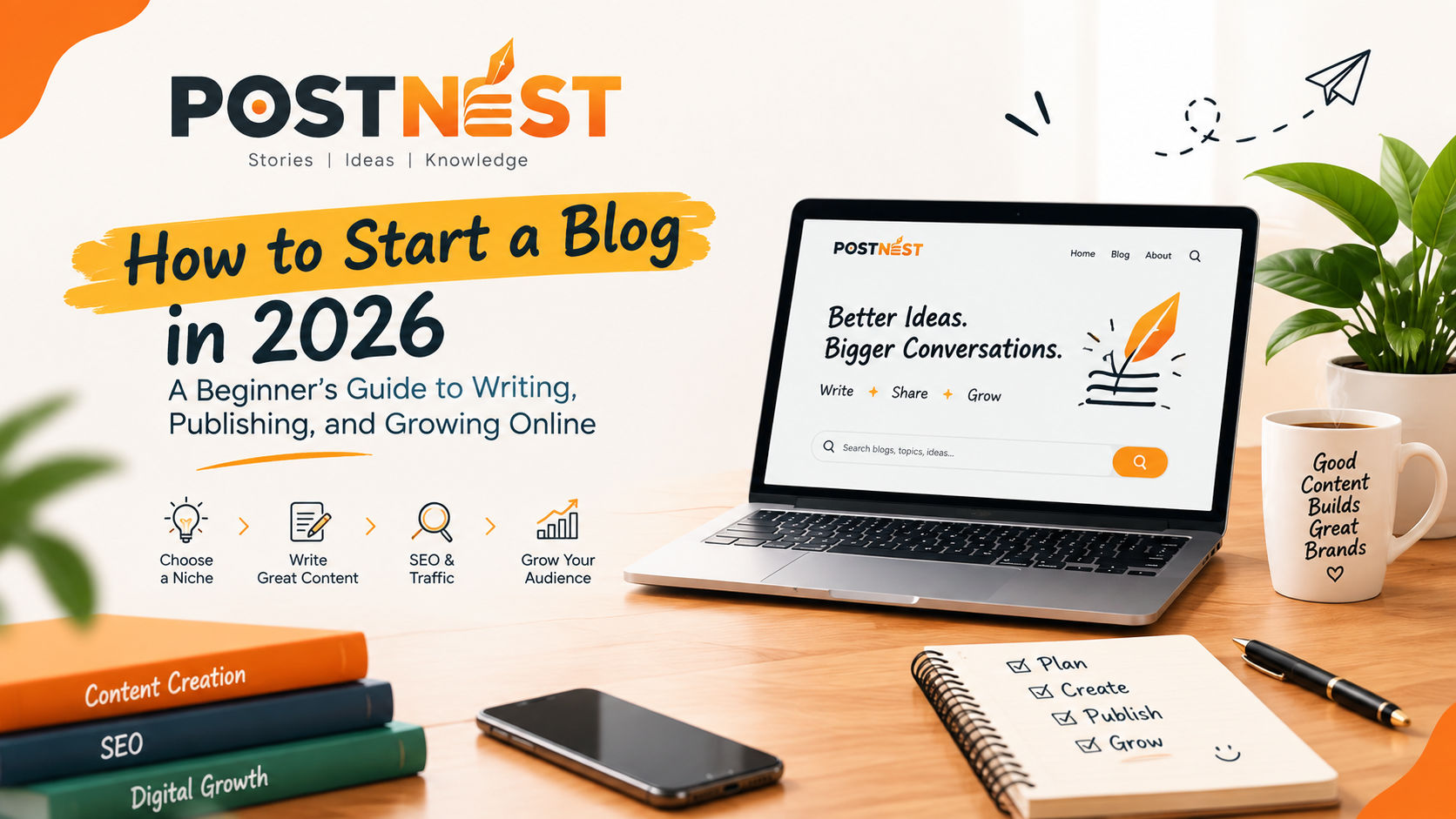
Starting a blog can seem complicated when you are seeing terms like SEO, keywords, domains, content strategy, backlinks, analytics, and monetization everywhere.
But blogging itself is much simpler.
At its core, a blog is a place where you share useful information, ideas, experiences, opinions, or knowledge with an audience. The challenge is not simply publishing an article. The real challenge is creating content people want to read and making it easy for them to discover it.
Whether you want to build a personal brand, share your expertise, grow a business, or simply write about something you enjoy, this guide will show you how to start blogging step by step.
What Is a Blog?
A blog is a website or section of a website where articles are regularly published around particular topics.
For example, someone might create a blog about:
Technology
Travel
Personal finance
Fitness
Food
Education
Career development
Business
Digital marketing
Lifestyle
Programming
A blog doesn't have to be limited to one format. You can publish tutorials, guides, opinions, case studies, reviews, how-to articles, lists, interviews, and personal experiences.
The most important thing is that your content provides something useful to the reader.
Why Should You Start a Blog?
Blogging can be useful for much more than earning money.
1. Build your personal brand
If you consistently publish useful content about a subject, people can start associating your name with that expertise.
For example, a software developer who regularly writes about web development can gradually build an online professional presence.
2. Share your knowledge
Everyone has something they know that can help someone else.
You don't necessarily need to be the world's leading expert. You simply need to provide useful information from your knowledge, experience, research, or perspective.
3. Grow an online audience
Good content can attract readers through search engines, social media, communities, referrals, and other channels.
Over time, individual articles can become a library of content that continues attracting visitors.
4. Support a business
Businesses can use blogs to answer customer questions, explain products, demonstrate expertise, and attract people who are searching for solutions.
A well-planned business blog can become part of a broader content marketing strategy.
5. Create opportunities
A blog can help demonstrate your skills and interests.
Depending on your niche, blogging may lead to freelance work, partnerships, clients, job opportunities, collaborations, or other professional opportunities.

How to Start a Blog Step by Step
You don't need to figure everything out at once.
Follow these steps.
Step 1: Choose a Topic or Niche
The first decision is what you want to write about.
A common mistake beginners make is choosing a topic simply because they think it will make money.
Instead, look for the intersection of:
What you know + What you enjoy + What people are searching for
For example, instead of creating a very broad website about "everything," you could focus on:
"Practical technology guides for beginners."
Then you can create articles around programming, software, AI tools, careers, productivity, and related topics.
A focused topic makes it easier to understand your audience and plan future content.
Step 2: Understand Your Audience
Before writing an article, ask:
Who am I writing for?
A beginner learning SEO has different needs from an experienced SEO professional.
A student looking for career advice has different questions from a business owner.
Understanding your reader helps you decide:
What language to use
How much explanation to provide
What examples to include
What questions to answer
What type of content to create
Write for a real person rather than writing only for search engines.
Step 3: Find Topics People Actually Search For
This is where SEO becomes important.
Instead of randomly choosing topics, research what your potential readers are looking for.
For example, someone interested in blogging might search:
How to start a blog
How to write a blog
How to get blog traffic
How to do SEO for a blog
Best blogging platforms
How to make money blogging
These searches can become individual articles.
A useful approach
Start with a broad topic and break it into smaller questions.
Blogging
↓
Starting a blog
↓
Choosing a blogging niche
Writing your first article
Blog SEO
Getting blog traffic
Blog monetization
This creates a connected content structure instead of a collection of unrelated articles.
Step 4: Create a Useful Article Structure
Before writing, create an outline.
A simple structure might look like:
Introduction
Explain the problem and what the reader will learn.
H2: What is blogging?
Give a simple explanation.
H2: Why start a blog?
Explain the benefits.
H2: How to start a blog
Break the process into steps.
H2: Common blogging mistakes
Help readers avoid problems.
H2: Frequently asked questions
Answer specific search-related questions.
Conclusion
Summarize the key points and give the reader a next step.
Good structure makes long articles much easier to read.
Step 5: Write for Humans First
SEO is important, but your article should never sound like it was written only to insert keywords.
For example, don't write:
"If you want to start a blog, starting a blog is important because starting a blog helps you start blogging."
That doesn't help anyone.
Instead:
"Starting a blog doesn't require you to know everything about writing or SEO. Begin with a topic you understand, identify the people you want to help, and publish useful articles consistently."
The second version sounds natural and actually communicates something.
Use your target keywords where they make sense, but prioritize clarity, usefulness, originality, and reader experience.
Step 6: Make Your Blog SEO-Friendly
Search engine optimization helps search engines understand your content and can improve its chances of being discovered.
Some important areas include:
Use a clear title
Your title should tell readers exactly what the article is about.
Use headings
Organize the article with logical H2 and H3 headings.
Write a useful introduction
Don't spend several paragraphs saying nothing.
Tell readers what they will learn.
Use descriptive URLs
For example:
/how-to-start-a-blog
is easier to understand than:
/article?id=72829
Add internal links
If you mention another topic you've already covered, link to that article.
For example:
Want to learn more about finding topics people search for? Read our guide to keyword research for beginners.
Internal linking helps readers discover more content and helps search engines understand how your articles relate to each other.
Optimize images
Use relevant images and descriptive alt text where appropriate.
Make the page mobile-friendly
Many readers access content from smartphones, so your blog should work well on smaller screens.
Step 7: Publish Consistently
You don't need to publish five articles every day.
Consistency is more important than simply producing a large number of articles.
For example:
1–2 high-quality articles every week
can be a much better strategy than publishing dozens of short, repetitive articles.
Focus on building a useful content library over time.
Step 8: Promote Your Content
Publishing an article doesn't guarantee that people will immediately find it.
Share your content through appropriate channels such as:
Social media
Email newsletters
Online communities
Professional networks
Relevant discussions
Partnerships
Other legitimate content channels
The goal isn't simply to promote links everywhere.
The goal is to put useful content in front of people who genuinely need it.
Step 9: Study What Your Readers Want
After publishing several articles, look at your performance.
Which topics receive attention?
Which articles keep readers engaged?
Which pages receive search impressions?
Which questions appear repeatedly?
Use these insights to decide what to create next.
Blogging becomes much more powerful when you treat it as an ongoing learning process rather than simply a publishing activity.
Common Blogging Mistakes to Avoid
Writing about everything
A website covering completely unrelated subjects can make it difficult to build a clear audience.
Copying other websites
Don't simply rewrite existing articles.
Research the topic, develop your own explanation, add useful examples, and provide something genuinely valuable.
Writing only for keywords
Keywords matter, but keyword stuffing can make content unpleasant to read.
Publishing without proofreading
Typos and poor formatting can reduce trust.
Ignoring old articles
Some older articles can become valuable again after updating outdated information, improving explanations, adding internal links, and making the page more useful.
Expecting instant traffic
SEO usually takes time.
A new website may need consistent publishing, technical improvements, promotion, and authority-building before competitive keywords become realistic targets.
How Long Should a Blog Post Be?
There is no magic word count that guarantees a ranking.
A simple question to ask is:
How much content is necessary to satisfy the reader's search intent?
A simple question may need 700 words.
A comprehensive guide might need 2,000–3,000 words or more.
Don't add unnecessary paragraphs simply to reach a particular word count.
Useful content beats artificial length.
How Can You Grow a Blog?
Blog growth usually comes from combining several things:
Useful content + SEO + distribution + consistency + patience
You can also create content clusters around important topics.
For example:
Main topic: Blogging
Supporting articles:
How to Start a Blog
How to Choose a Blogging Niche
How to Write Your First Blog Post
SEO for Bloggers
Keyword Research for Beginners
How to Increase Blog Traffic
Common Blogging Mistakes
How to Monetize a Blog
These articles can link to one another and create a stronger overall resource.
Frequently Asked Questions
Can a beginner start a blog?
Yes. You don't need to be an expert blogger to begin. Choose a topic you understand, learn as you go, and focus on creating useful content.
Is blogging still worth it in 2026?
Yes, but the approach has changed. Simply publishing large amounts of generic content is unlikely to be enough. Successful blogging increasingly depends on useful, original, trustworthy content and a clear understanding of the audience.
How often should I publish blog posts?
There is no universal number. A consistent schedule that you can maintain is generally better than publishing large amounts of low-quality content.
How long does it take for a blog to get traffic?
It varies significantly. New websites may take time to build visibility, especially for competitive search terms. Your niche, competition, content quality, technical SEO, authority, and promotion can all affect results.
Can blogging help build a personal brand?
Absolutely. Consistently sharing useful knowledge can demonstrate your expertise and give people a reason to discover and remember you.
Final Thoughts
Starting a blog is easy.
Building a valuable blog is the real challenge.
Don't focus only on publishing more articles. Focus on understanding your audience, answering real questions, creating genuinely useful resources, and improving your content over time.
Your first article probably won't be perfect—and that's okay.
Start writing. Learn from your readers. Improve your content. Keep publishing.
The goal isn't to create another website full of articles. It's to create a place people actually want to come back to.

Postnest solution
PostNest.in - Publish Like a Pro | Modern Tech Blogging Platform