
Blogging vs Social Media: Which Is Better for Building an Online Audience?
Blogging vs social media—which is better for building an online audience? Discover the pros, differences, and how to use both to grow your audience online.

Postnest
Author & Contributor
If you're trying to build an audience online, you've probably asked yourself this question:
Should I start a blog, or should I focus on social media?
It's a fair question.
There are millions of blogs, YouTube channels, Instagram accounts, LinkedIn profiles, and other online platforms competing for people's attention. If you're just starting out, it can feel impossible to know where you should spend your time.
The good news is that you don't necessarily have to choose one.
Blogging and social media serve different purposes. Understanding what each one does well can help you build an audience without wasting months creating content that doesn't move you closer to your goal.
Let's break it down.
Blogging vs Social Media: What's the Difference?
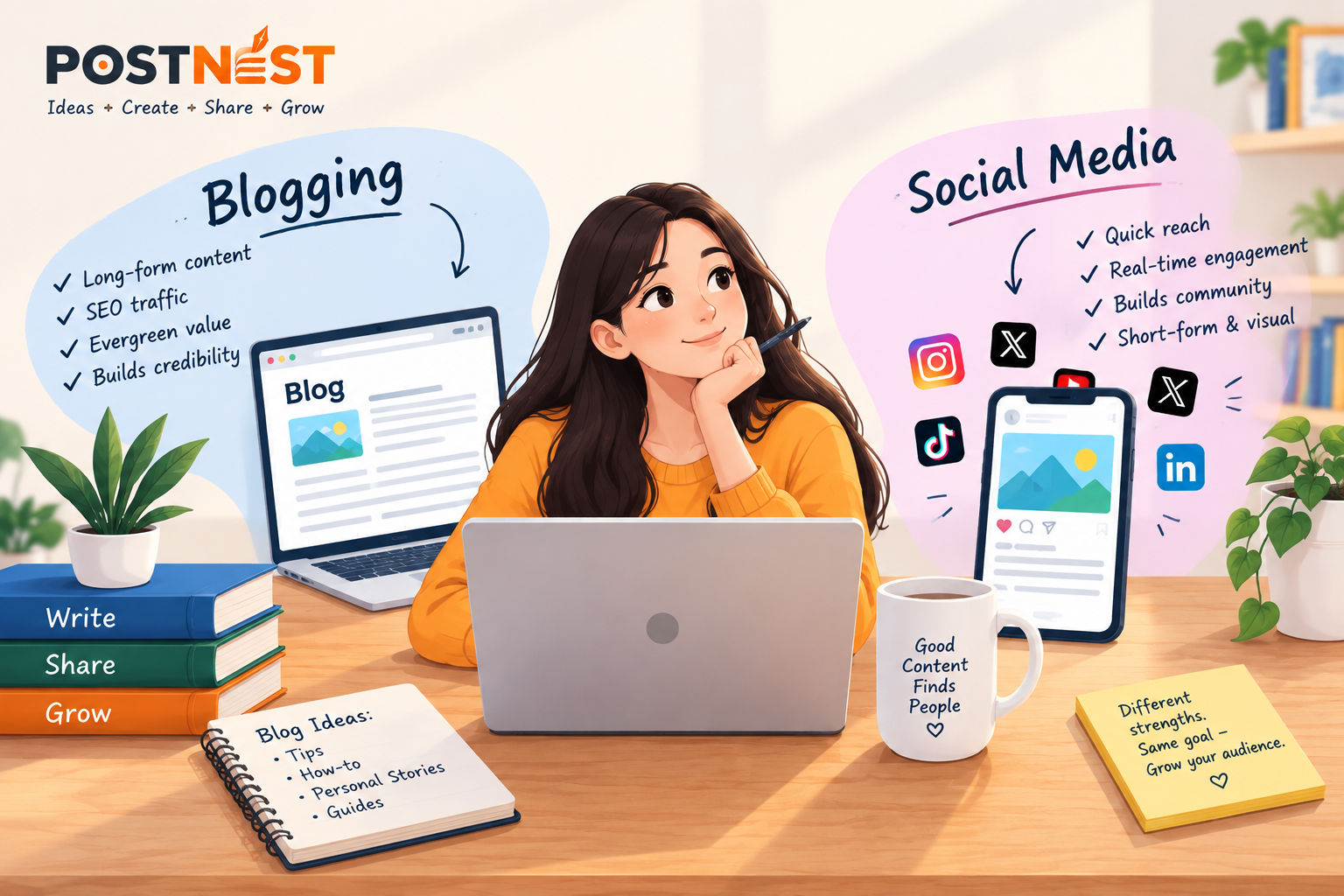
At a basic level, blogging is about creating long-form content that people can discover through search engines and other channels.
Social media is more focused on shorter, engaging content that gets distributed through a platform's feed or recommendation system.
For example, a blogger might publish an article called:
"10 Simple Ways to Improve Your Writing Skills"
Someone searching Google for writing tips could discover that article months after it was published.
On social media, you might turn the same idea into a short post:
"Want to become a better writer? Start by writing 300 words every day."
That post could reach hundreds or thousands of people quickly, but its visibility may decline as newer posts appear.
That's one of the biggest differences between the two.
The Biggest Advantage of Blogging
One of the strongest reasons to start a blog is search traffic.
A useful blog post can continue attracting visitors long after you publish it.
Imagine you write a detailed article about choosing a laptop for students. If the article starts ranking in Google, someone searching for that information six months later could still find your post.
That's called evergreen traffic.
Of course, ranking isn't guaranteed. It takes time, quality content, good SEO, and sometimes backlinks to build search visibility.
But when it works, your content can become an asset rather than something that disappears after a few hours.
Blogging also gives you more control
On your own website, you control much more of the experience.
You can decide:
What your website looks like
How your content is organized
What links you include
How you collect email subscribers
Which products or services you promote
How you monetize your traffic
That's different from building an audience entirely on a social platform.
The Biggest Advantage of Social Media
Social media has one major advantage over blogging:
It's usually much faster at getting your content in front of people.
You don't necessarily need thousands of followers to get discovered.
A good post can be recommended to people who don't follow you. If they find it useful or interesting, they might follow your account, share the post, or visit your website.
This makes social media particularly useful when you're trying to get your first audience.
For example, suppose you publish a detailed blog post about starting a freelance business.
Instead of simply waiting for Google traffic, you could create several social posts from that article:
One quick freelancing tip
A short checklist
A common mistake beginners make
A statistic from your article
A personal lesson
A question for your audience
Each post can point interested people toward the full article.
That's where blogging and social media become much more powerful together.
Blogging vs Social Media: Which One Is Better?
There isn't one answer that works for everyone.
It depends on what you're trying to accomplish.
GoalBloggingSocial MediaLong-term trafficStrongVariableQuick exposureUsually slowerStrongSEOExcellentLimitedBuilding a personal connectionGoodExcellentOwning your contentStrongLimitedContent lifespanOften longerOften shorterDirect audience interactionModerateStrongMonetization optionsManyDepends on platformBuilding a website assetExcellentNot directly
The important thing is not to think of blogging and social media as competitors.
They can work together.
Why Bloggers Should Use Social Media
Let's say you spend five hours researching and writing a high-quality blog post.
Why let that article sit on your website and wait for Google to find it?
You can distribute it.
Take one blog post and turn it into multiple pieces of social content.
For example:
Blog post:
"How to Start a Blog in 2026"
Social content:
"5 mistakes new bloggers should avoid"
"How much does it cost to start a blog?"
"3 things I wish I knew before starting my first blog"
"Blogging checklist for beginners"
"Should you start a blog if you have no audience?"
One piece of content can become an entire week's worth of social content.
This is called content repurposing, and it's one of the easiest ways to stay consistent without constantly coming up with completely new ideas.
Why Social Media Creators Should Have a Blog
The opposite is also true.
If you're already building an audience on social media, having your own website can give that audience somewhere deeper to go.
A social media post might answer one question in 200 words.
Your website can answer the same question in 2,000 words.
You can add examples, screenshots, videos, FAQs, resources, and related articles.
You can also build an email list and create a stronger relationship with your audience.
Most importantly, you're not completely dependent on one social platform.
Social media platforms can change their algorithms, features, reach, and policies.
Your website gives you an online home that you have much more control over.
What Should Beginners Start With?
If you're completely new, don't try to become an expert blogger and a full-time social media creator overnight.
You'll probably burn yourself out.
Instead, choose one primary content format and one distribution channel.
For example:
Option 1: Blog-first
Write one useful article per week and share it on social media.
Option 2: Social-first
Publish several short social posts each week and turn your best ideas into detailed blog articles.
Option 3: Content-first
Create one strong idea and repurpose it across your website and social platforms.
The third approach can be especially useful once you understand your audience.
How Long Does It Take to Build an Online Audience?
This is where many beginners become frustrated.
They publish five blog posts or ten social posts and expect thousands of followers.
Usually, it doesn't work that way.
Building an audience is a gradual process.
Your first 100 visitors may feel difficult.
Then you might reach 1,000.
Eventually, you may have articles bringing in traffic every day and social posts regularly introducing new people to your brand.
The exact timeline depends on your niche, content quality, consistency, competition, distribution, and ability to understand what your audience actually wants.
Instead of asking:
"How quickly can I get 10,000 followers?"
Try asking:
"Can I create something useful enough that 10 people want to come back?"
Then make it 100.
Then 1,000.
That's a much healthier way to think about audience growth.
Don't Just Create Content — Create a Reason to Return
Here's something that's easy to overlook.
Getting someone to discover your content is only the first step.
The bigger challenge is getting them to come back.
Think about the websites and creators you regularly follow.
You probably return because they consistently provide something valuable.
Maybe they teach you something.
Maybe they entertain you.
Maybe they help you solve a problem.
Maybe you simply like their perspective.
Your content should give people a reason to return.
That's why quality and consistency matter more than simply publishing as much as possible.
You don't need to publish three times a day if you have nothing useful to say.
One genuinely helpful article can be more valuable than ten rushed posts.
A Simple Blogging + Social Media Strategy
If I were starting from zero, I'd keep the strategy simple.
Step 1: Pick a specific audience
Don't try to create content for everyone.
Instead of:
"I write about business."
Try:
"I help new freelancers find their first online clients."
The more specific your audience is, the easier it becomes to create relevant content.
Step 2: Find real problems
Look at the questions people are asking.
Search Google.
Look at Reddit discussions.
Read comments on social media.
Pay attention to questions people repeatedly ask.
Those questions can become your content ideas.
Step 3: Create one useful article
Write the most helpful answer you can.
Don't write for search engines first.
Write for people.
Use clear headings, examples, short paragraphs, and practical advice.
Then naturally optimize the article for relevant search terms.
Step 4: Turn the article into social content
Don't simply post:
"New blog published. Read it here."
Give people a reason to care.
Share one useful takeaway from the article.
Then invite them to read the full guide if they want more.
Step 5: Repeat
Do it again.
And again.
Audience growth usually comes from a collection of useful content rather than one magical viral post.
So, Blogging or Social Media?
If your goal is to build a long-term online presence, blogging can provide a strong foundation because you own the website and can build search traffic over time.
If your goal is to reach people quickly and interact with them directly, social media can be extremely useful.
But you don't have to pick only one.
A smart approach can be:
Blog → Social Media → Website → Email/Audience
Create something valuable on your website.
Use social media to distribute the idea.
Bring interested people back to your website.
Then give them a reason to stay connected.
Over time, these channels can support each other.
Final Thoughts
The blogging vs social media debate doesn't really have to be a competition.
They're different tools for building an online audience.
Blogging helps you build a searchable library of valuable content.
Social media helps you distribute ideas, start conversations, and discover new audiences.