

What Should Factory Owners Check Before Finalising a Turnkey Project Contract
A turnkey project contract can simplify the establishment of a manufacturing facility by placing engineering, procurement, construction and commissioning responsibilities under an agreed delivery arrangement.

IMARCEngineering
Author & Contributor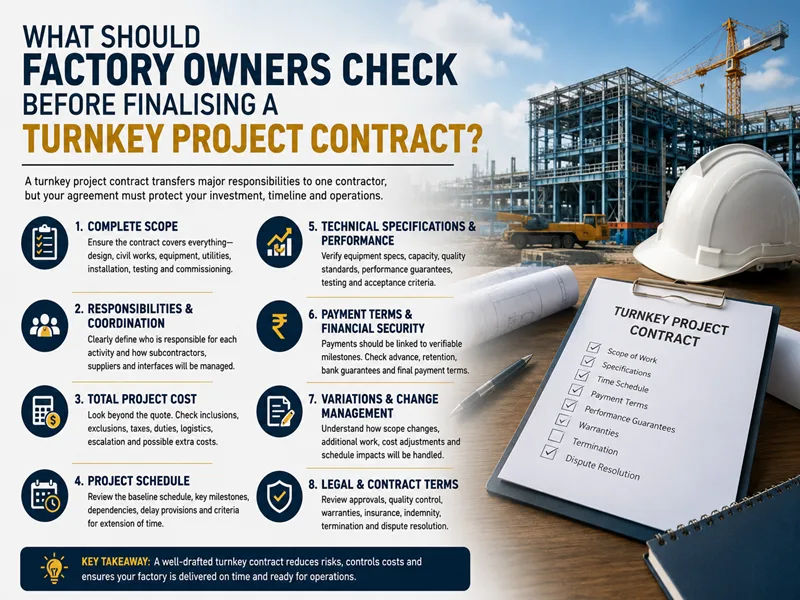
A turnkey project contract can simplify the establishment of a manufacturing facility by placing engineering, procurement, construction and commissioning responsibilities under an agreed delivery arrangement. However, appointing a single contractor does not automatically eliminate project risks. Unclear deliverables, incomplete technical specifications, underestimated costs and poorly defined responsibilities can create disputes even before the facility becomes operational.
For factory owners and manufacturing investors, the challenge is not simply finding a contractor willing to execute the entire project. It is determining whether the proposed agreement adequately covers the facility's actual requirements, establishes measurable delivery obligations and protects the investment throughout execution.
A contractor may offer an attractive price and promise timely completion, but the agreement may exclude essential utility infrastructure, equipment integration or statutory coordination. These omissions can lead to additional expenditure, conflicting responsibilities and commissioning delays.
Before signing, factory owners should therefore evaluate the contract from four perspectives: technical completeness, commercial transparency, execution accountability and operational readiness.
Verify Whether the Contract Covers the Complete Project Scope
The first step is to establish exactly what the contractor has agreed to deliver. The term turnkey is not sufficient to define contractual responsibility. One contractor may include building construction, machinery procurement and commissioning, while another may exclude external utilities, specialised installations or approval-related activities.
Factory owners should compare the proposed scope against the actual requirements of their manufacturing operations.
Important areas to examine include:
Engineering and design: Process layouts, architectural drawings, structural designs, electrical plans and mechanical engineering.
Civil construction: Site development, foundations, industrial flooring, buildings and structural installations.
Equipment procurement: Machinery specifications, supplier selection, transportation and delivery.
Utilities: Power distribution, water supply, compressed air, HVAC, fire protection and effluent treatment, wherever required.
Installation and integration: Equipment erection, piping, electrical connections and integration between production systems.
Testing and commissioning: Equipment inspections, operational trials, performance verification and final handover.
Consider a manufacturer establishing a new production facility. The contractor's proposal may include the factory building and machinery installation but exclude the electrical substation, compressed air distribution and wastewater treatment infrastructure. These systems may subsequently require separate procurement and additional construction activities.
To prevent such gaps, the agreement should contain a detailed Scope of Work (SOW), Bill of Quantities (BOQ), approved drawings, equipment schedules, deliverable lists and explicit exclusions. Every major system should have a clearly defined responsibility and completion requirement.
Examine Contractor Responsibilities and Coordination Arrangements
A turnkey contractor may engage several subcontractors and specialist suppliers to execute different parts of an industrial project. However, factory owners should not assume that appointing one primary contractor automatically resolves every coordination issue.
The agreement must clarify who remains accountable for integrating the different project components.
For example, civil construction may be completed by one subcontractor, electrical installations by another and production machinery supplied by a separate equipment manufacturer. If machinery foundations do not match approved equipment drawings, the owner needs to know which party is responsible for correcting the discrepancy.
Before signing, verify:
Who has overall responsibility for project execution?
Who coordinates engineering, procurement and construction?
Who approves and controls subcontractor activities?
Who resolves technical conflicts between different engineering disciplines?
Who manages equipment suppliers and delivery schedules?
Who is responsible for correcting design and installation discrepancies?
Who maintains project records and reports progress?
A responsibility matrix can help distinguish between the party performing an activity, the party approving it and the party accountable for its completion. This is particularly important for interfaces involving civil, mechanical, electrical and utility systems.
Evaluate the Total Project Cost Instead of Comparing Only Quotations
A lower initial quotation does not necessarily represent a lower final investment. Differences in project scope, equipment specifications, exclusions and commercial assumptions can make contractor quotations difficult to compare.
Factory owners should examine whether the proposed price covers the complete cost of delivering the required facility.
The financial assessment should include:
Cost areaWhat to examineEngineeringDesign development, revisions and technical documentationConstructionCivil works, structures, flooring and building developmentMachineryEquipment prices, transportation and installationUtilitiesElectrical infrastructure, water systems and other servicesCommissioningTesting, trial operations and technical supportStatutory requirementsApplicable fees and approval-related responsibilitiesLogisticsUnloading, storage, handling and transportationTaxesGST treatment and applicable dutiesAdditional workProvisional sums, contingencies and variation costs
The owner should also determine whether the contract price is fixed or subject to adjustments. Escalation provisions, changes in material prices, additional quantities and changes in technical specifications should have clearly documented treatment.
For Indian industrial projects, GST classification deserves particular attention. Section 2(119) of the Central Goods and Services Tax Act, 2017 defines a works contract in relation to specified activities involving immovable property and transfer of property in goods. The applicable tax treatment should be reviewed according to the actual contractual structure rather than assuming every turnkey arrangement receives identical treatment.
Check Whether the Project Schedule Defines Actual Completion
A promised completion date is meaningful only when the contract explains what must be achieved by that date.
Completion of civil construction does not necessarily mean that the factory is ready for production. Machinery may still require installation, electrical systems may need integration and utility infrastructure may remain incomplete.
Factory owners should review whether the baseline schedule includes:
Engineering development and drawing approvals.
Procurement and equipment manufacturing.
Equipment delivery and site readiness.
Civil construction and infrastructure development.
Machinery installation and utility connections.
Integrated testing and commissioning.
Final documentation and operational handover.
The agreement should establish measurable milestones, dependencies and reporting requirements. It should also define how delays are assessed and when extensions of time may be permitted.
For instance, delays caused by late owner approvals should be distinguished from delays caused by inadequate contractor resources or procurement failures. The contract should specify notification requirements, supporting evidence and procedures for evaluating time extensions.
Without these provisions, disagreements may arise over whether a delay was avoidable, who caused it and whether contractual delay damages apply.
Establish Technical Specifications and Performance Guarantees
One of the most important considerations for a manufacturing investor is whether the completed facility can achieve its intended production requirements.
An equipment list alone cannot establish this. Factory owners should examine the technical performance of individual machines as well as the integrated production system.
Relevant parameters may include:
Production capacity per hour, shift or day.
Product quality and output specifications.
Equipment operating speed and efficiency.
Power and utility consumption.
Material handling and production flow.
Compatibility between connected equipment.
Safety requirements and operating conditions.
Reliability, maintainability and availability expectations.
For example, a production line may contain machinery that individually meets the approved specifications but still fail to achieve the intended output because material handling, equipment sequencing or utility capacity has not been adequately coordinated.
The contract should therefore define measurable acceptance criteria, testing conditions, performance guarantees and remedies for failure.
It should also identify whether Factory Acceptance Tests (FAT), Site Acceptance Tests (SAT), integrated performance trials or other inspections are required. Responsibility for rectification and repeat testing should be clearly documented.
Review Payment Milestones and Financial Security
Payment conditions should reflect verified project progress rather than general assurances that activities are underway.
An owner who releases substantial payments before confirming procurement, construction or installation progress may face unnecessary financial exposure if the contractor fails to meet its obligations.
A practical payment structure can connect releases to documented milestones, such as approved engineering deliverables, verified equipment procurement, certified construction progress, installation completion and successful commissioning.
Before signing, examine:
Advance payment requirements and their purpose.
Advance payment guarantees, where applicable.
Performance bank guarantees and their validity.
Documentation required for payment certification.
Retention money and its release conditions.
Procedures for disputed invoices.
Final payment conditions and outstanding obligations.
The amount and timing of each payment should reflect the project's commercial structure and risk allocation. Factory owners should also verify the issuing bank, guarantee wording, expiry date and claim requirements rather than relying solely on the existence of a security instrument.
7. Understand Exclusions and Procedures for Scope Changes
Industrial projects frequently undergo changes after execution begins. Production capacity may be revised, equipment specifications may change or additional utility requirements may emerge following detailed engineering.
Such changes can affect procurement, construction costs and project schedules.
The agreement should explain how these variations will be evaluated and approved.
Factory owners should establish:
Who can request a scope change?
Who has authority to approve additional work?
How will revised costs be calculated?
How will the change affect completion milestones?
Are updated drawings and specifications mandatory?
Can additional work proceed without written approval?
A formal change-order procedure should document the revised scope, commercial impact, schedule implications and approval authority before additional work proceeds, except under agreed emergency arrangements.
This is especially important where the original contract contains broad exclusions or provisional work allowances.
Clarify Statutory Approval and Compliance Responsibilities
Regulatory requirements should be considered during project planning rather than addressed only when construction is nearing completion.
Depending on the manufacturing process, location and applicable regulations, an industrial facility may require environmental permissions, Consent to Establish, Consent to Operate, factory-related approvals, fire safety clearances, electrical approvals or specialised permissions such as PESO authorisations.
The contract should identify which activities the contractor will undertake and which remain the owner's responsibility.
For each applicable approval, clarify who prepares technical documents, coordinates applications, responds to observations, pays fees and tracks compliance conditions.
Importantly, assigning approval-related work to a contractor does not automatically transfer the owner's statutory obligations. The legal responsibilities of the relevant entity must be independently established.
Examine Quality Control, Inspection and Handover Conditions
The agreement should define how construction quality and equipment installation will be inspected throughout execution.
Factory owners should check whether the contractor has committed to an appropriate quality assurance and quality control plan, Inspection and Test Plans (ITPs), material verification, inspection records and non-conformance reporting.
Acceptance should also be based on defined evidence rather than a general declaration that the work is complete.
Before final handover, the owner should receive relevant as-built drawings, equipment manuals, warranties, inspection certificates, commissioning records, operating procedures, maintenance information and outstanding-work registers.
The agreement should distinguish mechanical completion, successful commissioning and final contractual acceptance. These stages should have separate verification requirements wherever appropriate.
Check Warranty, Defect Rectification and Termination Provisions
A completed facility may develop equipment, installation or workmanship problems after handover. The agreement should specify how such defects will be addressed.
Review the defects liability period, warranty coverage, response times, rectification obligations, replacement responsibilities and post-commissioning support.
Also examine what happens if the contractor materially breaches the agreement, repeatedly misses milestones or becomes unable to continue the project.
Termination clauses should address default notices, opportunities to rectify breaches, settlement of completed work, ownership of procured equipment, access to drawings and documents, and arrangements for completing unfinished activities.
Dispute resolution provisions should identify the governing law and the agreed mechanism for resolving contractual disagreements. For Indian projects, the Indian Contract Act, 1872 and the Arbitration and Conciliation Act, 1996 are relevant legal references. Section 73 and Section 74 of the Contract Act address compensation for breach and stipulated compensation respectively. An arbitration agreement should be examined for compliance with Section 7 of the Arbitration and Conciliation Act.
A Practical Pre-Signing Review for Factory Owners
Before executing the agreement, the project owner should bring the technical, commercial and legal reviews together.
The following checklist can help identify unresolved issues:
Complete scope, deliverables and exclusions have been documented.
Contractor and subcontractor responsibilities are clearly allocated.
Technical drawings and equipment specifications are approved.
Total project cost and potential additional expenses are understood.
Project milestones and completion requirements are measurable.
Performance guarantees and testing procedures are defined.
Payment releases are linked to verifiable deliverables.
Advance payment and performance security arrangements are reviewed.
Variation and change-order procedures are documented.
Statutory approval responsibilities are identified.
Inspection, quality control and acceptance requirements are established.
Warranty, defects liability and post-handover support are clarified.
Insurance, indemnity, termination and dispute resolution clauses are reviewed.
If important items remain unresolved, the owner should seek clarification and revise the agreement before signing rather than relying on informal assurances during execution.
How IMARC Engineering Can Help
IMARC Engineering supports manufacturing investors and factory owners in evaluating industrial project requirements before execution commitments are finalised. Its turnkey project management support can help review project scope, engineering proposals, equipment specifications, contractor responsibilities, cost estimates and execution schedules. By examining technical interfaces, utility requirements, statutory considerations and commissioning expectations, the team can help identify potential gaps that may affect project delivery. This provides owners with a more structured basis for contractor evaluation, project planning and execution oversight.
Connect with an expert: https://www.imarcengineering.com/contact?service=turnkey-project-management
Conclusion
Finalising a turnkey project contract requires more than comparing contractor quotations or agreeing on a completion date. Factory owners must establish what will be delivered, how performance will be verified, who is accountable for each activity and how additional costs or delays will be handled. A thorough technical, commercial and legal review before signing can help prevent avoidable disputes and protect the manufacturing investment. The objective should be a contract that supports delivery of a complete, integrated and operationally ready facility.
Frequently Asked Questions
1. What is the most important clause in a turnkey project contract?
The Scope of Work is fundamental because it defines the contractor's deliverables, exclusions and responsibilities. However, it must be supported by clear technical specifications, payment conditions, performance requirements and acceptance procedures.
2. Can a turnkey contractor charge additional costs after signing the contract?
Additional charges may arise where the agreement permits variations, price adjustments or payment for excluded work. Factory owners should examine these provisions and require documented approval of changes before additional work proceeds.
3. Should project payments be linked to construction milestones?
Yes. Payments linked to verifiable engineering, procurement, construction, installation and commissioning milestones provide better visibility over project progress and reduce premature financial exposure.
4. Who is responsible for statutory approvals in a turnkey project?
Responsibility depends on applicable law and the contractual arrangement. The agreement should identify the contractor's assistance and execution obligations while clearly recognising statutory responsibilities that remain with the factory owner or relevant project entity.
5. Why should factory owners review commissioning requirements before signing?
Commissioning requirements establish how equipment and integrated systems will be tested before acceptance. Defining these requirements early helps prevent disagreements over production capacity, equipment performance and final project completion.
Contact Us:
IMARC Engineering
Phone: +917827860593
Email: sales@imarcengineering.com
India: C-130, Sector 2, Noida, Uttar Pradesh 201301
LinkedIn: https://www.linkedin.com/showcase/imarc-engineering/
