
What Happens When a Storyboard Becomes the First Frame of an AI Video?
The same coastal shot generated from a three-panel storyboard and a single start frame, with a close look at what happened to the action and framing.

john smith
Author & Contributor
A woman is sitting on a bench above the coast with a sketchbook open on her lap. The shot needs her to close it, stand, turn and walk away. An open book at the start and a closed one at the end would still leave an important question unanswered. Did she actually close it on camera?
That is the difference between checking poses and checking an action. A storyboard is good at showing where the actor should be at different points in the scene. A continuous clip also needs the movements that connect those positions. The sketchbook makes this easy to inspect because its state and location should change in a clear order.
Give the same shot two different starts
The storyboard showed three moments side by side: seated with the sketchbook open, rising with it closed, and walking with it under an arm. The other input was a single wide image based on the first panel. It showed the same character, bench and coastline, with space to walk toward the right edge of the frame. The wide image was an edited expansion of that panel, so the two inputs differed slightly in framing as well as layout.
I submitted both images in the Image to Video workspace on Kling 3.0. Each went into the Start Frame field. The End Frame field stayed empty in both runs. I used Standard mode, a five-second duration and no generated sound. Each run used the same prompt.
One continuous locked-off wide shot, no cuts or panel borders. A woman in a rust orange jacket sits on a wooden bench at a coastal overlook with an open sketchbook on her lap. She closes the sketchbook fully with both hands while seated, rises holding the closed sketchbook, turns toward screen right, then takes two clear steps along the path with it tucked under her arm. Keep the same woman, clothing, bench, and coastline. Show her hands and the book throughout the closing action. Start seated and end walking. Natural motion, no speech.
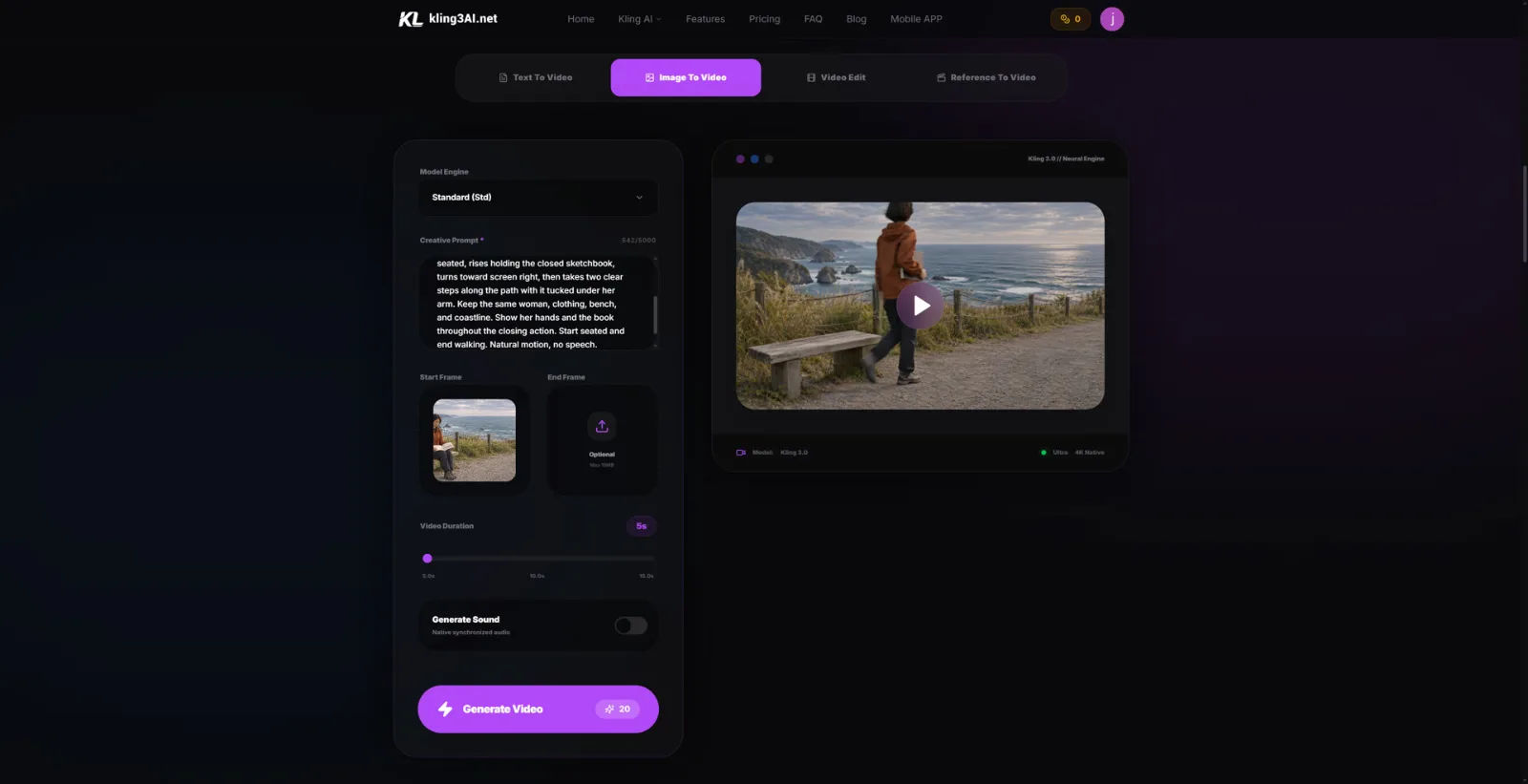
Uploading the storyboard to a Start Frame field is a specific choice. The three drawings go in as one image, with all three poses visible together. A dedicated storyboard or multi-shot mode would be a different workflow. Here, the useful comparison is what two different starting images ask the same image-to-video mode to do.
The storyboard moved, but the panels came with it
Both outputs were 1280 × 720 and about five seconds long. In the storyboard version, the opening showed the seated, rising and walking versions of the woman at the same time. The poses moved within the composite. Later, as the divisions faded, two walking figures were still visible. The shot therefore failed the requirement for one woman in one continuous view, even though there was plenty of motion.
The storyboard contained the right events, but it placed them next to one another in space. The generator carried that arrangement into the first part of the clip. If I had judged the output solely on whether someone was walking by the end, I would have missed the bigger problem. The person on the bench and the person already walking were visible at the same time.
The single image kept one subject and showed the book closing
I got a shot with one woman seated on the left. Around the first second, the open sketchbook starts to fold. She closes it and lifts it from her lap, then turns toward the path, rises in the second half of the clip and starts walking to the right near the end.
The side-by-side frame at about 1.5 seconds shows the difference in layout while the woman is still seated in the single-frame version. In the storyboard version, the seated and standing figures already share the screen.

About 1.5 seconds in. Storyboard version on the left, single-frame version on the right.
The departure starts too late for two clear steps to play out, and her head crosses the top edge as she stands. The right side of the start frame looks generous because the path is open. That space serves the walk. For the rise, I needed to judge the framing against the height of the standing figure. On a new reference, I would check where the top of her head would land before committing to the camera position.

About 4.8 seconds into the single-frame version, she has started walking and the top of her head is cropped by the frame.
Check the transition that makes the action believable
For a shot like this, start by writing down the state of the prop at three moments. The sketchbook should start open on the lap, close visibly while the actor is seated and stay closed as she gets up. Then check that the same actor carries it away. Looking at the transition between those moments is what separates a completed action from a plausible end pose.
Review the shot once for the overall sequence, then step through the moment when the hands meet the book. If the book changes state between frames without a visible closing movement, that part of the shot needs attention even if the ending looks right. Check the wider frame too. The top of the image has to accommodate the standing figure, and the right side needs enough space for the number of steps the shot calls for.
For another pass, I would keep the headroom check and give the exit more time. If the close and the exit still felt rushed, I would hold the camera on the bench long enough to show the book closing, then give the walk its own shot. This comparison includes one output per input and a small framing difference between the inputs, so it cannot establish how often either behavior occurs.