SQLite vs MySQL
Compare SQLite vs MySQL, including performance, scalability, security, setup, and use cases. Find out which database is best for your next project.

Tanvi Ladva
Author & Contributor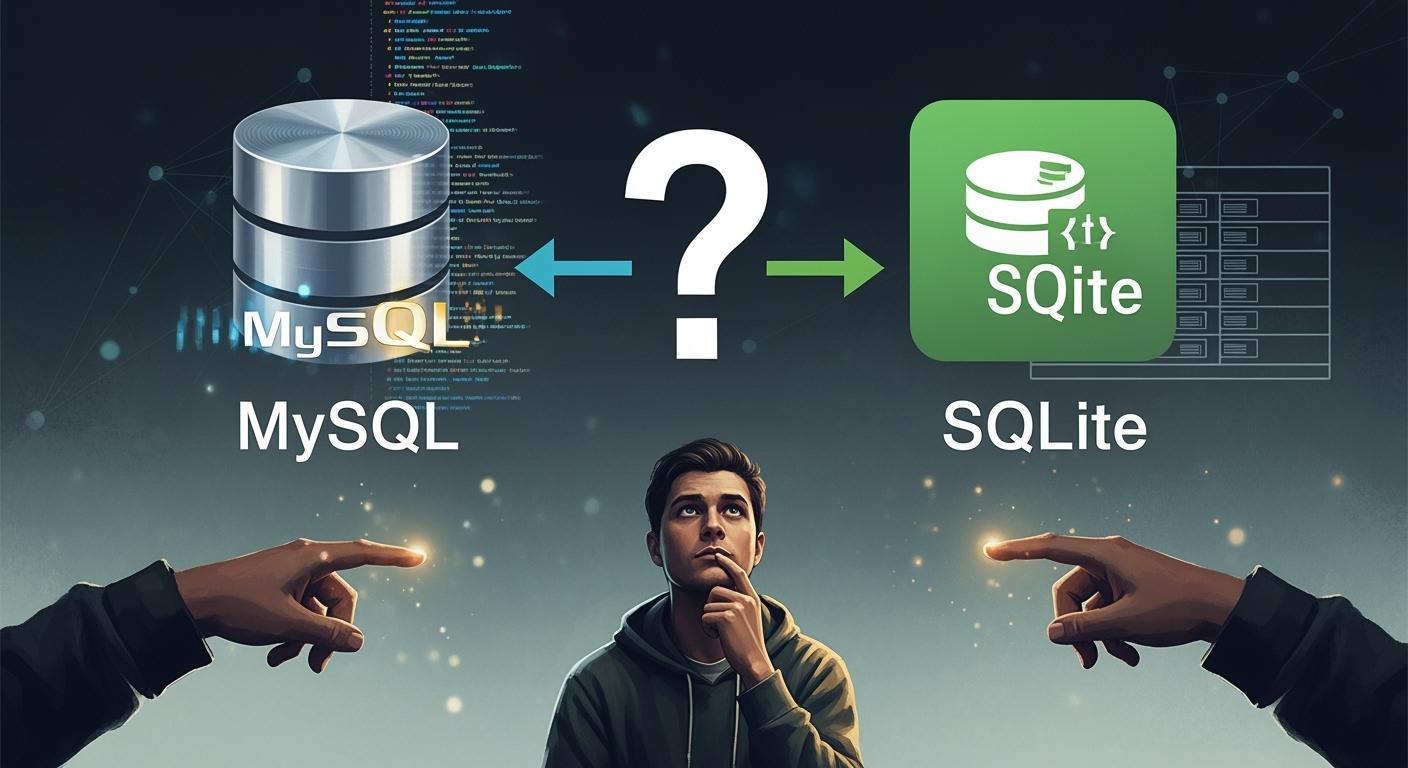
SQLite vs MySQL: Which Database Should You Choose for Your Next Project?
Choosing the right database is one of the most important decisions when building a web application. Whether you're developing a personal project, a blogging platform, an e-commerce website, or a large business application, your database plays an important role in storing, managing, and retrieving information.
Two popular database management systems developers frequently compare are SQLite and MySQL.
Both databases are widely used, reliable, and have their own advantages. However, they are designed for different use cases. SQLite is known for its simplicity and lightweight architecture, while MySQL is popular for handling larger applications and multiple users.
In this guide, we'll explore SQLite vs MySQL, compare their features, understand their differences, and help you decide which database is suitable for your next development project.
What Is SQLite?
SQLite is a lightweight, serverless relational database management system. Unlike traditional database systems, SQLite doesn't require a separate database server to operate.
It stores the entire database in a single file, making it easy to integrate into applications without managing additional infrastructure.
SQLite is commonly used in:
Mobile applications
Desktop software
Small web applications
Personal projects
Embedded systems
Applications that require local data storage
One of the biggest advantages of SQLite is its simplicity. Developers can start working with it without setting up a database server or managing complex configurations.
What Is MySQL?
MySQL is an open-source relational database management system that uses SQL (Structured Query Language) to manage and organize data.
Unlike SQLite, MySQL follows a client-server architecture. It runs as a separate database server, allowing multiple applications and users to connect to it.
MySQL is commonly used in:
E-commerce websites
Blogging platforms
Enterprise applications
Content management systems
Social networking platforms
Applications with multiple concurrent users
MySQL provides features for managing large datasets, user permissions, database connections, and complex application requirements.
SQLite vs MySQL: Key Differences
Let's compare SQLite and MySQL across some important factors.
FeatureSQLiteMySQLArchitectureServerlessClient-serverInstallationMinimal setupRequires server setupStorageSingle database fileManaged database storageConcurrent accessLimited write concurrencySupports multiple concurrent connectionsScalabilityBest for smaller workloadsSuitable for larger applicationsAdministrationVery simpleRequires database administrationNetwork accessNot built inSupportedBest use caseLocal and embedded applicationsWeb and enterprise applications
1. Performance
Performance is an important consideration when choosing a database.
SQLite offers excellent performance for local applications and workloads that involve frequent reads and relatively simple database operations. Since it doesn't communicate with a separate database server, it can reduce overhead for certain operations.
MySQL performs well in applications that require multiple connections, concurrent operations, and centralized database management.
However, actual performance depends on several factors, including database design, indexing, queries, hardware, and workload.
Winner: SQLite for lightweight local applications; MySQL for many multi-user web application workloads.
2. Scalability
SQLite is designed primarily for applications that don't require heavy concurrent writes or centralized database access.
For example, a small application storing user preferences or offline data can work perfectly well with SQLite.
MySQL is generally a better choice when an application needs to support multiple users, handle growing datasets, and serve requests from different application servers.
It also provides features that help developers manage larger database environments.
Winner: MySQL for larger multi-user applications.
3. Ease of Installation and Setup
SQLite is extremely easy to get started with. Developers don't need to install and configure a separate database server. They can create a database file and start executing SQL queries.
MySQL requires additional setup, including installing the database server, configuring users, managing connections, and setting up permissions.
For beginners learning SQL, SQLite can be a convenient starting point.
Winner: SQLite.
4. Security
Both SQLite and MySQL can be used securely when implemented correctly.
SQLite relies heavily on operating-system file permissions and application-level security. Anyone who can access the database file may potentially access its contents.
MySQL provides built-in authentication, user management, privileges, and network security configurations.
For applications where multiple users and services need controlled access to the database, MySQL provides more centralized security management.
Winner: MySQL for centralized access control and multi-user environments.
5. Database Management
SQLite requires very little administration. Developers can manage the database directly through the application or database management tools.
MySQL offers more advanced database management capabilities, including user administration, backup strategies, monitoring, replication, and server configuration.
This makes MySQL useful for applications that require more control over database infrastructure.
Winner: SQLite for simplicity; MySQL for advanced administration.
SQLite vs MySQL: Which One Is Better for Web Development?
The answer depends on the type of web application you're building.
Consider SQLite if you're developing:
A small personal website
A prototype or MVP
A local-first application
A simple application with limited write concurrency
A lightweight project without separate database infrastructure
Consider MySQL if you're developing:
A multi-user blogging platform
An e-commerce website
A social networking application
A business management system
A web application with multiple concurrent users
For production web applications, the decision should also consider hosting, backup requirements, expected traffic, database operations, and future development plans.
Can You Use SQLite and MySQL With Node.js?
Yes! Both databases can be integrated into Node.js applications.
For SQLite, developers commonly use libraries such as:
better-sqlite3
sqlite3
Prisma ORM
For MySQL, developers can use:
mysql2
Sequelize
Prisma ORM
TypeORM
These tools help developers interact with databases using JavaScript or TypeScript.
For example, Prisma provides an ORM that supports both SQLite and MySQL, allowing developers to work with database models through a consistent development experience.
SQLite vs MySQL: Which Should Beginners Learn First?
If you're new to backend development, SQLite is a good place to start.
It allows you to understand important database concepts such as:
Tables and relationships
Primary keys and foreign keys
SQL queries
Data insertion and retrieval
Database operations
After understanding these fundamentals, learning MySQL can help you understand server-based database management and build more complex applications.
However, if your immediate goal is to become a backend developer, learning MySQL directly is also a practical choice.
Final Verdict: SQLite or MySQL?
SQLite and MySQL are both valuable database technologies, but they solve slightly different problems.
SQLite is an excellent option when simplicity, portability, and lightweight database management are priorities.
MySQL is a strong choice for web applications that need centralized data management, multiple concurrent users, and advanced database administration.
There isn't one database that is always better. The right choice depends on your application's requirements, expected workload, and long-term goals.
The best approach is to understand both databases and choose the one that fits your project.
Keep Learning and Sharing Your Development Knowledge With PostNest
Learning database technologies becomes easier when developers share their experiences, tutorials, and practical knowledge.
If you've worked with SQLite, MySQL, Node.js, or other backend technologies, you can publish your technical articles for free on PostNest.
PostNest gives developers, bloggers, and content creators a platform to publish articles, share technical knowledge, and reach readers without needing to purchase their own domain or hosting.
Start writing, share what you learn, and build your online presence with PostNest.
Frequently Asked Questions (FAQs)
1. Is SQLite better than MySQL?
SQLite is better for lightweight, local, and embedded applications. MySQL is generally more suitable for larger web applications requiring multiple concurrent connections and centralized database management.
2. Is SQLite suitable for production websites?
Yes. SQLite can power production websites, especially when workloads are relatively small and write concurrency is limited. However, applications with heavy concurrent writes may benefit from a server-based database.
3. Is MySQL harder to learn than SQLite?
MySQL involves additional server configuration and administration, so it may initially feel more complex. However, both databases use SQL, and the fundamental concepts are transferable.
4. Can SQLite handle multiple users?
Yes. Multiple users or processes can access an SQLite database, particularly for reading. However, SQLite allows only one writer at a time per database file, which can become a limitation for write-heavy applications.
5. Can I migrate from SQLite to MySQL?
Yes. Developers can migrate data from SQLite to MySQL, but they may need to adjust data types, schema definitions, SQL queries, and database-specific configurations.
6. Should I use SQLite or MySQL with Node.js?
For small applications and prototypes, SQLite is a convenient option. For multi-user applications with centralized database requirements, MySQL is often a better choice. Your application's workload should guide the decision.