Inside the 2023 MOVEit Cyberattack: How a Zero-Day Vulnerability Led to a Global Data Breach
The 2023 MOVEit cyberattack exploited a zero-day vulnerability to steal sensitive data from thousands of organizations worldwide. The incident highlighted the importance of software security, vulnerability management, and proactive cybersecurity protection.

uma rajput
Author & Contributor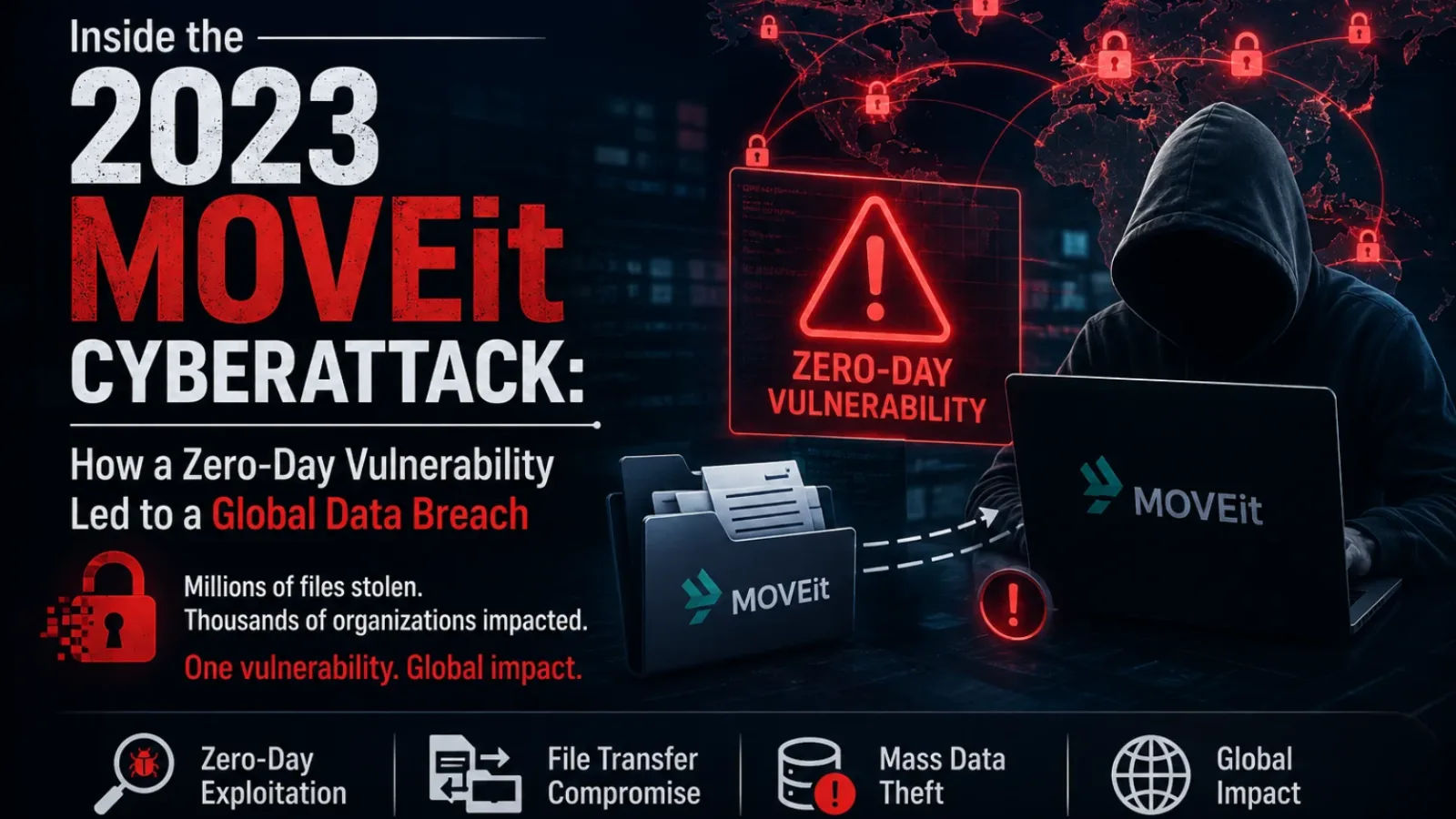
Introduction
Imagine an organization using a trusted file-sharing platform to exchange confidential customer records, employee information, and financial documents. The platform is designed to protect sensitive data, but a previously unknown software vulnerability allows cybercriminals to access information stored within it.
This scenario became reality in May 2023 when attackers exploited a zero-day vulnerability in Progress Software's MOVEit Transfer platform.
The incident was associated with the Cl0p cybercrime group and affected organizations across multiple industries. Rather than focusing primarily on encrypting computer systems, the attackers concentrated on stealing confidential information and using it for extortion.
The MOVEit incident highlights an important cybersecurity lesson: even organizations with established security programs can face serious risks when critical third-party software contains an exploitable vulnerability.
1. Understanding the MOVEit Transfer Platform
MOVEit Transfer is an enterprise managed file transfer solution developed by Progress Software.
Organizations use it to exchange sensitive files securely between internal departments, customers, suppliers, and external business partners.
Common applications include:
Sharing employee payroll information.
Transferring healthcare-related documents.
Exchanging financial records.
Managing government documents.
Sharing confidential business information.
Because file-transfer platforms frequently process sensitive information, their security is essential.
A vulnerability in such a platform can potentially expose information belonging to multiple organizations and their customers.
2. The Security Weakness Behind the Attack
The main vulnerability exploited during the campaign was CVE-2023-34362.
It was a critical SQL injection vulnerability affecting MOVEit Transfer.
SQL injection happens when an application improperly handles untrusted input, allowing an attacker to manipulate database queries.
In the MOVEit incident, attackers exploited this weakness through the web application to access underlying database information.
The vulnerability was particularly dangerous because attackers were exploiting it before Progress Software publicly disclosed it and released a security update.
This made it a zero-day vulnerability during the initial exploitation period.
Progress Software disclosed the vulnerability on May 31, 2023.
3. How the Attackers Compromised MOVEit Systems
The campaign involved multiple technical stages.
Step 1: Targeting exposed servers
Attackers identified internet-facing MOVEit Transfer installations that were vulnerable to the SQL injection flaw.
Internet-accessible enterprise applications can become attractive targets because attackers may reach them without first compromising an employee's computer.
Step 2: Exploiting the vulnerability
The attackers exploited CVE-2023-34362 to interact with the application's database without authorization.
This provided a path to compromise vulnerable MOVEit Transfer environments.
Step 3: Installing a malicious web shell
Investigators identified a malicious web shell called LEMURLOOT.
A web shell is a malicious server-side component that allows an attacker to interact with a compromised web application.
LEMURLOOT was specifically designed to target MOVEit Transfer.
According to the FBI and CISA advisory, it could retrieve system settings, enumerate database information, interact with user accounts, and download files.
Some versions used filenames resembling legitimate MOVEit application components to make detection more difficult.
Step 4: Accessing and stealing information
After compromising vulnerable systems, attackers used the web shell to identify and retrieve files stored in MOVEit environments.
Mandiant reported that some investigated incidents involved data theft within minutes of web shell deployment.
This demonstrates how quickly an organization can lose sensitive information after an internet-facing application is compromised.
Step 5: Extortion using stolen information
The Cl0p group claimed responsibility for the campaign on June 6, 2023.
The attackers threatened to publish stolen information unless affected organizations engaged with them.
This approach is known as data-theft extortion.
Unlike traditional ransomware operations that primarily encrypt files, this campaign focused heavily on stealing information and using the threat of disclosure as leverage.
4. Why Did the Incident Affect So Many Organizations?
The MOVEit incident was more than an isolated software compromise.
It demonstrated how a single vulnerable enterprise platform can create risks across an interconnected business ecosystem.
Several factors contributed to the scale of the campaign.
Centralized sensitive information: Managed file-transfer platforms often store or process confidential information from multiple departments and business partners.
Internet exposure: Publicly accessible applications can be discovered and targeted by attackers.
Third-party dependencies: Organizations may rely on the same software platform even when they have completely separate IT environments.
Delayed patching: Organizations need time to identify affected systems, assess exposure, test security updates, and deploy patches.
Data-theft extortion: Stolen information can create serious consequences even when attackers do not encrypt the victim's entire network.
The incident reinforced the need for organizations to assess the security of the software they depend on, not just their internal infrastructure.
5. How Organizations Can Detect Similar Attacks
Security teams should monitor critical file-transfer systems for unusual activity.
Important investigation areas include:
Web server monitoring
Look for unexpected server-side files, suspicious HTTP requests, and unauthorized modifications to application directories.
Authentication monitoring
Investigate unexpected administrative account creation, privilege changes, and unusual access to file-transfer services.
Database activity
Review unusual database queries, unexpected data access patterns, and abnormal file retrieval activity.
File-transfer monitoring
Identify unusual download volumes, unexpected access to sensitive folders, and transfers occurring outside normal business patterns.
Threat intelligence
Use trusted security advisories and indicators of compromise to identify known malicious activity.
Organizations should use indicators from official advisories as part of a broader investigation rather than treating one indicator as definitive proof of compromise.
6. Important Security Lessons for Businesses
The MOVEit incident provides several practical lessons.
1. Maintain an accurate software inventory
Organizations should know which applications are internet-facing, which versions they run, and what sensitive information they process.
2. Prioritize critical security patches
Security teams should have an emergency patch-management process for actively exploited vulnerabilities.
3. Reduce unnecessary internet exposure
Administrative interfaces and sensitive services should not be publicly accessible unless there is a clear business requirement.
4. Apply network segmentation
Critical file-transfer systems should be isolated appropriately to reduce the potential impact of a compromise.
5. Monitor sensitive data access
Organizations should maintain detailed logs and investigate unusual access or large-scale file downloads.
6. Strengthen incident response
Incident response plans should include procedures for isolating affected servers, preserving evidence, identifying exposed data, and notifying relevant stakeholders.
7. Evaluate third-party software risks
Businesses should assess the security practices of vendors whose software processes confidential information.
7. What Cybersecurity Students Can Learn from This Incident
The MOVEit incident provides an excellent learning opportunity for students interested in ethical hacking, application security, and security operations.
Students can explore the following topics in authorized lab environments:
SQL injection and secure database queries.
Web application vulnerability assessment.
Web shell detection and analysis.
HTTP request and server-log investigation.
File integrity monitoring.
Vulnerability management.
Incident response and digital forensics.
A useful practical exercise is to build a small test web application, review its database interactions, and learn how parameterized queries prevent SQL injection.
Students can also practice identifying suspicious web-server activity using sample logs.
All practical security testing should take place in systems owned by the learner or environments where explicit authorization has been granted.
8. Conclusion
The 2023 MOVEit cyberattack demonstrated how a single zero-day vulnerability in widely used enterprise software can expose sensitive information on a global scale.
The Cl0p campaign showed that cybercriminals do not always need to encrypt an organization's entire network to cause serious damage. Access to confidential files can be enough to create financial, legal, operational, and reputational consequences.
For businesses, the incident highlights the importance of software inventory management, rapid patching, application monitoring, data protection, and third-party risk management.
For cybersecurity students and professionals, it provides a valuable real-world example of how application vulnerabilities can be exploited and how defensive teams can respond.
The most important lesson is that cybersecurity must be continuous. Organizations need to identify weaknesses before attackers discover them and maintain the ability to detect, contain, and recover from security incidents.
About Cyber Security Training Institute
Develop your knowledge of cybersecurity, ethical hacking, network security, and vulnerability assessment through structured learning and practical exercises.
Visit https://www.cybersecurityinstitute.in/ to explore cybersecurity learning resources.