How Large Is the Real Opportunity for Smart Factories? Assessing Readiness, ROI, and Technology Adoption
The World Economic Forum's Global Lighthouse Network provides evidence of what coordinated investment can achieve. In July 2026, the Forum reported that the network had expanded to 238 factories. Generative AI accounted for 23% of the leading solutions reported in 2025, reflecting growing interest in applications that support complex industrial decisions. These factories represent advanced adopters, so their results should be treated as evidence of potential rather than typical industry performance. The distinction between technology interest and purchase readiness remains important. A plant may want predictive maintenance but lack reliable equipment data. Another may have connected machinery but no integration between production and maintenance systems. Each situation represents a different market opportunity, implementation cost and sales cycle.

vishakha dewatwal
Author & Contributor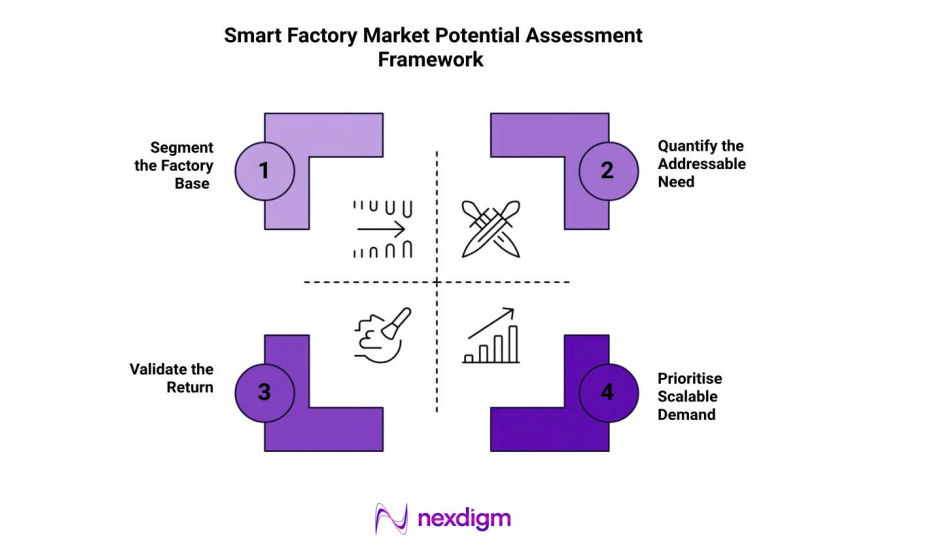
Smart Factory Potential Is Larger Than the Equipment Market
The commercial opportunity for smart factories extends beyond industrial robots and automated production lines. It includes sensors, industrial connectivity, manufacturing software, analytics, AI, systems integration and services that help factories turn operational data into better decisions. However, the addressable market is not equivalent to the value of every technology that could theoretically be installed in a factory. It depends on which facilities are ready to invest, which problems justify the expenditure and how quickly solutions can be deployed at scale.
To gain more information, refer to: Nexdigm Insights
The International Federation of Robotics reported 542,000 industrial robots installed worldwide in 2024, more than twice the number recorded a decade earlier. Asia accounted for 74% of new installations. This provides a useful indicator of automation adoption, although robotics represents only one component of the broader smart factory market.
For technology providers and manufacturers evaluating investment, the central task is to distinguish the total technology opportunity from the portion supported by funded projects and achievable returns.
Readiness Determines the Addressable Market
A realistic market estimate should segment factories according to their ability to adopt technology, not simply count manufacturing facilities.
Plants with modern equipment, established data infrastructure and defined
performance targets may be ready for advanced analytics or AI. Facilities with older
machinery may first need sensors, connectivity and systems integration. Smaller
manufacturers may favour modular solutions that address one production constraint without requiring a major factory-wide transformation.
For Smart factory market potential analysis, Nexdigm can segment the market by
manufacturing sector, plant maturity, technology requirements, investment readiness and expected project value. This makes it possible to estimate near-term demand separately from longer-term potential that depends on infrastructure upgrades or organisational change.
Market sizing should also account for overlapping budgets. A single factory
transformation programme may include robotics, software and integration services,
but these expenditures should not be counted as separate independent projects if they
belong to the same investment package.
To take the next step, simply visit our Request a Consultation page and share your
requirements with us.
Harsh Mittal
+91-8422857704
enquiry@nexdigm.com