

How AI Is Improving HR Operations in 2026
Discover how AI helps HR teams streamline recruitment, employee support, HR workflows, and workforce planning while maintaining human oversight.

HR Help Board
Author & Contributor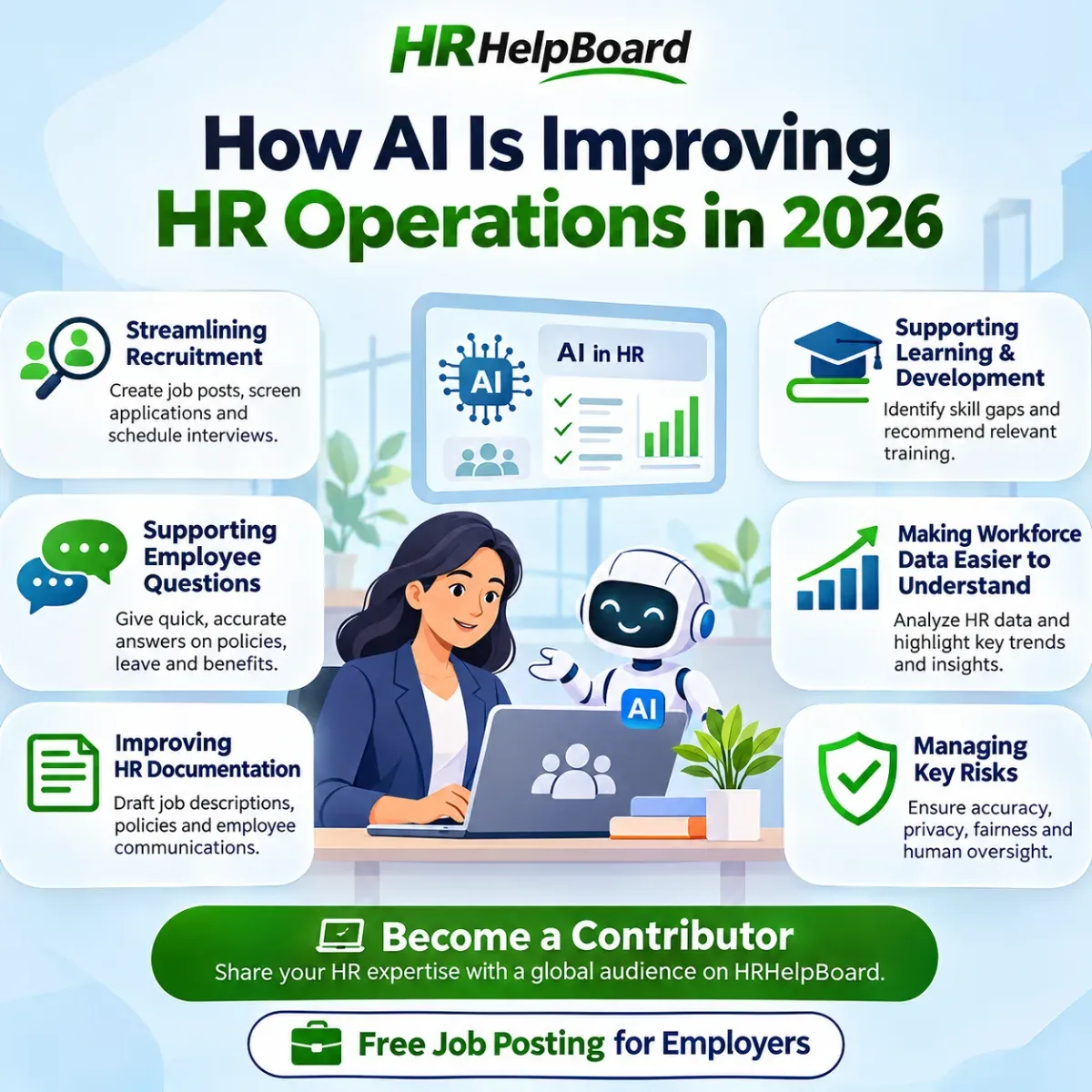
Artificial intelligence is becoming an important part of modern human resource management. HR teams are using AI-powered tools to reduce repetitive work, organize information, support employees, and make better-informed decisions.
The most effective use of AI is not to replace HR professionals. It is to give them more time for activities that require communication, judgment, problem-solving, and employee support.
1. Streamlining Recruitment
Recruitment involves several time-consuming activities, including preparing job descriptions, reviewing applications, coordinating interviews, and communicating with candidates.
AI tools can help recruiters draft job advertisements, organize applications, identify relevant skills, and manage interview scheduling. These capabilities can reduce administrative workload and help hiring teams move through the recruitment process more efficiently.
HR professionals should still review job descriptions and screening criteria to ensure they are accurate, relevant, and fair. Automated recommendations should not be treated as final hiring decisions.
2. Supporting Employee Questions
Employees frequently contact HR with questions about leave, benefits, workplace policies, payroll processes, and company procedures.
AI-enabled HR assistants can help employees find answers to common questions by retrieving information from approved internal resources. This can improve access to information and reduce repetitive requests to HR teams.
Organizations should ensure that these systems use current policies, protect confidential information, and direct employees to a human HR representative when a question requires judgment or personal support.
3. Improving HR Documentation
HR teams prepare and manage many documents, such as job descriptions, onboarding materials, policy communications, training content, and employee letters.
AI writing tools can help create first drafts, summarize information, and improve clarity. However, documents involving employment terms, legal requirements, or sensitive employee matters should always be reviewed by an authorized professional before use.
HR teams can also use structured templates to maintain consistency across documents. Resources such as HRHelpBoard provide HR letters, templates, and workplace guidance that can support everyday HR documentation.
4. Supporting Learning and Development
AI can help identify skill gaps, recommend learning resources, and personalize employee development plans based on role requirements and career goals.
Learning recommendations should be transparent and relevant to employees’ actual development needs. HR teams should avoid relying solely on automated assessments when making decisions about career progression or training opportunities.
5. Making Workforce Data Easier to Understand
HR analytics tools can help organize workforce information such as recruitment progress, employee turnover, training participation, and engagement survey results.
AI may assist with identifying patterns and preparing summaries, allowing HR teams to investigate trends more quickly.
These insights should be interpreted carefully. Data quality, context, privacy, and potential bias all matter when using analytics to inform workforce decisions.
6. Key Risks HR Teams Should Manage
AI can create value, but responsible implementation requires clear safeguards.
Accuracy: AI-generated information may be incomplete or incorrect.
Privacy: Employee and candidate data must be handled securely.
Bias: Automated systems may reproduce unfair patterns in historical data.
Transparency: Employees should understand how AI is used in relevant HR processes.
Human oversight: HR professionals must be able to review and correct AI outputs.
Organizations should evaluate tools before adoption, train users, and establish clear rules about which tasks can be automated and which require human review.
7. How to Introduce AI Into HR Workflows
HR teams can begin with a small, clearly defined use case, such as drafting routine communications or answering frequently asked policy questions.
Before implementation, identify the problem, review data protection requirements, test the tool with realistic examples, and define how results will be checked. Measure whether the tool improves efficiency and employee experience without reducing accuracy or trust.
Expand its use only when the initial workflow demonstrates reliable results.
Conclusion
AI is helping HR teams manage routine tasks, improve access to information, support recruitment, and make workforce data easier to analyze. Its value depends on thoughtful implementation, reliable information, and responsible human oversight.
By combining useful technology with HR expertise, organizations can build more efficient processes while keeping employee needs and fair decision-making at the center.