From Network Scanning to Penetration Testing: A Practical Roadmap to Ethical Hacking
This article explains a practical roadmap to ethical hacking, covering networking fundamentals, Linux, network scanning, vulnerability assessment, web application security, and penetration testing. It highlights essential cybersecurity tools, authorized lab practice, CEH Practical preparation, and the importance of hands-on skills for building a career in cybersecurity.

uma rajput
Author & Contributor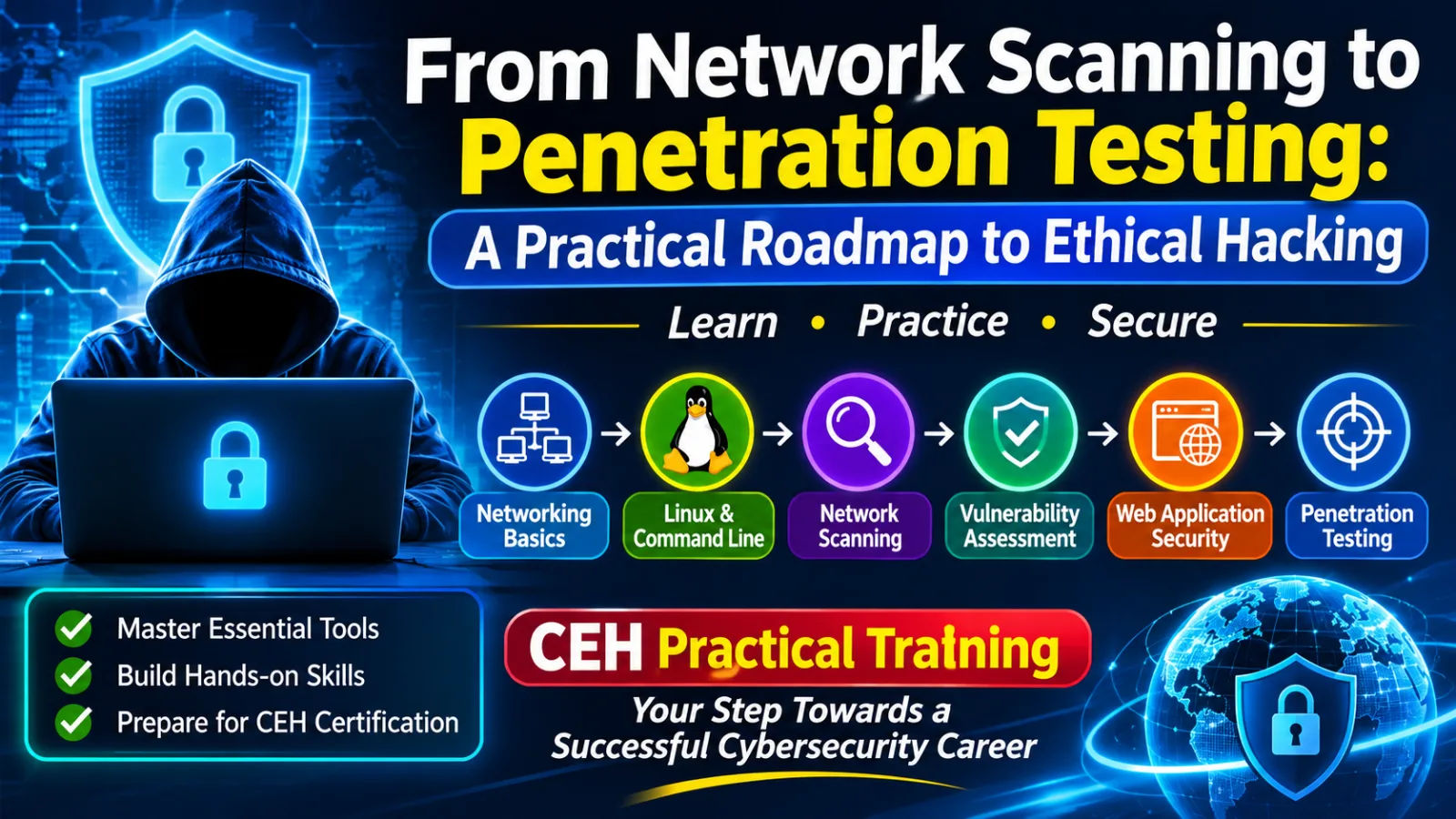
Ethical hacking is an important part of modern cybersecurity. Organizations use security assessments to identify weaknesses in their networks, applications, and computer systems before those weaknesses can be exploited by attackers.
For anyone starting a cybersecurity career, learning ethical hacking involves more than understanding security terminology. It requires practical knowledge of networking, operating systems, vulnerability assessment, security tools, and the methods used to investigate technical problems.
A structured learning approach can help beginners develop these skills step by step.
1. Build a Strong Foundation in Networking
Networking is one of the first areas to understand before beginning ethical hacking. Security professionals need to know how computers communicate, how data moves between systems, and how network services operate.
Important networking concepts include:
IP addresses and subnetting
TCP and UDP protocols
DNS and DHCP
HTTP and HTTPS
Firewalls and network ports
Routing and switching
Client-server communication
Understanding these concepts makes it easier to identify unusual network activity and investigate potential security weaknesses.
For example, knowing how common network services operate helps a security tester understand why an unexpected open port might require further investigation.
2. Learn Linux and Command-Line Operations
Linux is widely used in cybersecurity environments because it provides powerful command-line utilities and security tools.
Beginners should become comfortable navigating directories, managing files, changing permissions, monitoring processes, and configuring network settings.
Useful Linux commands include:
pwdto display the current directorylsto list files and directoriescdto change directorieschmodto modify file permissionspsto view running processesip addrto inspect network interfacesss -tulnto inspect listening network services
Practicing these commands in a personal virtual machine or authorized laboratory environment can improve confidence with Linux administration.
3. Understand Network Scanning and Enumeration
Network scanning helps security professionals discover active devices, open ports, and available services within an authorized testing environment.
Nmap is one of the commonly used tools for this purpose. It can help identify hosts, examine network services, and collect information about the systems being assessed.
Enumeration takes the investigation further by collecting additional details about accessible services and network resources.
A good security tester does not simply collect information. They interpret the results, identify unusual configurations, and determine which findings deserve further investigation.
4. Learn Vulnerability Assessment
A vulnerability assessment is the process of identifying and evaluating security weaknesses in a system or application.
Common weaknesses include outdated software, insecure configurations, weak passwords, unnecessary services, and missing security updates.
Tools such as Nessus can assist with vulnerability scanning. However, automated results should always be reviewed carefully because scanners can produce false positives or findings that need additional validation.
A useful assessment should explain:
What weakness was identified?
Which system or application is affected?
What is the possible security impact?
How serious is the risk?
What steps can reduce or remove the vulnerability?
Clear documentation is an important part of professional cybersecurity work.
5. Develop Web Application Security Skills
Web applications are common targets for attackers because they often process user information, authenticate accounts, and connect to databases or external services.
Ethical hackers study common web security issues, including:
SQL injection
Cross-site scripting (XSS)
Broken access control
Authentication weaknesses
Security misconfiguration
Insecure input handling
Burp Suite is a popular tool for examining web application requests and responses. It can help testers understand how an application handles user input and communicates with its backend.
These techniques should be practiced only on applications and laboratory environments where testing permission has been granted.
6. Practice in Authorized Cybersecurity Labs
Practical exercises help learners connect theoretical concepts with real security scenarios.
A beginner can start with a small virtual lab containing a Linux machine, a testing machine, and intentionally vulnerable applications designed for training.
A simple learning routine might include:
Practicing basic Linux administration.
Scanning a permitted laboratory network.
Identifying services and reviewing their configurations.
Testing a deliberately vulnerable web application.
Examining network traffic with Wireshark.
Writing a short report describing findings and remediation.
Keeping notes about each exercise makes it easier to understand mistakes and measure progress.
Never scan, access, or test systems without explicit authorization from their owners.
7. Prepare for Practical Ethical Hacking Certification
Certifications can provide structure to cybersecurity learning and help candidates demonstrate their knowledge.
The CEH Practical certification focuses on hands-on ethical hacking challenges. Preparation involves developing familiarity with security tools, network assessment, enumeration, system security, web application testing, and other practical cybersecurity activities.
Learners interested in guided preparation can explore CEH Practical Training at WebAsha Technologies.
Before enrolling, candidates should review the current course structure, prerequisites, lab access, training format, and certification requirements to make sure the program matches their goals.
8. Build Reporting and Communication Skills
Finding a vulnerability is only one part of an ethical hacking assessment. Security professionals must also explain their findings clearly.
A useful penetration testing report should include:
Executive summary
Assessment scope and authorization
Testing methodology
Identified vulnerabilities
Evidence and technical observations
Risk and potential impact
Recommended remediation
Retesting results, where applicable
Good reporting helps technical teams understand what needs to be fixed and why the issue matters.
9. Continue Learning and Improving
Cybersecurity changes constantly. New vulnerabilities, technologies, and attack techniques appear regularly, so professionals need to keep improving their knowledge.
Reading security advisories, studying technical documentation, practicing in legal labs, and reviewing security case studies can help learners stay informed.
It is also useful to develop complementary skills in cloud security, scripting, incident response, and secure software development.
Conclusion
Building ethical hacking skills is a gradual process that combines technical knowledge, practical exercises, and responsible security practices.
Starting with networking and Linux, progressing to scanning and vulnerability assessment, and then learning web application security and penetration testing provides a useful learning roadmap.
The most important habit is consistent practice in authorized environments. By learning how vulnerabilities are identified, documented, and fixed, aspiring cybersecurity professionals can build a stronger foundation for future opportunities in information security.