Free Online Image Converter & Image Tools: Convert, Resize, Compress and Edit Images
Convert, resize, compress and edit images with free online image tools. Explore converters, image editors and optimization utilities.

Krypton web
Author & Contributor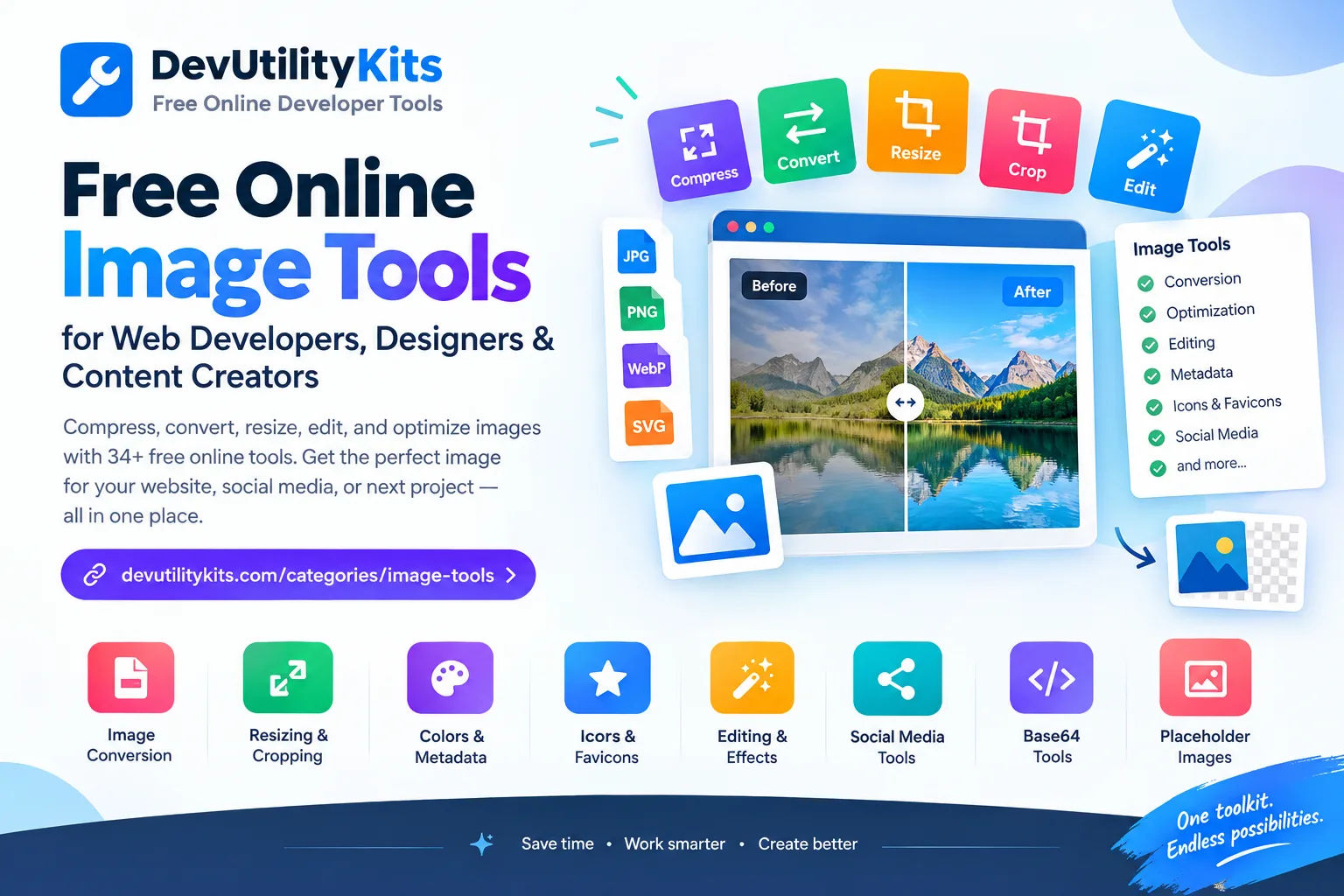
Images are an important part of modern websites, applications, blogs, online stores, and social media platforms. However, preparing images for different purposes can take more time than expected.
You might need to convert a JPG image to PNG, resize a large photograph, compress an image for faster website loading, remove unwanted backgrounds, or create a favicon for a website.
Installing a separate application for every small image-related task is not always practical. This is where free online image converter and image editing tools can make everyday work easier.
DevUtilityKits Image Tools brings together a collection of online image utilities designed to help developers, designers, bloggers, website owners, and digital content creators handle common image tasks.
Let's explore the different types of image tools that can simplify your workflow.
Why Are Online Image Tools Useful?
Working with images involves more than simply uploading a picture to a website.
Different platforms and applications have different image requirements. A website may need optimized WebP images, a mobile application may require specific dimensions, and a social media post may need a particular aspect ratio.
Online image tools help simplify these tasks.
Some important benefits include:
Save time: Complete common image operations without opening complex editing software.
Convert image formats: Prepare images in formats suitable for different projects.
Optimize website images: Reduce unnecessary image file sizes.
Prepare social media graphics: Resize images for different publishing platforms.
Create web assets: Generate favicons, icons, and placeholder images.
Inspect image information: Review dimensions, metadata, and other image properties.
For everyday image preparation, having related utilities available in one place can reduce unnecessary workflow interruptions.
1. Free Online Image Converter Tools
Image conversion is one of the most common tasks for website owners and developers.
Different image formats serve different purposes. JPG is widely used for photographs, PNG is useful when transparency is required, SVG is commonly used for scalable vector graphics, and WebP is a popular format for web images.
DevUtilityKits includes several image conversion utilities.
Convert Between Popular Image Formats
Image Converter – Convert images between supported formats.
JPG to PNG Converter – Convert JPG images into PNG format.
PNG to JPG Converter – Convert PNG images into JPG format.
SVG to PNG Converter – Convert SVG graphics into PNG images.
PNG to SVG Converter – Convert PNG images into SVG format where supported.
WebP Converter – Work with WebP image conversion.
These tools are useful when preparing images for websites, applications, presentations, and digital publishing.
For example, a developer might receive a PNG logo but need a JPG version for a particular workflow. An online image converter can make that transformation more convenient.
2. Image Resizing, Compression and Cropping
Large images can affect website performance and make content harder to manage.
Resizing and compression are two important steps in preparing images for the web.
Resize Images
The Image Resizer helps change image dimensions for different requirements.
It can be useful when preparing:
Website banners
Blog thumbnails
Product images
Profile pictures
Application graphics
Compress Images
The Image Compressor helps reduce image file sizes.
Smaller images can reduce transfer size and support faster page loading, although actual performance depends on the website, hosting, caching, and delivery setup.
Crop and Rotate Images
Sometimes an image contains unnecessary areas or needs a different orientation.
Useful tools include:
Image Cropper – Remove unwanted areas and focus on the important part of an image.
Image Rotator – Change image orientation.
These utilities are useful for preparing photographs, website graphics, and digital content.
3. Image Metadata and Base64 Tools
Images contain more information than what appears visually.
Depending on the file format, metadata may include dimensions, camera information, orientation, and other properties.
Developers and website administrators sometimes need to inspect or transform this information.
Useful tools include:
Image Metadata Viewer – Inspect available image metadata.
EXIF Viewer – View EXIF information stored in supported images.
EXIF Remover – Remove supported EXIF metadata.
Image to Base64 – Convert an image into Base64 text.
Base64 to Image – Convert Base64 image data back into an image.
These tools can be particularly useful when working with APIs, HTML, CSS, image uploads, and application development.
For example, Base64 encoding is sometimes used to embed small image assets directly into HTML or CSS. However, it is not always the best choice for larger images because it can increase document size.
4. Image Quality, DPI and Aspect Ratio Calculators
Image dimensions and resolution matter when preparing graphics for websites, documents, printing, and digital publishing.
Understanding image properties helps avoid unexpected results.
DevUtilityKits includes several related utilities:
Image DPI Calculator – Work with image dots-per-inch calculations.
Image Aspect Ratio Calculator – Calculate and understand image proportions.
Image Size Calculator – Work with image size calculations.
These tools are useful when preparing images for specific layouts, print requirements, and responsive website designs.
5. Favicon and ICO Tools for Websites
A favicon is the small icon displayed in browser tabs, bookmarks, and other browser interfaces.
Although it is a small asset, it contributes to a website's visual identity.
Creating favicon files with the correct sizes can sometimes be inconvenient when working with different image formats.
Two useful utilities are:
Favicon Generator – Prepare favicon assets for websites.
ICO Converter – Convert images into ICO format and work with multiple icon sizes.
When designing favicons, remember that a detailed logo may not remain clear at very small sizes such as 16×16 pixels. Simplifying artwork for smaller icon sizes can produce a better result.
6. Image Editing and Visual Effects
Not every image task requires a full professional graphics editor.
Sometimes you only need to apply a simple visual effect or prepare an image for a particular design.
The following utilities cover common image editing tasks:
Image Color Picker – Identify colors from an image.
Blur Image – Apply a blur effect.
Pixelate Image – Create a pixelated visual effect.
Grayscale Image – Convert an image to grayscale.
Image Border Generator – Add borders to images.
Image Watermark – Add watermark overlays.
Image Background Remover – Remove image backgrounds.
These tools can help with quick image preparation for blog posts, presentations, product graphics, and social media content.
7. Social Media Image Resizing Tools
Every social media platform has its own image dimensions and recommended aspect ratios.
Using the wrong dimensions can result in cropped graphics, poor presentation, or unnecessary editing work.
Preparing platform-specific images becomes easier with dedicated resizing utilities.
Explore these tools:
Social Image Resizer – Prepare images for social sharing.
YouTube Thumbnail Downloader – Retrieve available thumbnail images from supported YouTube URLs.
Instagram Image Resizer – Prepare images for Instagram.
Facebook Image Resizer – Resize images for Facebook content.
LinkedIn Image Resizer – Prepare graphics for LinkedIn publishing.
These utilities are useful for bloggers, content creators, marketers, and businesses managing multiple social media channels.
8. Placeholder Image Generator
During website development, designers and developers often need temporary images before the final graphics are ready.
A placeholder image helps test page layouts, image dimensions, spacing, and responsive designs.
The Placeholder Image Generator is useful when preparing mockups, prototypes, website templates, and development projects.
Instead of searching for temporary graphics every time, developers can use placeholder images while building the final design.
Tips for Better Website Image Optimization
Using an image converter is only one part of image optimization.
If you manage a website, consider these practical recommendations:
Choose suitable formats: Use formats appropriate for the image and your website requirements.
Resize before uploading: Avoid serving unnecessarily large images when smaller dimensions are sufficient.
Compress images: Reduce file size while maintaining acceptable visual quality.
Use descriptive filenames: Choose filenames that explain the image content.
Add meaningful alt text: Help accessibility tools and search engines understand the image.
Check image dimensions: Use suitable aspect ratios for the intended layout.
Review metadata: Remove sensitive metadata when appropriate, especially before publishing photographs.
Remember that image optimization involves more than file compression. Responsive image delivery, lazy loading, caching, and suitable image dimensions also contribute to website performance.
Final Thoughts
Image preparation is a regular part of web development, website management, and digital content creation.
Whether you need to convert JPG to PNG, resize a photograph, compress an image, remove metadata, create a favicon, or prepare graphics for social media, having the right online utilities can save time.
DevUtilityKits brings together a collection of free online developer and image tools designed to simplify these everyday tasks.
Explore the Free Online Image Tools collection and find practical utilities for converting, resizing, compressing, editing, and preparing images.
Spend less time on repetitive image tasks and more time creating, developing, and building.
Frequently Asked Questions
What is the best free online image converter?
The best image converter depends on the formats and output you need. A general image converter is useful for common format changes, while dedicated converters can help with specific tasks such as JPG to PNG, PNG to JPG, SVG to PNG, and WebP conversion.
How can I reduce image size for my website?
Use an image compressor to reduce file size and resize images to dimensions appropriate for their display area. Choose a suitable output format and review the final image quality before publishing.
What is the difference between JPG and PNG?
JPG is commonly used for photographs and supports lossy compression. PNG supports lossless compression and transparency, making it useful for logos, icons, and graphics that need transparent backgrounds.
Why should I remove EXIF metadata from images?
EXIF metadata can contain information such as camera details, timestamps, and sometimes location information. Removing unnecessary metadata before sharing images can help protect privacy.
Can online image tools help with SEO?
Yes. Properly resized and compressed images can support page performance. Descriptive filenames, meaningful alt text, appropriate image formats, and responsive delivery also contribute to a better image experience.
Are online image tools useful for developers?
Absolutely. Developers use image tools to convert assets, prepare favicons, resize graphics, inspect metadata, generate placeholders, and optimize images for websites and applications.
Discover all developer utilities: https://devutilitykits.com/
DevUtilityKits – One Toolkit. Every Developer.