
Entry-Level Remote Jobs in the USA: 10 Jobs to Consider as a Beginner
Explore 10 entry-level remote jobs in the USA, the skills beginners need, where to find legitimate openings, and how to apply with confidence.
Priyanshi
Author & Contributor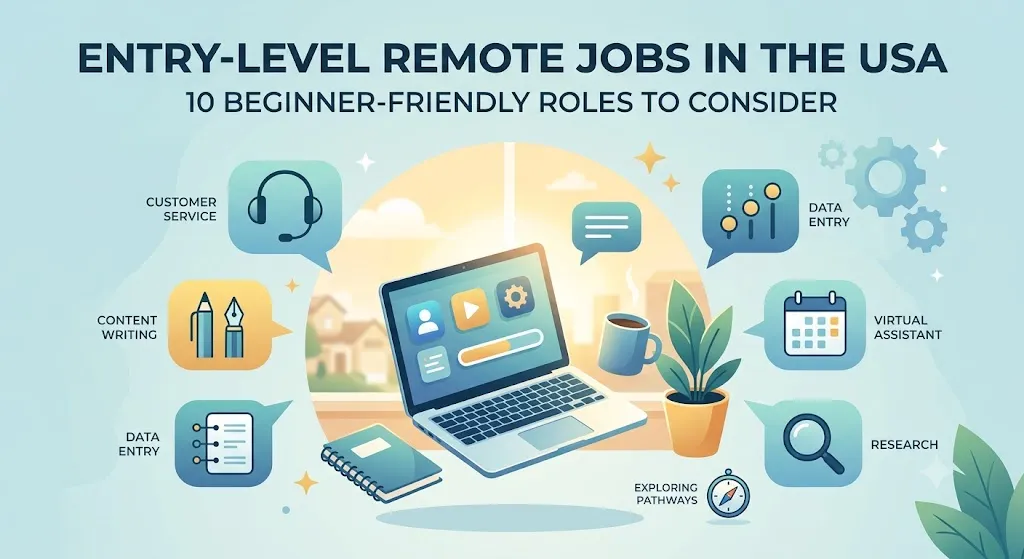
Looking for entry-level remote jobs in the USA but do not have much work experience yet? You are not alone. Many people want to work from home because it can save commuting time, offer more flexibility, and make it easier to balance work with other responsibilities.
The good news is that you do not always need years of experience to begin a remote career. Some employers consider candidates with basic computer skills, clear communication, attention to detail, and a willingness to learn. However, the requirements depend on the role, and some entry-level positions still ask for previous experience, specific qualifications, or professional training.
In this guide, we will explore 10 entry-level remote jobs worth considering, the skills you may need, where to find legitimate openings, and how to improve your chances of getting hired.
What Are Entry-Level Remote Jobs?
Entry-level remote jobs are positions designed for people who are starting their careers or have limited experience in a particular field. These jobs allow employees to complete their work from home or another approved location instead of travelling to a traditional office every day.
Some positions provide training, while others expect applicants to arrive with basic knowledge of the work. Remote jobs may be full-time, part-time, temporary, freelance, or contract-based.
It is also important to understand that remote does not always mean you can work from anywhere in the world. Some US employers only hire people who live in specific states or already have permission to work in the United States. Always check the location and eligibility requirements before applying.
10 Entry-Level Remote Jobs in the USA to Consider
Here are 10 types of remote work that beginners can explore. These are career options, not a list of guaranteed current vacancies.
1. Customer Service Representative
Customer service representatives help customers with questions, orders, account issues, and basic problems. Many companies use phone calls, email, or live chat to communicate with customers.
Typical responsibilities:
Answer customer questions politely.
Explain products, services, or company policies.
Help resolve complaints and basic technical issues.
Update customer records when needed.
Skills you may need: Clear communication, patience, basic computer skills, and problem-solving.
This can be a useful starting point if you enjoy helping people. Some employers provide paid training, although others require previous customer service experience.
2. Data Entry Clerk
Data entry clerks enter, update, and organise information in digital systems. The work may involve updating spreadsheets, checking records, or transferring information from documents into a database.
Typical responsibilities:
Enter information accurately.
Review records for missing or incorrect details.
Organise digital files.
Follow instructions for handling company information.
Skills you may need: Typing accuracy, attention to detail, basic spreadsheet knowledge, and organisation.
Be especially careful with data entry job advertisements. Offers promising unusually high earnings for simple typing tasks, especially when they require an upfront payment, deserve extra scrutiny.
3. Virtual Assistant
A virtual assistant provides administrative support to a business owner, team, or independent professional. The exact tasks depend on the employer.
Typical responsibilities:
Organise calendars and appointments.
Manage emails and basic administrative tasks.
Prepare documents and maintain records.
Help organise meetings and follow-ups.
Skills you may need: Organisation, written communication, time management, and familiarity with tools such as email, calendars, and spreadsheets.
You can practise these skills by organising a sample calendar or creating a simple project-tracking spreadsheet to demonstrate your abilities.
4. Content Writer
Content writers create useful written material for websites, blogs, newsletters, and businesses. Some positions focus on short articles, while others involve product descriptions, website copy, or research-based content.
Typical responsibilities:
Research topics using reliable sources.
Write clear and useful content.
Edit drafts for spelling, grammar, and readability.
Follow a content brief and meet deadlines.
Skills you may need: Writing, research, grammar, and the ability to explain ideas simply.
If you are new to writing, create three or four sample articles on topics you understand. A small portfolio can help employers evaluate your work even if you have not held a formal writing job before.
5. Social Media Assistant
Social media assistants help businesses maintain their presence on platforms such as Instagram, LinkedIn, Facebook, and TikTok.
Typical responsibilities:
Schedule posts.
Draft captions and organise content ideas.
Reply to basic comments or messages.
Track engagement and prepare simple reports.
Skills you may need: Writing, creativity, organisation, and basic knowledge of social media platforms.
You can build a sample content calendar for a fictional business to show that you understand planning and consistency. Some positions also require experience with design tools or analytics.
6. Junior IT Support Specialist
Junior IT support specialists help people solve everyday computer and software problems. This work may involve troubleshooting login issues, installing approved software, or explaining basic technical steps.
Typical responsibilities:
Respond to support requests.
Troubleshoot common computer problems.
Document issues and their solutions.
Escalate complex problems to experienced team members.
Skills you may need: Basic computer knowledge, logical thinking, communication, and a willingness to learn.
Some roles accept beginners with suitable technical knowledge, while others require certifications, practical experience, or specific qualifications. Look carefully at the requirements before applying.
7. Online Research Assistant
Online research assistants collect and organise information to help businesses, writers, or research teams make decisions.
Typical responsibilities:
Find information from reliable websites.
Compare information from different sources.
Organise findings in documents or spreadsheets.
Summarise results clearly.
Skills you may need: Research, critical thinking, accuracy, and written communication.
For a portfolio sample, choose a simple topic and prepare a short report with links to trustworthy sources. This can demonstrate how you find and organise information.
8. Junior QA Tester
Quality assurance (QA) testers help identify problems in websites, apps, and software before they reach users. Some junior roles involve manual testing rather than advanced programming.
Typical responsibilities:
Test a website or app using provided instructions.
Identify errors or unexpected behaviour.
Record steps to reproduce a problem.
Check whether reported issues have been fixed.
Skills you may need: Attention to detail, logical thinking, clear writing, and basic familiarity with websites or apps.
You can practise by testing a website and writing a sample bug report that explains what happened, what you expected, and how someone could reproduce the issue.
9. Transcriptionist
Transcriptionists turn audio or video recordings into written text. Depending on the job, the material may include interviews, meetings, podcasts, or other recordings.
Typical responsibilities:
Listen carefully to recordings.
Type spoken words accurately.
Review spelling, punctuation, and formatting.
Follow confidentiality and formatting rules.
Skills you may need: Listening, typing, grammar, and attention to detail.
Some transcription work requires specialist knowledge, particularly in medical or legal settings. Beginners should check whether training is provided and whether the role requires a typing test.
10. AI Data Evaluation Assistant
Some companies hire contributors to review AI-generated answers, assess content quality, label information, or follow structured guidelines to help improve AI systems.
Typical responsibilities:
Review AI-generated responses.
Check whether answers follow instructions.
Identify errors or unclear information.
Provide feedback using a defined process.
Skills you may need: Reading comprehension, critical thinking, accuracy, and clear written communication.
Some projects accept applicants without a technical background, while others require specialist expertise. These opportunities may be freelance or project-based rather than permanent employment, and the availability of work can change.
Where Can You Find Entry-Level Remote Jobs in the USA?
Finding the right vacancy starts with using reliable job-search websites and checking each listing carefully.
1. Indeed
Indeed allows job seekers to search for remote roles using terms such as “entry-level remote,” “remote customer service,” or “remote data entry.” You can narrow results using filters for experience level, job type, and other criteria.
Website: https://www.indeed.com/
2. USAJOBS
USAJOBS is the official US federal government employment website. It includes opportunities for eligible students, recent graduates, and other applicants. Some federal positions offer early-career pathways, but you must review the eligibility and location requirements for each announcement.
Website: https://www.usajobs.gov/
3. CareerOneStop
CareerOneStop provides career exploration, job-search resources, training information, and other support for people looking for work in the United States.
Website: https://www.careeronestop.org/
4. LinkedIn Jobs
LinkedIn Jobs lets you search for remote positions and learn about employers. Use specific job titles and experience filters, and check the employer's official website before submitting sensitive information.
Website: https://www.linkedin.com/jobs/
5. PostNest Opportunities
You can also explore job-related articles and career resources published through PostNest Opportunities. Use these resources to discover roles, understand the requirements, and prepare for applications.
Visit PostNest: https://www.postnest.in/
Remember to check the publication date and original employer details for any job shared through a third-party website. A job article is a starting point for research, not proof that a vacancy is still open.
What Skills Do You Need for an Entry-Level Remote Job?
You do not need to master every professional tool before applying. Start with the skills that match the roles you want.
Basic computer skills: Be comfortable using a browser, email, documents, and file-sharing tools.
Communication: Practise writing clear emails, explaining problems, and asking questions when instructions are unclear.
Time management: Remote employees often need to plan their work and meet deadlines without someone supervising every task.
Attention to detail: Accurate work matters in data entry, research, transcription, testing, and administrative support.
Problem-solving: Employers value people who can follow instructions, investigate simple problems, and recognise when they need help.
You can practise these skills through personal projects, volunteering, coursework, or sample assignments. Describe your experience honestly on your resume.
How to Apply for Entry-Level Remote Jobs With Little Experience
Starting your first job search can feel difficult, especially when advertisements ask for experience. A practical approach can help you focus on roles that match your current abilities.
Step 1: Choose One or Two Job Types
Avoid applying randomly to every remote job you find. Choose a small number of roles based on your strengths. For example, someone who enjoys writing may focus on content writing and research, while someone who likes solving technical problems may explore IT support or QA testing.
Step 2: Prepare a Simple Resume
Keep your resume easy to read. Include your contact details, relevant skills, education, projects, volunteer work, and any experience that demonstrates your ability to complete the job.
You do not need to claim professional experience you do not have. Relevant coursework and personal projects can still show employers what you can do.
Step 3: Create a Small Portfolio
A portfolio is useful for roles such as writing, social media, research, and QA testing. Prepare two or three samples that demonstrate your skills.
For example, a beginner content writer could create sample blog posts, while a QA applicant could prepare sample bug reports. Label practice projects honestly rather than presenting them as paid client work.
Step 4: Use Specific Search Terms
Search using the job title, experience level, and remote location. Examples include:
Entry-level remote customer service jobs
Remote virtual assistant jobs for beginners
Remote content writer jobs entry level
Junior QA tester remote jobs
Remote data entry jobs in the USA
Read the full job description instead of relying only on the title. Confirm whether the role is truly remote and whether applicants must live in a particular state or country.
Step 5: Tailor Each Application
Read the job requirements and explain how your skills match them. Use examples where possible instead of sending the same generic resume to every employer.
Keep track of the company, job title, application date, and follow-up details in a spreadsheet. This makes it easier to stay organised.
Step 6: Prepare for Online Interviews
Test your internet connection, microphone, and camera before an interview. Be ready to explain why you want the role, how you manage your time, and how you would handle common work situations.
If you do not know an answer, explain how you would approach the problem and learn what is needed.
How to Avoid Remote Job Scams
Not every remote job advertisement is genuine. Be careful when an offer seems unusually attractive or asks you to take risks before you have verified the employer.
Watch for these warning signs:
Upfront fees: Be suspicious if someone asks you to pay to secure a job, receive a guaranteed offer, or unlock your wages.
Unrealistic earnings: Very high pay for simple tasks, with no clear explanation of the work, deserves careful checking.
Unverified employers: Search for the company independently and look for a genuine website and consistent contact details.
Requests for sensitive information: Do not share banking credentials, passwords, or identity documents with unverified contacts.
Pressure to act immediately: Be cautious if a recruiter demands quick payment or insists that you skip normal hiring steps.
Verify the vacancy through the employer's official careers page whenever possible. A professional-looking website or a message using a company logo does not prove that an offer is legitimate.
Frequently Asked Questions
1. Can I get an entry-level remote job in the USA with no experience?
Yes, some employers consider candidates with little or no direct experience. However, you may still need basic skills, relevant qualifications, or training. Look for positions that clearly state their experience requirements and provide examples of what you can do.
2. What is the easiest remote job for a beginner?
There is no single easiest job for everyone. Customer service, administrative support, data entry, and some content-related roles may be accessible to beginners who meet the requirements. Choose a role that fits your skills and communication style.
3. Do entry-level remote jobs always require a college degree?
No. Requirements vary by role and employer. Some positions accept a high school diploma or equivalent, while others require a degree, certification, or specialist knowledge. Read the job description carefully.
4. Can I apply for US remote jobs from another country?
Some employers hire internationally, but many US-based remote positions require candidates to live in the United States and have the necessary work authorisation. Check the location restrictions before applying. A remote label does not automatically mean the job is open worldwide.
5. How can I tell if a remote job is legitimate?
Verify the company and vacancy through official channels, review the responsibilities and payment terms, and be cautious about requests for upfront fees or sensitive information. If something seems suspicious, stop and investigate before continuing.
6. Where should beginners look for remote job opportunities?
Start with established job-search websites such as Indeed and LinkedIn Jobs, official career pages, and government resources such as CareerOneStop and USAJOBS where applicable. Check every listing's date, requirements, location restrictions, and application process.
Final Thoughts
Finding entry-level remote jobs in the USA takes patience, but you do not need to have your entire career figured out before getting started. Choose a role that matches your current abilities, improve the skills it requires, and prepare a few examples that demonstrate what you can do.
Apply consistently, read job descriptions carefully, and learn from each application. Most importantly, do not let promises of easy money distract you from genuine opportunities.
Whether you are interested in customer service, writing, administration, technology, or AI-related work, start with one clear goal and build from there. A realistic first step today can help you work towards a stronger career tomorrow.
Editorial note: Job availability, employer requirements, and hiring conditions change. Check the original employer's listing for current details before applying.