Can a Green Ammonia Plant Run 24/7 on Solar and Wind Power? The Engineering Behind Round-the-Clock Production
A structured Green Ammonia Plant Planning and Engineering Approach helps project developers evaluate renewable power requirements, energy storage capacity, process flexibility and infrastructure integration to determine how reliably a plant can maintain round-the-clock production.

anand
Author & Contributor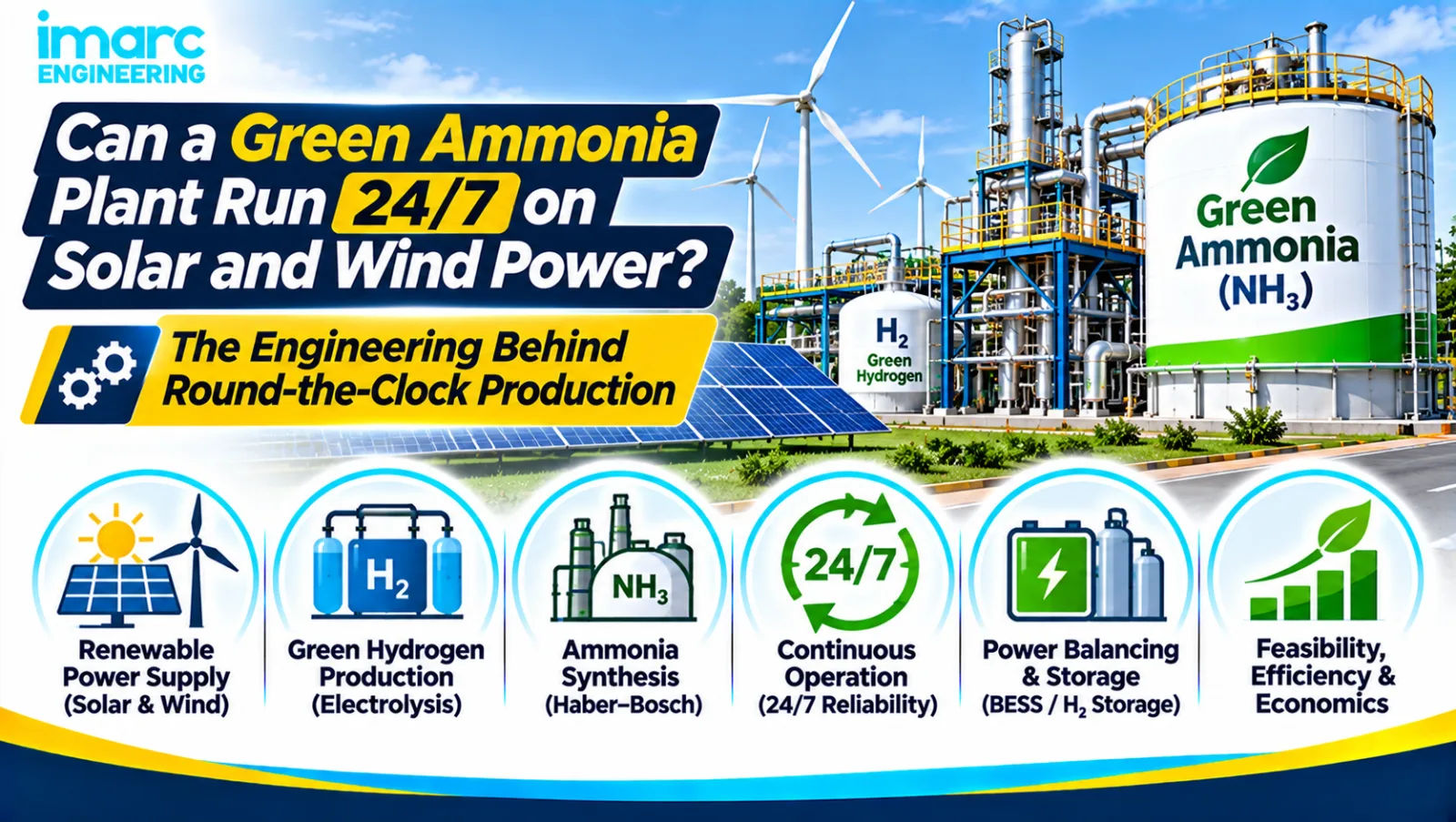
Solar and wind do not generate power around the clock. A conventional ammonia synthesis loop is designed to run continuously at high load. This mismatch is the central engineering problem for any green ammonia plant that aims to operate solely or primarily on renewable electricity. The question is not whether renewables can produce hydrogen and ammonia at all. It is whether the plant can maintain stable, high-utilisation production without excessive curtailment, oversized assets or frequent shutdowns of the synthesis loop.
Achieving 24/7 green ammonia production using solar and wind power requires careful coordination of renewable energy generation, electrolyser flexibility, hydrogen storage and continuous ammonia synthesis operations. A structured Green Ammonia Plant Planning and Engineering Approach helps project developers evaluate renewable power requirements, energy storage capacity, process flexibility and infrastructure integration to determine how reliably a plant can maintain round-the-clock production.
The Core Engineering Conflict
Traditional Haber-Bosch plants expect a steady flow of hydrogen and nitrogen and stable operating conditions. Rapid or large changes in feed rate, temperature or pressure stress the catalyst, compressors and control systems. Many synthesis loops have historically been limited in how far and how fast they can turn down.
Solar output drops to zero at night and varies with cloud cover. Wind varies hour to hour and season to season. Without intermediate buffering, the electrolyzers would have to follow the renewable profile closely, and the ammonia loop would either shut down frequently or run at very low average load. Both outcomes destroy project economics and can damage equipment.
How Round-the-Clock Operation Is Actually Achieved
Plants that claim high uptime on solar and wind do not rely on the renewables alone matching the synthesis demand in real time. They use a combination of the following engineering measures:
1. Intermediate energy and hydrogen buffers
Battery storage smooths short-term power fluctuations. Hydrogen storage (pressurised or sometimes liquefied) decouples electrolyzer output from the ammonia synthesis rate. The electrolyzers can run hard when power is abundant and charge the hydrogen buffer; the synthesis loop draws from the buffer when renewable generation drops.
2. Hybrid renewable generation
Combining solar and wind at the same site reduces the depth and duration of low-generation periods compared with either resource alone. The residual variability is still significant, but the required storage volume falls.
3. Oversizing renewables relative to the synthesis capacity
It is often more economic to install more solar and wind capacity than the average power demand of the plant and to accept intentional curtailment during peak generation hours. Studies across many locations show that optimal designs routinely curtail a substantial fraction of available renewable energy rather than trying to utilise every kilowatt-hour.
4. Flexible electrolyzer and synthesis operation
Modern PEM electrolyzers can ramp quickly and operate across a wide load range. Alkaline electrolyzers are typically better suited to steadier base-load duty. Hybrid electrolyzer fleets (alkaline for bulk, PEM for fast response) are increasingly used. On the ammonia side, newer designs and operating strategies allow synthesis loops to turn down to lower minimum loads and to ramp more responsively than older plants, though the air-separation unit and the synthesis loop itself remain among the least flexible elements.
5. Advanced energy management and forecasting
Real-time optimisation systems and weather-forecast-driven scheduling allocate power between electrolyzers, storage charging/discharging and the synthesis loop. Some large projects use AI-based control to anticipate renewable output changes and pre-position hydrogen inventory or adjust production rates.
6. Limited grid support (where allowed)
In some configurations a grid connection provides backup power during prolonged low-renewable periods, subject to carbon-intensity rules if the ammonia must meet strict “green” or RFNBO criteria. Pure off-grid designs avoid this but require larger storage or more flexible process operation.
What Real Projects Demonstrate
Commercial-scale green ammonia facilities that have reached advanced stages or commissioning typically combine several of the above measures. Examples include hybrid wind-solar portfolios, hydrogen buffering, battery systems, and process designs that allow the synthesis section to operate across a defined flexible range rather than at a single fixed load. Pure “solar-only, no storage, continuous synthesis” configurations are rarely chosen for large plants because the required oversizing and curtailment become extreme or the synthesis loop utilisation becomes unacceptably low.
Practical Design Questions That Decide Feasibility
Before claiming 24/7 capability, project teams need clear answers to:
What is the minimum stable load of the chosen ammonia synthesis technology, and how fast can it ramp?
How many hours of hydrogen storage are required to bridge typical and extreme low-renewable periods at the site?
What renewable mix (solar/wind ratio) and oversizing factor minimise levelised cost while meeting the target annual production?
Is intentional curtailment accepted in the economic model, and at what level?
Will any grid electricity be used, and under what carbon or additionality constraints?
How will the air-separation unit and balance-of-plant be kept within safe operating envelopes during low-power periods?
These questions determine whether the plant can genuinely run with high annual utilisation or whether it will effectively be a variable producer with high capital intensity.
When This Analysis Must Be Done
The renewable-resource assessment, storage sizing, electrolyzer configuration and synthesis flexibility analysis should be completed before final technology selection, before major equipment orders, and before the financial model is locked for investment decision. Changing storage volume or synthesis minimum load after financial close is expensive.
How IMARC Engineering Can Help
IMARC Engineering supports project developers and investors with technical evaluation of green ammonia concepts, including renewable-resource matching, storage and electrolyzer configuration assessment, process flexibility review, and overall plant design integration for continuous or high-utilisation operation.
If you are assessing whether a green ammonia plant can realistically achieve round-the-clock production on solar and wind at a specific site, a structured engineering review of resource variability, buffering requirements and process constraints is the practical next step: https://www.imarcengineering.com/contact-us
Conclusion
A green ammonia plant can run with high annual uptime on solar and wind power, but not by simply connecting intermittent electricity to a conventional continuous Haber-Bosch loop. Round-the-clock production requires deliberate engineering: hybrid generation, intermediate hydrogen and/or battery storage, controlled oversizing with curtailment, flexible electrolyzer and synthesis operation, and intelligent energy management. Projects that treat these elements as optional add-ons rather than core design decisions usually end up with either low utilisation or prohibitively high costs. The engineering is solvable; it is not automatic.
Contact Us:
IMARC Engineering
Phone: +917827860593
Email: sales@imarcengineering.com
India: C-130, Sector 2, Noida, Uttar Pradesh 201301
LinkedIn: https://www.linkedin.com/showcase/imarc-engineering/