

Alibaba’s New AI Chip and 10-Trillion-Parameter Model Explained
Alibaba’s New AI Chip and 10-Trillion-ParAlibaba is pushing the boundaries of AI with advanced chips and increasingly massive models. Explore what 10-trillion-parameter AI could mean, how AI chips power these systems, and what it means for the future of artificial intelligence. ameter Model Explained

Tanvi Ladva
Author & Contributor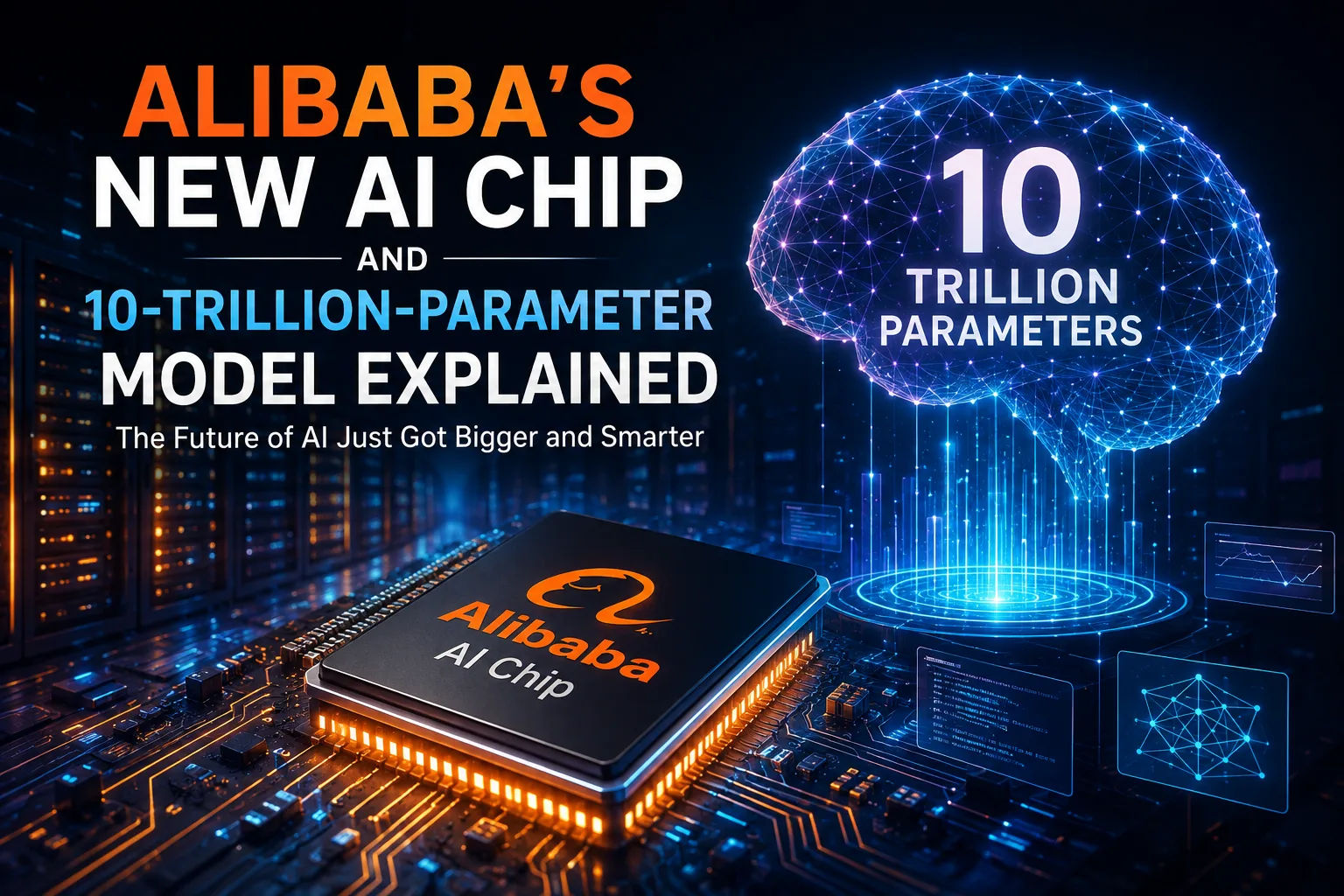
Alibaba’s New AI Chip and 10-Trillion-Parameter Model Explained
Artificial intelligence is entering a new phase. The competition is no longer only about building smarter AI models. Companies are also competing to develop the chips, computing infrastructure, and technologies required to power those models.
Alibaba is one of the major technology companies investing in this direction. Its AI developments have attracted attention because of its work across both AI models and computing hardware, along with the industry's growing interest in extremely large models that could reach trillions of parameters.
But what exactly is a 10-trillion-parameter model? Why are AI chips becoming so important? And what could this mean for the future of artificial intelligence?
Let's break it down.
What Is a Parameter in an AI Model?
Parameters are values that an AI model learns during training. They help the model recognize patterns, understand relationships between information, and generate responses.
When you ask an AI system a question, the model uses the patterns it learned during training to determine an appropriate response.
The number of parameters is often used as an indication of how large an AI model is.
For example:
1 billion parameters represents a relatively smaller model.
100 billion parameters represents a much larger model.
1 trillion parameters represents an enormous model.
10 trillion parameters would be an extraordinary scale.
However, parameter count alone does not determine how intelligent an AI system is. Architecture, training data, algorithms, reasoning techniques, and hardware efficiency are also extremely important.
Why Is 10 Trillion Parameters Significant?
A 10-trillion-parameter model would be ten times larger in parameter count than a 1-trillion-parameter model.
Training and operating a model at this scale could require enormous amounts of computing power.
It could involve:
Large numbers of AI accelerators
High-speed memory
Extremely fast networking
Large data centers
Significant electricity consumption
Advanced distributed computing software
The challenge is therefore not simply creating a huge model.
The bigger challenge is making thousands or potentially many more computing devices work together efficiently.
This is where AI chips become extremely important.
Alibaba’s AI Chip Development
Alibaba has been investing in artificial intelligence infrastructure through its semiconductor and cloud-computing ecosystem.
Its semiconductor subsidiary, T-Head, has worked on processors and computing technologies that support Alibaba's broader technology infrastructure.
Developing specialized chips can potentially give technology companies greater control over computing performance, costs, energy efficiency, and hardware-software integration.
This is part of a broader industry trend.
Companies around the world are developing specialized AI accelerators because modern AI workloads require enormous amounts of computational power.
What Does an AI Chip Actually Do?
AI models perform huge numbers of mathematical operations during both training and inference.
Traditional CPUs can perform these calculations, but specialized AI accelerators are designed to handle many of these operations much more efficiently.
A simplified AI workflow looks like this:
Data → AI Model → Mathematical Operations → AI Chip → Result
During training, these calculations are repeated billions or even trillions of times while the model learns patterns from its training data.
As models become larger and more complex, the demand for specialized computing hardware increases.
How Are AI Chips Connected to Huge AI Models?
Imagine trying to train a 10-trillion-parameter model using a single computer.
That would not be practical.
Instead, the workload has to be distributed across many machines and computing devices.
A simplified system might look like this:
AI Model
↓
Distributed Computing System
↓
Thousands of AI Accelerators
↓
High-Speed Networking
↓
Large Data Center
Each computing device handles part of the workload while the entire system works together.
This means advances in AI hardware can directly influence how quickly and efficiently companies can train and operate increasingly large AI models.
Does Alibaba Already Have a 10-Trillion-Parameter Model?
This is an important distinction.
Discussions about a 10-trillion-parameter model should not automatically be interpreted as meaning Alibaba has already released a publicly available model with exactly 10 trillion active parameters.
There is a difference between a current production model and a future research or infrastructure target.
Alibaba's Qwen family has become an important part of its AI ecosystem, while the broader AI industry continues to explore models with increasingly large parameter counts.
Another important development is the use of Mixture-of-Experts, or MoE, architecture.
With MoE, a model can contain a very large number of total parameters while activating only a portion of them for a particular request.
This can make extremely large models more computationally practical.
What Is Mixture-of-Experts?
Mixture-of-Experts is an AI architecture that divides a model into multiple specialized components known as experts.
Instead of using every parameter for every question, the system can select specific experts that are most relevant to the task.
A simplified process looks like this:
User Question
↓
Routing System
↓
Relevant AI Experts
↓
Generated Response
This approach allows a model to have a very large total parameter count without requiring every parameter to be processed for every token.
This distinction becomes particularly important when discussing trillion-parameter and multi-trillion-parameter AI models.
Why Does This Matter for the AI Industry?
Alibaba's hardware and AI ambitions reflect a larger transformation taking place across the AI industry.
In the past, much of the competition focused on one major question:
Who can build the biggest and most capable AI model?
Today, another question is becoming increasingly important:
Who can operate advanced AI efficiently at massive scale?
That requires optimizing the entire technology stack.
Chips → Memory → Networking → Data Centers → Training Software → AI Models → Applications
If one part of this system becomes a bottleneck, increasing the size of an AI model becomes significantly more difficult.
Alibaba and the Global AI Chip Race
Alibaba is part of a much larger global AI hardware ecosystem.
Companies including NVIDIA, AMD, Google, Amazon, and various semiconductor companies are developing specialized hardware for AI workloads.
At the same time, Chinese technology companies are working to strengthen domestic AI computing capabilities.
This competition matters because advanced AI chips have become critical infrastructure.
They are increasingly important for:
Generative AI
Cloud computing
Robotics
Autonomous systems
Scientific research
AI-powered software
Large language models
AI chips are no longer simply another type of computer component. They are becoming a fundamental part of the infrastructure supporting modern artificial intelligence.
What Could Extremely Large AI Models Enable?
If very large AI models become practical and efficient, they could potentially support increasingly advanced applications.
More Advanced Reasoning
Larger and better-trained models could potentially handle increasingly complex multi-step tasks.
Multimodal AI
Future AI systems may combine text, images, audio, video, and code within a unified model.
AI Agents
Advanced models could become the reasoning engines behind AI agents capable of planning tasks, using software, interacting with services, and completing longer workflows.
Scientific Research
AI could assist researchers with simulations, mathematical problems, programming, literature analysis, and other research activities.
Enterprise AI
Businesses could use advanced AI systems for customer support, data analysis, software development, automation, and internal knowledge management.
However, these possibilities depend on much more than parameter count.
Bigger Doesn't Always Mean Better
One of the biggest misconceptions about artificial intelligence is that a model with more parameters is automatically smarter.
That is not necessarily true.
A smaller model with better architecture, training data, optimization, and inference techniques can outperform a much larger model on specific tasks.
This is why AI researchers are increasingly focused on efficiency as well as scale.
Some important techniques include:
Mixture-of-Experts
Quantization
Knowledge distillation
Model compression
More efficient training methods
More efficient inference
Specialized AI hardware
The objective is not simply to create the largest AI model possible.
The objective is to create powerful AI systems that can operate efficiently and economically at scale.
The Bigger Picture
Alibaba's work in AI hardware and large-scale AI models represents part of a much larger transformation in the technology industry.
The future of AI will not depend on models alone.
It will depend on an entire ecosystem of hardware and software working together.
From specialized AI chips and high-speed networking to massive data centers and increasingly sophisticated model architectures, companies are building the infrastructure required for the next generation of artificial intelligence.
A 10-trillion-parameter model may sound like an extremely distant milestone, but the infrastructure being developed today could determine whether models at that scale eventually become practical.
Final Thoughts
Alibaba's AI ambitions highlight an important reality about the future of artificial intelligence: the AI race is becoming a full-stack technology race.
Building a powerful AI model requires much more than advanced algorithms. It requires computing power, memory, networking, energy, software, and specialized hardware.
As companies continue exploring trillion- and potentially multi-trillion-parameter systems, AI chips could become just as important as the models running on them.
The next major AI breakthrough may therefore not come from a model alone.
It could come from the combination of better models, better chips, and better infrastructure.
And that combination could play a major role in shaping what artificial intelligence is capable of over the coming years.